El universo, en toda su variedad —la gravedad, las partículas, el espacio, el tiempo, la materia que vemos, la materia oscura, la energía oscura— es la manifestación de una única sustancia física, el Pleno. PIU-Ψ deriva esa variedad desde una sola afirmación —el universo es energía, finita en cada punto y conservada—, que lleva sin saltos al campo $\Psi = S\,e^{i\theta}$ y a la ecuación F1 sobre la red diamante, y la contrasta número a número con lo que miden los laboratorios, los aceleradores, los satélites, los telescopios y los detectores de ondas gravitacionales. Lo hace sobre los teoremas y las observaciones de generaciones de científicos, cada uno con su autor, y muestra que esa unidad estaba ahí, esperando ser integrada.
«El fin del espacio vacío»
Una conversación que presenta PIU-Ψ en lenguaje cotidiano: qué es el Pleno y cómo de él emergen la gravedad, la luz, las partículas y el sector oscuro.
PIU en lenguaje cotidiano
¿Qué es el Pleno?
Un único material físico que ocupa todo el universo. No "espacio vacío con cosas dentro": el Pleno es el sustrato mismo, y todo lo demás —partículas, ondas, materia oscura, incluso el espacio y el tiempo— son distintas formas en que ese único material se comporta. Igual que el agua puede ser ola, remolino, niebla o calma sin dejar de ser agua, el Pleno es siempre lo mismo: cambia el modo, no la sustancia.
¿Por qué es importante?
La física actual se apoya en dos teorías que no encajan entre sí —la gravedad de Einstein, que describe el cosmos, y la mecánica cuántica, que describe lo subatómico— y admite no saber qué es el 95% del universo (materia y energía oscuras). Son los dos problemas abiertos más grandes de la ciencia. PIU muestra que no son piezas separadas: la gravedad, lo cuántico y el sector oscuro son manifestaciones del mismo Pleno bajo distintas condiciones. Unifica lo que parecía inconexo, la tarea pendiente desde hace un siglo.
¿Qué es PIU?
Un programa de física teórica que parte de un solo enunciado: el universo es energía, finita en cada punto y conservada. Esa energía es un sustrato único, el Pleno; leída por región es su densidad, y sus dos lecturas —cuánta hay y cómo cambia— forman el campo $\Psi = S\,e^{i\theta}$, cuya dinámica se lee en F1, el Lagrangiano del Pleno. De ahí, PIU no postula la gravedad, la mecánica cuántica, el electromagnetismo, la materia ni el sector oscuro: los deriva, los hace surgir como consecuencias de ese único punto de partida. No es una metáfora ni una filosofía; es un edificio matemático que se somete a verificación numérica. Y los números responden: la razón entre la materia oscura y la bariónica, $\sqrt3\pi$, a $0.86\sigma$ de Planck 2018 sin un parámetro ajustado, y la partición $\Omega_m=1-f_c$ a $0.30\sigma$, en una sola comparación con la fracción de energía oscura; las constantes fundamentales $G$ y $\hbar$ obtenidas como identidades estructurales del medio, con coeficiente unidad derivado; el límite de Chandrasekhar con su coeficiente completo derivado; la evolución unitaria de forma exacta sobre la red; y una respuesta con resultado a cada uno de los seis problemas abiertos de la física, desde ese mismo punto de partida. Un cómputo bayesiano con criterios de admisión declarados sitúa en $3.4\times10^{4}$ el peso contra la lectura de ese conjunto como coincidencia. Cada afirmación lleva su clasificación epistémica explícita, cada cabo abierto está declarado con su criterio de cierre y cada teorema usado está atribuido a su autor.
¿Qué hay en cada pestaña?
Las pestañas superiores van de lo general a lo técnico. Las pestañas 01 (PIU) y 06 (Sector Oscuro) están escritas para el lector general, con la mayor accesibilidad posible; las demás incorporan progresivamente más matemática, hasta el detalle formal. Cada pestaña se sostiene por sí sola. Y cada término técnico va acompañado de su atribución histórica: esos enlaces llevan a los resultados reales y publicados sobre los que se apoya el programa.
«¿Qué es el cosmos? ¿Qué es el Pleno? ¿Cómo opera?»
Una introducción de 90 páginas en veinticinco secciones, escrita en lenguaje cotidiano y con una sola ecuación explicada en palabras, que recorre toda la idea de PIU-Ψ: qué es el Pleno, cómo se organiza internamente como un cristal, y cómo de él emergen el tiempo, la gravedad, la luz, las partículas, el calor, las estrellas, el sector oscuro, el interior de los agujeros negros y el ciclo de crunch y rebote. Reúne veintisiete leyes, constantes y hechos de los libros de física, la mayoría con nombre propio, en ocho sectores, y todos salen del mismo objeto. Es la mejor puerta de entrada para una primera lectura, o para compartir con cualquier persona curiosa sin formación técnica previa. Disponible en español e inglés, en PDF y en EPUB para Kindle.
«El compendio matemático de PIU-Ψ V5.6»
El reverso técnico de la introducción divulgativa: el compendio matemático recoge, reorganizadas por tema físico, todas las derivaciones del corpus con su desarrollo completo — desde la Lagrangiana F1 y los axiomas A1–A6 hasta la emergencia de la gravedad, la mecánica cuántica, el sector oscuro y las constantes operacionales. Cada resultado va acompañado de su etiqueta de estatus, de modo que se distingue con precisión qué está derivado, qué está anclado a un dato y qué permanece abierto. Es el documento pensado para la verificación línea a línea. Disponible en español e inglés.
Se invita formalmente a físicos, matemáticos y demás científicos a descargar el compendio, examinar las derivaciones, reproducir los cálculos y someter el marco a su evaluación crítica. La solidez de un programa físico se mide por su exposición al escrutinio: toda objeción, corrección o extensión es bienvenida.
Un siglo de física dividida
A comienzos del siglo XX, la física vivía un momento doloroso y maravilloso: dos revoluciones simultáneas que parecían incompatibles. La relatividad general de Einstein (1915) explicaba el cosmos a gran escala como geometría del espacio-tiempo curvado por la energía. La mecánica cuántica de Heisenberg, Schrödinger, Dirac y Born (1925-1928) explicaba el mundo microscópico en términos probabilísticos. Cada una funcionaba mejor que cualquier teoría anterior en su dominio. Pero ninguna se podía formular en términos de la otra.
Esta tensión nunca se ha resuelto. Y en las décadas siguientes, lejos de desaparecer, se profundizó:
Dos revoluciones simultáneas, mutuamente incompatibles
Einstein RG y los pioneros de la cuántica Heisenberg, Schrödinger, Dirac, Born construyen las dos teorías más exitosas de la historia de la física. Ninguna se puede formular en términos de la otra.
Aparece la materia oscura
Fritz Zwicky Zwicky 1933 observa que las galaxias en el cúmulo de Coma se mueven demasiado rápido para la materia visible. Propone "materia oscura" — el primer indicio de que buena parte de la materia del universo no se ve.
Los solitones topológicos como materia
Tony Skyrme Skyrme 1962 propone que los bariones son configuraciones topológicas estables de un campo. Finkelstein y Rubinstein Finkelstein–Rubinstein 1968 demuestran que estas configuraciones admiten, por topología, cuantización fermiónica.
La gravedad como propiedad emergente
Andrei Sakharov Sakharov 1967 propone que las ecuaciones de Einstein no son fundamentales, sino que emergen como respuesta efectiva del vacío cuántico a la curvatura. Una idea profética que esperaría décadas para encontrar el sustrato sobre el que apoyarse.
Q-balls: solitones escalares con carga conservada
Sidney Coleman Coleman 1985 construye configuraciones solitónicas de campos escalares con carga $U(1)$ conservada. Un mecanismo concreto para tener materia estable que no es partícula.
El universo acelera — aparece la energía oscura
Perlmutter, Riess y Schmidt Perlmutter–Riess–Schmidt 1998 miden supernovas tipo Ia y descubren que la expansión del universo está acelerándose. El 68% del cosmos pasa a ser "energía oscura" sin explicación física derivada.
Planck mide el cosmos con precisión sin precedente
La colaboración Planck Planck 2018 publica $\Omega_M = 0.315$, $\Omega_\Lambda = 0.685$, $\Omega_b = 0.049$ con errores del orden del 1%. El 95% del cosmos sigue siendo postulado — pero ahora con cifras precisas.
PIU integra el rompecabezas
El programa PIU integra estos resultados de generaciones —Skyrme, Finkelstein-Rubinstein, Sakharov, Coleman, Madelung, Bohm, Gent, Peter-Weyl, Bogoliubov, Yukalov, Anselmi-Piva, las observaciones de Planck y DESI— en un único edificio derivacional. Cada pieza es de su autor; derivarlas juntas desde una sola afirmación —el universo es energía— y la ecuación que de ella se sigue, F1 sobre la red diamante, es lo que PIU aporta.
Una sola sustancia, distintos modos
La intuición que organiza PIU es estructuralmente directa: no hay sustancias físicas distintas que coexistan, hay una sola sustancia con distintos modos de comportamiento. Esa sustancia es la energía: el universo es energía, y el Pleno es ese sustrato único, del que el espacio, el tiempo, la materia y las fuerzas son modos de ser, no inquilinos. Los modos que observamos son lo que llamamos radiación, materia, materia oscura y energía oscura.
Una analogía simple: el agua. Una misma sustancia, el agua, puede ser ola que se propaga (radiación), remolino estable que persiste (partícula), corriente interna que gira sin asomar a la superficie (materia oscura), o calma extensa que llena el océano (energía oscura como suelo coherente). No hace falta inventar una sustancia para cada fenómeno: es la misma agua en distintos estados de excitación.
En PIU ocurre eso, pero con un solo campo físico fundamental, el Pleno, descrito por un campo escalar complejo $\Psi = S \cdot e^{i\theta}$ donde $S = |\Psi|$ es la amplitud y $\theta$ es la fase. Las ondas de fase del Pleno son radiación. Los remolinos topológicos estables (skyrmiones) son materia bariónica. Las configuraciones excitadas sin carga topológica, cuya fase interna rota (Q-balls), son materia oscura: su carga es global, no se acopla a la luz, y por eso son oscuras. El Pleno-suelo coherente ($S \equiv S_{\min}$) es energía oscura. Y la geometría del espacio-tiempo —con sus curvaturas que llamamos gravedad— es la forma efectiva en que ese sustrato responde a las concentraciones de energía.
Una sola idea organizadora, cuatro consecuencias observables, ningún axioma extra para cada caso. Ese es el núcleo estructural de PIU.
F1: una sola ecuación, un solo medio
F1 es el último eslabón de una cadena que parte de un solo enunciado sobre la energía y avanza sin saltos.
Un enunciado, dos ramas, una ecuación
- El enunciado raíz (A1). El universo es energía: un sustrato único —el Pleno—, homogéneo e isótropo. Esa energía es finita en cada punto, $0<E<\infty$, y se conserva: no se crea ni se destruye, solo se transforma.
- El ser: la energía leída por región es densidad. Densidad, masa y energía son un solo objeto leído desde tres ángulos —cantidad por región, inercia, sustancia—: $\rho_P \equiv M \equiv E$. Con el grano mínimo de estructura, $\ell_P$, son las dos propiedades sustantivas del medio.
- Las dos ramas a $90^\circ$: el campo $\Psi$. La energía tiene una rama de cuánta hay —el módulo $S$, con un piso que viene de $E>0$ y un techo que viene de $E<\infty$— y una rama de cómo cambia —el cambio $C$, acotado por su tope $c$—. Para que la energía permanezca mientras cambia, las dos ramas son ortogonales, y la unidad imaginaria es esa rotación de $90^\circ$: $\Psi = S\,e^{i\theta}$, con $S$ la permanencia y la fase $\theta$ el cambio.
- El hacer: la dinámica sale de la conservación. Lo que sale de una rama entra en la otra: el balance es una ecuación de continuidad, $\partial_t\rho_E+\nabla\cdot j_E=0$; su factor de conversión es $E=Mc^2$, una $c$ por rama; y el reparto de la capacidad de cambio entre las dos ramas es el factor de Lorentz.
- F1. Cada término se lee de una cláusula de A1: el cinético se desdobla en las dos ramas; la pared de Gent sostiene el techo ($E<\infty$) y la de Klauder el piso ($E>0$); el flexural es la misma finitud leída sobre la curvatura, a la escala del grano $\ell_P$.
La génesis es DLF de fundamento: da el origen de cada pieza de F1 y ordena los seis axiomas bajo uno raíz. La forma $\Psi = S\,e^{i\theta}$ la fijan A2 y A5, y la génesis da su porqué (§I.4). El desarrollo completo está en §04 Fundamentos.
La intuición se convierte en física cuando se escribe la ecuación. La densidad lagrangiana del Pleno reúne cuatro términos físicamente interpretables, cada uno con una función estructural específica. F1 se escribe con tres cantidades primarias y nada más —la densidad del medio $\rho_P$, la velocidad $c$ y la longitud de grano $\ell_P$—; todo lo demás, incluidas $G$, $\hbar$, $E_0$, $S_{\min}^\text{estr}$ y $S_{\max,\text{geom}}$, se deriva de esas tres más la geometría de la red. No hay coeficiente que ajustar:
La ecuación de la que brota la física emergente
Cuatro términos del Pleno, y de ellos, como consecuencia, la física conocida.
Rigidez cinética
La resistencia del Pleno a ser deformado en el tiempo o el espacio, sobre el campo complejo $\Psi=S\,e^{i\theta}$. Permite que las perturbaciones se propaguen como ondas, a velocidad $c$; la parte de módulo $S$ da la gravedad, la de fase $\theta$ el electromagnetismo y la mecánica cuántica.
La escala de la gravedad: el coeficiente del término es $\tfrac12\rho_P c^2\ell_P^2$, escrito solo con las primarias del medio. Leído en el lenguaje de la relatividad, esa misma cantidad es $c^4/(2G)$, la rigidez cinética del medio. No es el prefactor del escalar de Ricci, $c^4/(16\pi G)$: los dos difieren en el factor geométrico $8\pi$ y comparten la escala estructural $\rho_P c^2\ell_P^2$, la rigidez del medio. La gravedad está inscrita en el Pleno desde el inicio.
Rigidez elástica (potencial)
La energía interna del Pleno como medio: el potencial desnudo $W_\text{bare}$, hiperelástico, más el potencial topológico logarítmico de Gent Gent 1996, $V_\text{topo}$, la pared ultravioleta que codifica la cota dura superior $S_{\max,\text{geom}}$ (A6).
Genera: los dos sectores oscuros —la materia oscura como excitación sin carga topológica y la energía oscura como fracción coherente del exceso del Pleno-suelo sobre el telón— y la pared superior: $V_\text{eff}$ supera cualquier valor finito antes de $S_{\max,\text{geom}}$, así que el colapso termina en un núcleo finito y el crunch cósmico en un rebote sin singularidad. Ver §06.
Rigidez de flexión
Corrección de cuarto orden, suprimida por $\ell_P^4$. Análoga a la rigidez de flexión $EI$ de una viga elástica de Euler-Bernoulli. Penaliza el curvamiento abrupto en la escala de Planck. La rigidez de flexión efectiva tras el promedio isotrópico SO(3) es $\gamma_\kappa = \rho_P c^2 \ell_P^4/40 = \hbar c/40$ — identidad nativa que demuestra la naturaleza cuántica genuina del término UV.
Estabilidad UV sin ghosts: el único grado de libertad masivo que introduce es el fakeon de Lee-Wick Anselmi–Piva 2017 en $k^2 = 20/\ell_P^2$, que a escalas $L \gg \ell_P$ se desacopla con residuo del polo físico $+1$ y devuelve Einstein puro. El polo es planckiano: $M_\text{LW}=\sqrt{20}/\ell_P$. Sobre la red, esa raíz de regulación queda fuera del espectro —$\omega\ge\sqrt{20}\,c/\ell_P$, por encima del techo de banda $\omega_{\max}=\sqrt{12}\,c/\ell_P$—, y la evolución es unitaria de forma exacta y no perturbativa.
Pared de Klauder
La pared cuántica infrarroja que sostiene la positividad estricta del módulo, $S>0$ (A2): crece como $1/S^2$ al acercarse $S$ a cero, valor que ninguna configuración alcanza, de modo que el medio nunca se anula. Su coeficiente $3/8$ y su signo los fija la cuantización afín de Klauder sobre la semirrecta abierta $S>0$, sin libertad de ordenamiento.
Genera: la pared infrarroja del potencial efectivo, que impide la extinción del medio en cualquier régimen; el rebote cosmológico lo sostiene la pared superior de $V(S)$, no esta.
Las ecuaciones de Einstein (signo y escala por la vía de Sakharov, coeficiente a nivel de árbol), la ecuación de Schrödinger (vía Madelung-Bohm), las ecuaciones de Maxwell del campo libre, desde la circulación orientada de la fase sobre las plaquetas de la red —el fotón como canal sin gap, con sus dos polarizaciones en los dos ciclos transversos del espacio de enlaces—, la estructura algebraica de Yang-Mills desde el doblete A/B, la materia bariónica (skyrmiones del Pleno, con número bariónico de Hopf + cuantización de Finkelstein-Rubinstein en la forma de Wilczek-Zee), la materia oscura (Q-balls de Coleman), la energía oscura (fracción coherente del exceso del Pleno-suelo sobre el telón, con la depleción cuántica de Yukalov), las constantes $G$ y $\hbar$ como identidades estructurales del medio, la red diamante como geometría del medio saturado, la evolución unitaria exacta, el bounce primordial sin singularidad, y la razón $\sqrt3\pi$ entre la materia oscura y la bariónica, sin un parámetro ajustado.
La disección completa de F1 término por término —con qué representa físicamente cada uno, por qué está, qué produce, y su tag epistémico— está en §04 Fundamentos.
Cómo PIU integra mecánica cuántica y relatividad general
Este es el problema central de la física desde hace cien años: ¿cómo se reconcilian las dos teorías más exitosas, mutuamente incompatibles, que la humanidad ha producido? La respuesta de PIU es estructural: no son dos teorías a unificar — son dos descripciones efectivas del mismo campo $\Psi$, obtenidas en dos límites distintos del Pleno.
De F1 emergen dos cadenas derivacionales paralelas que parten del mismo origen y terminan, una, en las ecuaciones de Einstein, y la otra, en la ecuación de Schrödinger. Lado a lado:
Relatividad General de Einstein
Cuando el flujo del Pleno se promedia sobre escalas grandes, sus fluctuaciones cuánticas inducen, vía mecanismo de Sakharov, un término efectivo proporcional al escalar de Ricci. La geometría del espacio-tiempo es propiedad emergente, no estructura paralela.
- F1 + Madelung produce flujo hidrodinámico relativista del Pleno con $\rho \propto S^2$, $u^\mu \propto \partial^\mu\theta$. Madelung 1927
- Fluctuaciones cuánticas del flujo inducen $\mathcal{L}_{\text{ind}} \propto R$ — gravedad inducida de Sakharov, que entrega el signo, la escala $\rho_P c^2\ell_P^2$ y la no-contaminación del modo TT. Sakharov 1967
- Cierre tensorial covariante por consistencia variacional y conservación de energía-momentum.
- El coeficiente no lo fija el lazo, lo fija la vía de árbol: el $8\pi$ del acoplo es $2\times4\pi$. El $4\pi$ es la medida de la esfera en la respuesta de largo alcance de la red —su función de Green tiende a $1/(4\pi r)$, y el teorema de Gauss lee esa medida—; el $2$ lo pone la reversión de traza, aislada por un control negativo que entrega $4\pi$ al suprimirla. El $8\pi$ no es un coeficiente local de la red. Ni lazo, ni corte, ni esquema. De ahí $K_\text{TT} = \rho_P c^2\ell_P^2/(8\pi)$, y el $1/4$ de Bekenstein-Hawking hereda esa condición. derivado
- Recuperación de RG completa como régimen efectivo IR del Pleno, con $G = c^2/(\rho_P\ell_P^2)$ y el coeficiente unidad del diccionario, $\kappa_G=1$, declarado una sola vez: entre las infinitas combinaciones de $(\rho_P,\ell_P,c)$ con dimensión de $G$, la dinámica de F1 selecciona esta y no otra.
UN SOLO
CAMPO
Mecánica Cuántica de Schrödinger
Cuando se aplica la descomposición de Madelung al mismo campo $\Psi$ en régimen no-relativista, se recupera literalmente la ecuación de Schrödinger con el potencial cuántico de Bohm como corrección.
- $\Psi = S\,e^{i\theta}$ — descomposición de Madelung aplicada al campo del Pleno. Madelung 1927
- Régimen no-relativista de F1 reduce la dinámica a ecuaciones de continuidad y Hamilton-Jacobi.
- El potencial cuántico de Bohm $Q = -(\hbar^2/2m)\nabla^2 S/S$ emerge como término de gradiente. Bohm 1952
- $\hbar = \rho_P c \ell_P^4$ derivado vía cuantización del rotor de fase $U(1)$: momento de inercia $I_\theta = \rho_P\ell_P^5$ y frecuencia $\omega_P = c/\ell_P$ de la celda, sin factor residual. derivado
- Regla de Born emerge como consecuencia de la dinámica de $|\Psi|^2$; decoherencia reemplaza al colapso.
Lo que esto significa. La métrica $g_{\mu\nu}$ y la función de onda $\psi$ no son objetos físicos distintos: son dos formas efectivas del mismo campo $\Psi$ en dos regímenes distintos. Cuando se promedia coherentemente sobre escalas grandes, $\Psi$ se ve como geometría. Cuando se observa no-relativísticamente sobre escalas pequeñas, $\Psi$ se ve como función de onda. La incompatibilidad histórica entre RG y MQ se reformula: no son teorías rivales, sino descripciones complementarias de un mismo sustrato, cada una válida en su régimen.
El desarrollo completo de ambas cadenas, con cierres tensoriales y clasificaciones epistémicas explícitas, está en §05 MQ + RG.
El sector oscuro, derivado desde el mismo F1
El otro gran problema abierto de la física contemporánea —junto a la unificación MQ+RG— es la naturaleza del 95% oscuro del universo. ΛCDM lo describe ajustando dos parámetros independientes sin explicar qué entidades físicas representan. Cuarenta años de búsquedas directas, indirectas y en colisionadores no han detectado ninguna partícula candidata. PIU deriva otra cosa: la materia oscura y la energía oscura no son entidades exóticas, sino dos modos del mismo Pleno, derivados desde el mismo F1.
Las dos fracciones cosmológicas centrales del universo salen de la estructura del Pleno y concuerdan con Planck 2018 por debajo de $1\sigma$. La razón $\sqrt3\pi$ es geometría del sustrato: ningún número entra en ella desde la observación. En $f_c$ la estructura del cociente está derivada y el numerador es cantidad de estado, calibrada al régimen presente. Son los dos resultados cosmológicos centrales del corpus:
Razón cosmológica MO / M
Derivada desde geometría discreta del Pleno (cociente entre el área de la esfera, donde se expanden los defectos sin carga, y la del tetraedro de coordinación, donde ancla el winding) con penalidad espinorial $1/2$ de Haar $SO(3)/SU(2)$. Pilares en literatura canónica: Peter-Weyl 1927, Peierls-Nabarro 1940, Finkelstein-Rubinstein 1968.
PIU: 5.4414 · Planck 2018: 5.375 ± 0.077 · Acuerdo: 0.86σ
Fracción de energía oscura
Derivada como fracción condensada de Bogoliubov-Josephson Bogoliubov 1947 · Yukalov 2007 del Pleno-suelo. El número $f_c$ mide qué fracción del Pleno-suelo está efectivamente coherente — y se identifica con $\Omega_{EO}$. Estructura derivada —la ocupación efectiva sobre la capacidad geométrica máxima—; numerador calibrado. $\Omega_m=1-f_c=0.3131$ es la misma comparación.
PIU: 0.6869 · Planck 2018: 0.6847 ± 0.0073 · Acuerdo: 0.30σ
Estos resultados, con la anatomía completa de las fórmulas, el contraste con ΛCDM, las observaciones históricas (Zwicky 1933, Perlmutter-Riess-Schmidt 1998, Planck 2018, DESI 2024-2025) y las implicaciones para la física moderna, están desarrollados en una pestaña dedicada: §06 Sector Oscuro.
Qué establecen dos acuerdos por debajo de $1\sigma$
Un acuerdo simultáneo de $0.30\sigma$ y $0.86\sigma$ entre valores calculados y observados es estadísticamente excelente. La objeción que cabe oponerle es la de coincidencia, y el programa no la deja en el aire: la mide.
De dónde viene la objeción. El programa trata la objeción de coincidencia numerológica como posibilidad viva y la somete a cálculo. La objeción, en su forma fuerte, no dice que las cuentas estén mal: dice que un conjunto suficientemente grande de expresiones algebraicas simples acaba rozando cualquier valor observado, de modo que acertar no probaría estructura sino abundancia de intentos. Es lo que pasó con la ley de Titius-Bode, que ajustó los radios orbitales del sistema solar con una progresión geométrica y no significaba nada, y con los números grandes de Eddington. La pregunta, entonces, es cuantitativa: ¿cuán improbable es este conjunto de aciertos si detrás no hubiera ninguna estructura real?
Qué contesta el cálculo. Para contestar esa pregunta hay que comparar dos explicaciones posibles del mismo hecho —que los aciertos vienen de estructura física real, o que vienen de casualidad algebraica— y ver cuál de las dos deja los datos menos sorprendentes. El aparato que hace esa comparación se llama factor de Bayes. No exige creer nada de antemano: el escéptico y el simpatizante entran con posiciones distintas y salen movidos en la misma dirección y en la misma cantidad. Eso es lo que hace utilizable el cálculo.
Cómo se construye. A cada resultado admitido se le asigna una probabilidad $p_i$: cuán fácil le sería a un marco sin estructura real dar en ese blanco. Acertar la cota de Tsirelson $2\sqrt2$ es difícil ($p=0.10$); reproducir las ecuaciones de Maxwell lo consigue cualquier teoría con un campo $U(1)$ y acción de segundo orden, así que es fácil ($p=0.60$). Un resultado entra en el cómputo solo si cumple cuatro criterios: que su desenlace discrimine entre las dos hipótesis, que el programa no tenga libertad para ajustarlo, que su blanco estuviera establecido de antemano, y que se lea con un canal de medición propio y no compartido con otro ítem ya contado. Quince resultados los superan; otros catorce quedan fuera del cómputo con su motivo publicado. Quedar fuera no los hace incorrectos ni les baja el estatus: solo significa que no aportan evidencia independiente a esta cuenta en particular. Cada exclusión reduce el factor, de modo que publicarlas hace el cálculo más exigente, no más débil.
Por qué no se multiplica sin más. El producto de las quince probabilidades es $\prod p_i = 8.4\times10^{-10}$, pero usar ese número supondría independencia total, y el programa no puede invocarla: todos sus resultados brotan del mismo tronco. La corrección aplicada es $(\prod p_i)^{\lambda}$, donde $\lambda$ entre 0 y 1 mide cuánta evidencia independiente queda tras descontar el solapamiento derivacional. No penaliza la economía del marco: descuenta la posibilidad de contar dos veces un mismo eslabón que aparece en varios resultados. Con $\lambda=0.5$ —dependencia fuerte, la lectura de referencia— el resultado es
$\text{BF} \approx 3.4\times10^{4}$, con el rango completo $[65,\;1.2\times10^{9}]$ según cuánta evidencia independiente se conceda al conjunto. Se reporta el rango, no un valor único.
Qué tan improbable queda la coincidencia. Esa es la cifra que se puede leer directamente, y depende de con cuánto escepticismo se llegue. El cálculo lo publica para tres posiciones de partida:
| Con qué escepticismo se llega | Probabilidad de que sea coincidencia, después de mirar la evidencia |
|---|---|
| Neutro — «no tengo idea, 50 y 50» | 3 entre 100 000 |
| Escéptico — «le doy una posibilidad entre cien» | 3 entre 1 000 |
| Muy escéptico — «una entre mil» | 2.8 %, es decir una entre treinta y cinco |
Hace falta declarar la posición de partida porque un cálculo de este tipo no produce una probabilidad por sí solo: produce el desplazamiento. Toma la desconfianza con la que uno llega y dice en cuánto queda después de mirar los quince resultados. Quien llegue convencido de que todo es coincidencia saldrá menos convencido; quien llegue neutro saldrá casi persuadido de lo contrario; y ambos se habrán movido lo mismo. El factor $3.4\times10^{4}$ es la medida de ese desplazamiento: multiplica por treinta y cuatro mil las apuestas a favor de que haya estructura real detrás.
El valor $1$ es el punto neutro de esa escala: significaría que los datos son igual de esperables con estructura y sin ella, y por tanto que la evidencia no distingue nada. Por debajo de $1$ la evidencia empezaría a apoyar la coincidencia, y un valor como $10^{-9}$ dejaría al programa destruido. Un análisis frágil cruza ese punto en cuanto se le exige un supuesto adverso.
Qué tan sólida es esa cifra. Aguanta el maltrato sin cruzar nunca el punto neutro. Triplicando todas las $p_i$ —suponiendo que cada una fue estimada tres veces demasiado favorable— y bajando además a $\lambda=0.35$, el factor sigue por encima de $10$: aun así seguiría multiplicando por diez las apuestas a favor de la estructura. En el supuesto más punitivo de todos, el que equivale a declarar que los quince resultados son casi un solo hecho, todavía vale $65$. Y retirando un ítem cada vez, ninguna omisión individual hace caer el factor más de $4.5$ veces: no hay un resultado del que penda el argumento.
Y qué no significa. Cuatro límites, declarados con la misma precisión que el resultado. Las $p_i$ son juicios informados con su justificación escrita, no frecuencias medidas. Las de los resultados ya conocidos exigen estimar la amplitud de la familia de formalismos que reproduce cada estructura, y esa amplitud no es medible: es el eslabón más débil, y por eso esas probabilidades se fijan altas. Las escalas verbales de Jeffreys y Kass-Raftery se calibraron para comparar modelos mediante verosimilitudes marginales, y aquí no hay verosimilitud marginal: se citan sólo como referencia de orden de magnitud, y el argumento no se apoya en sus etiquetas. Y sobre todo: un factor de Bayes compara dos hipótesis y no valida ninguna. Que la coincidencia quede desfavorecida no establece que el programa sea correcto — el espacio de teorías alternativas que explicaran los mismos hechos por otro mecanismo no está poblado. Lo que el cálculo sí traslada es una carga concreta: quien sostenga la coincidencia debe explicar quince resultados leídos con quince instrumentos que no comparten nada, obtenidos de una ecuación con tres cantidades primarias y sin un solo coeficiente ajustado.
Hay además una segunda prueba, más estrecha, que responde a otra pregunta y no se combina con esta: cuántas fórmulas algebraicas simples rozarían una razón cosmológica dada. Se enumera computacionalmente el espacio —3778 expresiones distintas sobre $\{1, 2, 3, 4, \pi, e\}$ con operadores $\{+, -, \times, \div, \sqrt{\cdot}, \ln, (\cdot)^2\}$ hasta complejidad $N=5$— y la probabilidad de que dos de ellas reproduzcan a la vez $\sqrt{3}\pi$ y $f_c$ dentro de $2\sigma$ resulta menor que $3\times10^{-4}$: un factor $K_c \approx 6.7\times10^5$ contra la lectura de esas dos razones concretas como fórmulas afortunadas. Acota fórmulas; el anterior acota marcos. Cada uno mide una cosa, y multiplicarlos sería contar dos veces (§09 Papers).
El paso siguiente es de exposición: la verificación independiente de las derivaciones y las mediciones de mayor precisión (CMB-S4, Euclid, Vera Rubin, LISA, ET), que estrechan las barras de error y separan PIU de ΛCDM. Las predicciones falsables, cada una con el instrumento que la refutaría, están en §08 Predicciones; el inventario de lo abierto, en §11 Abiertos.
Lo que el corpus deriva, frente a lo que medimos
Una teoría física se juzga por sus números. Estos son los logros cuantitativos del corpus: cantidades físicas derivadas desde primeros principios, contrastadas con los valores que medimos de forma independiente, con acuerdo declarado.
Por qué los resultados salen sin unidades, y qué pasa cuando se las ponemos
Primero: el Pleno no tiene unidades. No mide en metros, ni segundos, ni kilos. Esas son varas humanas, reglas que fabricamos para comparar y anotar. El Pleno es lo que es, y se comporta según relaciones puramente geométricas — proporciones, razones, números pelados. Por eso los resultados del programa salen, de entrada, sin unidad ninguna: que la materia oscura sea $\sqrt{3}\pi$ veces la visible, que la energía oscura ocupe una fracción $0.6869$ del cosmos, que el módulo mínimo del campo valga $12(\pi^2-4)/\pi^4$, que la cota de Tsirelson sea $2\sqrt2$. Ninguna de esas cifras tiene metros dentro. Son lo que el medio produce cuando se le deja hablar en su propio idioma, y son el sesenta por ciento de las filas verificadas.
Segundo: para comparar con el laboratorio hay que poner unidades, y hay que decidir dónde. Un número pelado no se puede contrastar con un instrumento: la balanza de torsión da newtons por metro cuadrado por kilogramo, no razones. Así que en algún punto hay que traducir, y traducir exige un diccionario. En este programa el diccionario cuesta exactamente dos números: cuánto mide $\ell_P$ en metros y cuánto vale $\rho_P$ en kilogramos por metro cúbico. Dos, ni uno más ni uno menos, porque las magnitudes fundamentales que llevan dimensiones son solo esas dos —$c$ es estructura causal y convención del SI—. Esa es la decisión: los dos números se declaran una vez, y a partir de ahí todo lo demás se lee en unidades humanas.
Tercero, y es el punto que suele malentenderse: poner la vara no cambia el resultado. No lo modifica, no lo mejora, no lo ajusta, y no le quita el estatus de derivado. Es exactamente lo que pasa con $\pi$: la razón entre la circunferencia y el diámetro vale lo mismo se mida en metros o en pulgadas, y escribirla en pulgadas no convierte a $\pi$ en un parámetro ajustado. La derivación ya ocurrió, entera, antes de que apareciera ninguna unidad. La vara solo permite comparar lo derivado con lo medido. Por eso la etiqueta calibrado aplicada a una vara no significa «este número se ajustó para que saliera bien»: significa «aquí se declaró en qué unidades se está leyendo».
Y hay una razón por la que la vara no puede rescatar nada. El diccionario es uno solo y vale para todo el corpus. Si alguien moviera $\ell_P$ o $\rho_P$ para arreglar el valor de $G$, rompería en el mismo gesto $\hbar$, el radio de Schwarzschild, el límite de Chandrasekhar y todo lo que se lee en unidades humanas. No hay una vara por resultado que se pueda girar; hay dos números que sostienen la traducción entera. Esa rigidez es lo que hace que la comparación con el laboratorio signifique algo.
De ahí la organización del cuaderno de verificación en tres capas: la capa 0, donde el medio produce números puros y no hay vara alguna que pueda contaminar nada; la capa 1, el diccionario y sus dos números, que no es contenido de la teoría sino traducción; y la capa 2, la lectura en unidades humanas, que es la única donde un dato de laboratorio puede falsar algo. En el panel que sigue, las primeras filas son razones puras —el Pleno en su propio lenguaje— y las de $G$ y $\hbar$ ya viven en la capa 2.
¿Qué significa derivar?
Es la palabra que más se repite en PIU, y la que sostiene el programa entero.
Postular un número es tomarlo prestado de la naturaleza: medirlo con un instrumento, anotarlo, y usarlo tal cual. La física moderna hace esto con sus constantes fundamentales —la gravedad $G$, la constante de Planck $\hbar$, las masas de las partículas—: las mide con enorme precisión, pero no puede decir por qué valen lo que valen. Son datos de entrada que la teoría acepta sin explicar.
Derivar un número es lo contrario: obtenerlo como consecuencia forzosa de un punto de partida más simple, sin haberlo medido antes ni haberlo metido a mano. Si de unas pocas reglas sobre el Pleno se sigue —con matemáticas, paso a paso— que la gravedad tiene que valer lo que los experimentos miden, entonces esa cifra ya no es un dato prestado: es una consecuencia entendida. Se pasa de saber que la naturaleza es así a entender por qué no podría ser de otro modo.
Ahí está la diferencia y la razón de que importe. Una teoría que solo describe puede acertar sin explicar. Una teoría que deriva se juega mucho más: si el número que obtiene no coincide con el que se mide, queda refutada de inmediato. Cada "derivado" de esta página es, a la vez, un logro y un riesgo asumido — y es lo que separa a PIU de un ajuste de datos.
Seis derivaciones contra seis valores observados
Cifras derivadas desde F1 y los axiomas del Pleno; cada fila declara lo que entra desde fuera.
0 parámetros libres
Planck 2018
estructura derivada · numerador calibrado
Planck 2018
una sola comparación con $\Omega_m$
selección dinámica
CODATA 2022
exacto por construcción
selección dinámica
SI
exacto por construcción
coeficiente completo derivado
valor canónico, $\mu_e=2$
0 parámetros libres
curvas de luz SN Ia
Ningún número de este panel se ajusta al dato con que se compara. Las observaciones de Planck 2018 no entran en la derivación de $\sqrt{3}\pi$, que es geometría discreta del Pleno; en $f_c$, la estructura sale de la teoría de Bogoliubov-Yukalov del condensado, y el numerador es cantidad de estado —dónde está este universo sobre su trayectoria—, calibrada y no parámetro de ley: el acuerdo es real, y su margen es el de esa calibración. Esa es la forma de la afirmación: cantidades calculadas a priori, cada una con lo que toma del mundo declarado.
$G$ y $\hbar$: qué se deriva y qué se traduce
La identidad está derivada. La forma $1/r$ del potencial sale de linealizar F1 y aplicar la función de Green; comparar con Newton identifica el prefactor sin factor residual —al normalizar las cargas gravitacionales como $q_i=\sqrt{4\pi}\,m_ic^2$, que cancela exactamente el $4\pi$ de la función de Green—, y de ahí $G = c^2/(\rho_P\ell_P^2)$. Esa normalización pertenece a la calibración, el paso posterior a la derivación que traduce el medio a unidades humanas y no la degrada: el diccionario, declarado una sola vez, $\kappa_G=\kappa_\hbar=1$, equivalente a $\ell_P=\ell_\text{Planck}$. El contenido no trivial no es que las dimensiones cuadren —cuadran para infinitas combinaciones de $(\rho_P,\ell_P,c)$— sino que la dinámica selecciona esta y no otra. Ningún parámetro se ajusta a $G$ observado: la forma y la combinación son derivado, y el coeficiente unidad es el diccionario.
La traducción es otra cosa. El Pleno funciona en razones puras. Para leer la identidad en el laboratorio hacen falta unidades, y eso cuesta un diccionario de dos números: $\ell_P$ en metros y $\rho_P$ en kilogramos por metro cúbico. Sustituyendo $\rho_P = 5.1548\times10^{96}\ \mathrm{kg/m^3}$ y $\ell_P = 1.6163\times10^{-35}\ \mathrm{m}$, la cadena devuelve $G = 6.6743\times10^{-11}$, la cifra de CODATA 2022. El acuerdo es exacto por construcción y el residuo es idénticamente cero: las cuatro cifras coinciden porque la aritmética del diccionario es exacta, no porque una medida haya igualado a una predicción.
Por qué «exacto por construcción» no rebaja nada. Los dos números del diccionario se infieren operacionalmente de $(G,\hbar,c)$, y por eso la evaluación devuelve las constantes medidas. Esa inferencia es un artefacto metodológico, no un enunciado ontológico: en el orden lógico del programa los primarios del Pleno son anteriores a las constantes que derivan, no al revés. Lo que la coincidencia numérica no aporta es confirmación independiente. La confirmación llega cuando se mida $\rho_P$ o $\ell_P$ por vía propia —física no gravitacional y no cuántica—, y la vía está trazada: la densidad del núcleo regular de un objeto compacto. Su parte gravitante, $\rho_{\max,g}\approx 1.6545\,\rho_P$, fija $\ell_P$ sin usar el valor de $G$ ni el de $\hbar$. Es el cabo C-meta-1.b, el único cabo nativo del inventario y una de sus cinco confrontaciones falsables: no es precondición del estatus de derivado. Y es también la prueba más limpia que el programa arriesga, porque con los dos primarios medidos por vía propia los coeficientes de $G$ y de $\hbar$ quedan expuestos: dos bits, uno por rama.
La lectura que esto abre. Invirtiendo la identidad, $1/G = K/c^4$ con $K = \rho_P c^2\ell_P^2 \approx 1.2103\times10^{44}$ N, la tensión estructural del medio. Entonces $G$ no es una intensidad de fuerza sino la blandura del Pleno, el inverso de su rigidez. La gravedad es débil porque el medio es densísimo y por tanto rigidísimo: el problema de jerarquía deja de ser un misterio y pasa a ser la lectura macroscópica de un medio extraordinariamente rígido.
Las dos derivaciones cosmológicas $\sqrt{3}\pi$ y $f_c$ son de otra clase: no dependen de la elección numérica de $(\rho_P, \ell_P)$. Se obtienen de geometría discreta y teoría de condensados aplicadas al Pleno, producen valores adimensionales, y se contrastan con observaciones independientes. Viven en la capa donde el medio produce números puros sin vara alguna, que es el sesenta por ciento del cuaderno numérico: 373 filas de capa 0 sobre 617.
La ecuación de Emden no se importa: se obtiene
El límite de masa de una enana blanca es el resultado del catálogo que más piezas encadena, y la cadena está cerrada de un extremo al otro. La medida de modos con $g=2$ del espín-$\tfrac12$ da la densidad y la energía por unidad de volumen; la presión como flujo isótropo de momento —con el $1/3$ derivado, no supuesto— da $P = u/3$ en el límite ultrarrelativista; la ecuación de estado resultante fuerza el índice politrópico $n=3$ por $1+1/n = 4/3$; y el equilibrio con la ecuación de Poisson del programa entrega la ecuación de Emden de índice tres. Del $K^{3/2}$ sale, derivado, el prefactor $\sqrt{3\pi}/2$. El único paso numérico de toda la cadena son $\xi_1 = 6.8968486$ e $I_3 = 2.0182360$.
Dos precisiones que el resultado exige. La primera: el gas degenerado es de electrones, y su carácter fermiónico sale de la unicidad de Pauli y del espín-$\tfrac12$ del programa; la masa del electrón no interviene, porque se cancela en el límite ultrarrelativista. La segunda: lo que sostiene el límite no es la rigidez flexural —esa solo aporta el déficit ultravioleta, una parte en $10^{42}$ a $10^{48}$ a densidad de enana blanca— sino el cuanto de acción vía incertidumbre más la estadística fermiónica.
Una sola magnitud entra desde fuera, y no es física prestada: la masa de materia por electrón degenerado, $\mu_e m_u$, que dice de qué está hecha la estrella y no qué es el Pleno. Es argumento de la función, del mismo tipo que $m_1$ y $m_2$ en $U = -Gm_1m_2/r$, y por eso no se deriva. Reclasificada así, expone una predicción falsable: $M_\text{Ch} \propto \mu_e^{-2}$, esto es $5.83$, $1.456$ y $1.256\,M_\odot$ para hidrógeno, carbono-oxígeno y hierro-56.
Mucho más que seis números — el catálogo entero, por dominio físico
Las seis derivaciones anteriores son una muestra. El catálogo completo está organizado por dominio: las constantes fundamentales; la gravedad emergente, de Newton a Einstein; la mecánica cuántica con su piso $\hbar/2$ exacto, Dirac y Chandrasekhar; el electromagnetismo de Maxwell desde la circulación orientada de la fase, con el fotón y sus dos polarizaciones, Yang-Mills, el confinamiento y la cuantización de la carga; las partículas como solitones, con el protón y su radio; la geometría de la red diamante, derivada y no postulada; la razón $\sqrt3\pi$ entre la materia oscura y la bariónica, sin parámetro ajustado, y la partición $\Omega_m=1-f_c$; y la relatividad como reología del medio, con el ciclo sin singularidad y el interior del agujero negro. Cada resultado lleva su clasificación epistémica visible.
Ver el catálogo completo en §07 Catálogo de éxitos →Cada pieza, atribuida a su autor
El Pleno integra; los gigantes aportaron los cimientos
PIU es un programa original sobre los fundamentos físicos del universo, construido estrictamente sobre teoremas y resultados ya validados por la comunidad científica. Cada idea, teorema u observación de la que el corpus depende está atribuida explícitamente a quien la produjo. PIU integra el conocimiento humano; no se apropia de él.
Cuando el corpus afirma que la materia bariónica es un skyrmión, esa idea es de Tony Skyrme (1962). Cuando se demuestra que ese skyrmión, con carga impar, es fermiónico, el teorema es de Finkelstein y Rubinstein (1968), en la forma de Wilczek y Zee. Cuando se calcula el factor exacto $1/2$ del cociente de Haar, el resultado matemático es de Peter y Weyl (1927). Cuando la materia oscura se identifica como Q-ball, el mecanismo es de Sidney Coleman (1985). Cuando la mecánica cuántica se recupera desde el Pleno, la formulación es de Erwin Madelung (1927) y David Bohm (1952). Cuando la gravedad se deriva como respuesta inducida, la idea es de Andrei Sakharov (1967). Cuando el Pleno se caracteriza como medio elástico saturable, el modelo es de Alan Gent (1996). Cuando la depleción cuántica del condensado se computa, la teoría es de Bogoliubov y Yukalov (2007).
El conocimiento físico es una construcción colectiva, y reconocer esa colectividad —con nombre, año y resultado específico atribuido— es parte del rigor del programa. La bibliografía completa, con atribución directa por cada uso en el corpus, está en §12 Bibliografía.
Los autores cuyos resultados PIU integra
Cada teorema, principio u observación tiene atribución directa en su lugar de uso. Los gigantes sobre cuyos hombros se apoya el corpus:
Rigor matemático en tres dimensiones
La seriedad matemática de PIU se mide en tres dimensiones independientes y complementarias. Cada afirmación del corpus se evalúa contra las tres simultáneamente:
Rigor lógico-deductivo
Cada resultado se clasifica obligatoriamente: derivado (prueba completa, sin hueco), DLF (deducción lógica fuerte: argumento estructural sin hueco conceptual, sin demostración cerrada), calibrado (el número no sale de F1: entra desde una medida, con su error declarado), hipótesis (conjetura motivada) y cabo (hueco declarado, con su criterio de cierre escrito). No se presenta una deducción como derivación, ni una hipótesis como deducción. La trazabilidad lógica es estructural, no opcional.
Rigor de fuentes (literatura validada)
Cada premisa está apoyada en teoremas o resultados publicados y científicamente validados. No se admiten conjeturas no validadas como insumo. PIU hereda el peso epistémico de Skyrme, Finkelstein-Rubinstein, Peter-Weyl, Coleman, Madelung, Bohm, Sakharov, Gent, Bogoliubov, Yukalov, Anselmi-Piva y Peierls-Nabarro. La bibliografía con atribución exacta está en §12.
Rigor cuantitativo (contra observación)
Las cifras producidas por el corpus se contrastan numéricamente con observación independiente, con anclas y error declarados. La razón $\sqrt3\pi$ concuerda con Planck 2018 a $0.86\sigma$ con 0 parámetros libres, y la partición $\Omega_{EO}=f_c=1-\Omega_m$ a $0.30\sigma$, con estructura derivada y numerador calibrado. El límite de Chandrasekhar sale con su coeficiente completo derivado —$1.456\,M_\odot$ para $\mu_e=2$— y el exponente de dilatación de las supernovas a $0.27\sigma$, ninguno con parámetro ajustado. Los desacuerdos se muestran con la misma visibilidad: el split $\Delta$-N, $264.19$ MeV frente a $293.08$ MeV —razón $0.9014$—, que figura en la tabla en lugar de un cero. El índice espectral se declara con su orden y su clasificación: el corpus deriva $n_s=1$ a orden cero y la corrección en forma exacta, $n_s-1=12w/(1+3w)$, con el signo del tilt igual al de $w_\text{eff}$ en el cruce de horizonte derivado; el signo rojo es requisito sobre ese cruce (cabo C-VII-05) y el valor $0.965$ es calibrado. El scoreboard del capítulo 6 sintetiza estas derivaciones.
Una afirmación PIU se considera respaldada cuando pasa las tres pruebas simultáneamente. Por ejemplo, "$\Omega_{MO}/\Omega_M = \sqrt{3}\pi$" satisface las tres porque (1) cada paso está clasificado como derivado o DLF, (2) los tres pilares reposan en estructura ya establecida —clases solitónicas y conservación $U(1)$— más literatura matemática canónica: Peter-Weyl, Peierls-Nabarro y Finkelstein-Rubinstein, (3) el valor coincide con Planck 2018 a $0.86\sigma$. Esta validación triple es práctica sistemática del corpus, y cada una de sus tres pruebas queda expuesta a la revisión independiente.
Una retirada solo cuenta cuando el reemplazo se verifica desde cero
Retirar una afirmación que no se sostenía es la mitad del trabajo; la otra mitad es comprobar que lo que se pone en su lugar sí se sostiene. El corpus somete a esa prueba sus ocho retiradas desde cero —recalculando la geometría, no releyendo el texto— y publica el resultado de cada comprobación.
Ese mismo recálculo es el que fija la convención de área de las familias de lazos —una sola, la orientada— y deja las razones en 24 y 48 por sitio, y 6 y 24 por lazo, enteros exactos de la geometría del medio; y el que separa, en el caso de $E_0$, la igualdad de la que se despeja de las tres condiciones que sí pueden fallar y se comprueban en el cuaderno.
Lo derivado y lo abierto, con la misma precisión
Un programa de fundamentos se reconoce tanto por lo que deriva como por la claridad con la que declara lo que tiene abierto. El inventario tiene veinte cabos, y ninguno es portante: ninguna afirmación viva del corpus presupone un cabo abierto. Cinco son confrontaciones falsables —cerrarlos crea una confrontación con el dato que hoy no existe— y quince son de enriquecimiento, que añaden al cerrar y no quitan mientras sigan abiertos. Aparte van siete subordinados, que viven dentro de su principal, y una vía de verificación abierta: el Monte Carlo de red de F1 sobre la red diamante. Cada cabo lleva su severidad, su prioridad y el criterio exacto con que se cierra. Y en lista separada, sin contarlas, cinco fronteras —la naturalidad del escalar electrodébil, los acoplamientos renormalizados en $M_Z$, el coeficiente de fuentes del empalme red→continuo, la lectura ontológica de tiempo, masa y materia condensada, y el sector que porta el campo radial del halo del agujero negro—, que no son deudas del programa. La cifra que encabeza el inventario es la de deuda portante, y es cero.
Ningún cabo tiene severidad alta. En prioridad alta quedan dos: el embedding de hipercarga y el factor $\sqrt{20}$ que separa la escala de relajación flexural de $\ell_P/c$ —la coincidencia se comprueba y no se deriva—. En el sector débil, lo que resta es la desviación custodial: el coeficiente del operador custodial a la escala electrodébil está sin computar, y el criterio de cierre es calcularlo y compararlo con el $10^{-3}$ que el dato exige. En el plano de la confrontación queda la capa del análisis combinado del sector cosmológico, ya acotada: sobre el dato desnudo la confrontación está hecha, y lo que permanece es decidir cuál de las capas del análisis combinado —$r_d$ del fondo cósmico de microondas, muestra de supernovas, plantilla CPL— sostiene el $1.3\sigma$ residual. El inventario completo está en §11 Abiertos, junto con la invitación abierta a la comunidad científica a revisar, verificar y extender.
Siete entradas del registro están cerradas, cada una con su razón escrita y el álgebra a la vista: la unitariedad —el hamiltoniano de la red es autoadjunto y acotado inferiormente, y la evolución es unitaria de forma exacta y no perturbativa—; el interior del agujero negro, con un núcleo de densidad gravitante universal $1.6545\,\rho_P$ bajo el supremo de ocupación $2.1773\,\rho_P$ y masa mínima $M_{\min}\approx0.1343\,m_P$; los grados de libertad térmicos, que son los modos de la red diamante, con $T_{\max}=2.3545\,T_P$; la cancelación de anomalías gauge; el portador en F1 del sector vectorial transverso; la normalización de las amplitudes del funcional flexural con que se comparan los politipos, de la que el orden de los politipos no depende; y el libro mayor de lo posicional, que reúne lo que el programa toma del mundo —dos cantidades de estado, una escala infrarroja y la vara— y no encuentra ningún parámetro de ley. La tabla completa está en §11 Abiertos.
Rutas de lectura
Para revisión técnica · DisponibleEl catálogo maestro del programa, resultado a resultado
§V.1 del corpus enumera cada predicción que el programa deriva, con su enunciado, su clasificación epistémica y la subsección donde la derivación cumple los cinco componentes de la norma de presentación matemática. El esquema combina tres familias: las empíricas heredadas agrupadas en P1–P14, las estructurales nuevas de P15 a P37, y los bloques temáticos con prefijo nominal. Encabezan $G$, $\hbar$ y $v_\text{OG}$ por ser identidades estructurales del aparato.
Los tres cuadernos de verificación: la tabla y el script
El paquete contiene los tres cuadernos que los documentos nombran, con sus salidas en CSV y en PDF. verificar_PIU.py recalcula cada cantidad desde su fórmula de primeros principios y la confronta con lo impreso: 648 verificaciones sobre 617 filas, 573 veredictos contra el corpus y 75 contra el compendio. verificar_PIU_simbolico.py rehace el álgebra en forma exacta: 312 verificaciones sobre 194 filas, 192 de ellas emparejadas a un control negativo que debe dar un resultado distinto para que la fila pase. Y auditar_cifras.py recorre las fuentes LaTeX de los cuatro documentos y compara cada decimal impreso contra su forma cerrada: 4905 cifras auditadas; una cifra transcrita mal, o desactualizada respecto de su fórmula, no sobrevive. Los cuadernos corren además en un modo que los avería a propósito —ocho averías deliberadas en el numérico, y las ocho se detectan—, de modo que las comprobaciones demuestran que muerden.
DOI de V5.6: 10.5281/zenodo.23064146
MQ + RG unificación, en detalle
Las dos cadenas derivacionales paralelas Pleno → Einstein y Pleno → Schrödinger, paso a paso, con cierres tensoriales explícitos.
§05 →Sector oscuro — pestaña dedicada
DM y DE como dos modos del Pleno, anatomía completa de las fórmulas, contraste con ΛCDM, lo que esto significa para la física moderna.
§06 →Predicciones falsables
Las once predicciones falsables con el instrumento que refutaría cada una, y el catálogo maestro completo: $P1$–$P14$ agrupadas, $P15$ a $P37$, y los bloques temáticos del fotón, los hadrones y la escala hadrónica.
§08 →Descargar corpus y papers
El corpus PIU-Ψ V5.6 completo, los cinco papers temáticos publicados con DOI, e invitación formal a la revisión por pares.
§09 →F1 disectada término por término
El enunciado raíz, seis axiomas y la ecuación fundamental F1 desglosada con qué representa, por qué está, qué produce.
§04 →Cabos abiertos e invitación a la comunidad
Los veinte cabos del inventario —ninguno portante—, con su clase, su severidad y su criterio de cierre, y las cinco fronteras. Canales formales de contribución.
§11 →The universe, in all its variety —gravity, particles, space, time, the matter we see, dark matter, dark energy— is the manifestation of a single physical substance, the Pleno. PIU-Ψ derives that variety from a single statement —the universe is energy, finite at every point and conserved—, which leads without jumps to the field $\Psi = S\,e^{i\theta}$ and to the equation F1 over the diamond lattice, and checks it figure by figure against what laboratories, accelerators, satellites, telescopes and gravitational-wave detectors measure. It does so on the theorems and observations of generations of scientists, each with its author, and shows that this unity was there, waiting to be integrated.
"The End of Empty Space"
A conversation introducing PIU-Ψ in everyday language: what the Pleno is and how gravity, light, particles, and the dark sector emerge from it.
PIU in plain language
What is the Pleno?
A single physical material that fills the entire universe. Not "empty space with things in it": the Pleno is the substrate itself, and everything else —particles, waves, dark matter, even space and time— are different ways that one material behaves. Just as water can be wave, whirlpool, mist, or calm without ceasing to be water, the Pleno is always the same thing: the mode changes, not the substance.
Why does it matter?
Contemporary physics rests on two theories that don't fit together —Einstein's gravity, which describes the cosmos, and quantum mechanics, which describes the subatomic— and admits it does not know what 95% of the universe is (dark matter and dark energy). These are the two largest open problems in science. PIU shows they are not separate pieces: gravity, the quantum, and the dark sector are manifestations of the same Pleno under different conditions. It unifies what seemed disconnected, the task pending for a century.
What is PIU?
A theoretical-physics program that starts from a single statement: the universe is energy, finite at every point and conserved. That energy is a single substrate, the Pleno; read per region it is its density, and its two readings —how much there is and how it changes— form the field $\Psi = S\,e^{i\theta}$, whose dynamics is read in F1, the Lagrangian of the Pleno. From there, PIU does not postulate gravity, quantum mechanics, electromagnetism, matter or the dark sector: it derives them, makes them emerge as consequences of that single starting point. It is not a metaphor or a philosophy; it is a mathematical structure submitted to numerical verification. And the numbers respond: the ratio between dark matter and baryonic matter, $\sqrt3\pi$, at $0.86\sigma$ from Planck 2018 with no fitted parameter, and the partition $\Omega_m=1-f_c$ at $0.30\sigma$, in a single comparison with the dark-energy fraction; the fundamental constants $G$ and $\hbar$ obtained as structural identities of the medium, with unit coefficient derived; the Chandrasekhar limit with its full coefficient derived; exactly unitary evolution on the lattice; and an answer with a result to each of the six open problems of physics, from that same starting point. A Bayesian computation with declared admission criteria puts the weight against reading that set as coincidence at $3.4\times10^{4}$. Every claim carries its explicit epistemic classification, every open end is declared with its closure criterion, and every theorem used is attributed to its author.
What is in each tab?
The top tabs go from general to technical. Tabs 01 (PIU) and 06 (Dark Sector) are written for the general reader, as accessibly as possible; the others add progressively more mathematics, up to full formal detail. Each tab stands on its own. And every technical term carries its historical attribution: those links lead to the real, published results on which the program rests.
"What is the cosmos? What is the Pleno? How does it operate?"
A 90-page introduction in twenty-five sections, written in everyday language and with a single equation explained in words, walking through the whole idea of PIU-Ψ: what the Pleno is, how it internally organizes itself like a crystal, and how time, gravity, light, particles, heat, the stars, the dark sector, the interior of black holes and the crunch-and-bounce cycle emerge from it. It gathers twenty-seven laws, constants and facts from the physics books, most of them bearing a proper name, in eight sectors, and all of them come out of the same object. It is the best gateway for a first reading, or to share with any curious person without prior technical background. Available in English and Spanish, in PDF and in EPUB for Kindle.
"The mathematical compendium of PIU-Ψ V5.6"
The technical counterpart to the general introduction: the mathematical compendium gathers, reorganized by physical topic, every derivation in the corpus with its full development — from the F1 Lagrangian and axioms A1–A6 to the emergence of gravity, quantum mechanics, the dark sector, and the operational constants. Each result carries its status label, so one can tell precisely what is derived, what is anchored to a datum, and what remains open. It is the document intended for line-by-line verification. Available in English and Spanish.
Physicists, mathematicians, and scientists more broadly are formally invited to download the compendium, examine the derivations, reproduce the calculations, and subject the framework to critical evaluation. The strength of a physical program is measured by its exposure to scrutiny: every objection, correction, or extension is welcome.
A century of divided physics
At the start of the twentieth century, physics lived through a painful and marvellous moment: two simultaneous revolutions that seemed incompatible. Einstein's general relativity (1915) explained the cosmos at large scale as the geometry of spacetime curved by energy. The quantum mechanics of Heisenberg, Schrödinger, Dirac and Born (1925–1928) explained the microscopic realm in probabilistic terms. Each worked better than any previous theory in its own domain. But neither could be formulated in terms of the other.
That tension has never been resolved. And in the decades that followed, far from disappearing, it deepened:
Two simultaneous, mutually incompatible revolutions
Einstein GR and the pioneers of quantum theory Heisenberg, Schrödinger, Dirac, Born build the two most successful theories in the history of physics. Neither can be formulated in terms of the other.
Dark matter appears
Fritz Zwicky Zwicky 1933 observes that galaxies in the Coma cluster move too fast for the visible matter. He proposes "dark matter" — the first sign that much of the matter in the universe cannot be seen.
Topological solitons as matter
Tony Skyrme Skyrme 1962 proposes that baryons are stable topological configurations of a field. Finkelstein and Rubinstein Finkelstein–Rubinstein 1968 prove that these configurations admit, by topology, fermionic quantization.
Gravity as an emergent property
Andrei Sakharov Sakharov 1967 proposes that Einstein's equations are not fundamental, but emerge as the effective response of the quantum vacuum to curvature. A prophetic idea that would wait decades to find a substrate to rest on.
Q-balls: scalar solitons with conserved charge
Sidney Coleman Coleman 1985 builds solitonic configurations of scalar fields with conserved $U(1)$ charge. A concrete mechanism for stable matter that is not a particle.
The universe accelerates — dark energy appears
Perlmutter, Riess and Schmidt Perlmutter–Riess–Schmidt 1998 measure type Ia supernovae and discover that the expansion of the universe is accelerating. 68% of the cosmos becomes "dark energy" with no derived physical explanation.
Planck measures the cosmos with unprecedented precision
The Planck collaboration Planck 2018 publishes $\Omega_M = 0.315$, $\Omega_\Lambda = 0.685$, $\Omega_b = 0.049$ with errors of order 1%. 95% of the cosmos remains postulated — but now with precise figures.
PIU integrates the puzzle
The PIU program integrates these results of generations —Skyrme, Finkelstein-Rubinstein, Sakharov, Coleman, Madelung, Bohm, Gent, Peter-Weyl, Bogoliubov, Yukalov, Anselmi-Piva, and the observations of Planck and DESI— into a single derivational structure. Each piece belongs to its author; deriving them together from a single statement —the universe is energy— and the equation that follows from it, F1 over the diamond lattice, is what PIU contributes.
One single substance, different modes
The intuition that organizes PIU is structurally direct: there are not distinct physical substances coexisting, there is one substance with different modes of behaviour. That substance is energy: the universe is energy, and the Pleno is that single substrate, of which space, time, matter and forces are ways of being, not tenants. The modes we observe are what we call radiation, matter, dark matter and dark energy.
Think of a simple analogy: water. One and the same substance can be a wave that propagates (radiation), a stable eddy that persists (a particle), an inner current that turns without breaking the surface (dark matter), or the vast calm that fills the ocean (dark energy as a coherent floor). There is no need to invent a substance for each phenomenon: it is the same water in different states of excitation.
In PIU that is what happens, but with a single fundamental physical field, the Pleno, described by a complex scalar field $\Psi = S \cdot e^{i\theta}$ where $S = |\Psi|$ is the amplitude and $\theta$ is the phase. The phase waves of the Pleno are radiation. The stable topological eddies —skyrmions— are baryonic matter. The excited configurations without topological charge, whose internal phase rotates —Q-balls—, are dark matter: their charge is global, it does not couple to light, and that is why they are dark. The coherent Pleno floor ($S \equiv S_{\min}$) is dark energy. And the geometry of spacetime —with the curvatures we call gravity— is the effective way that substrate responds to concentrations of energy.
One organizing idea, four observable consequences, no extra axiom for each case. That is the structural core of PIU.
F1: one single equation, one single medium
F1 is the last link of a chain that starts from a single statement about energy and advances without jumps.
One statement, two branches, one equation
- The root statement (A1). The universe is energy: a single substrate —the Pleno—, homogeneous and isotropic. That energy is finite at every point, $0<E<\infty$, and conserved: it is neither created nor destroyed, only transformed.
- The being: energy read per region is density. Density, mass and energy are a single object read from three angles —quantity per region, inertia, substance—: $\rho_P \equiv M \equiv E$. With the minimal grain of structure, $\ell_P$, they are the two substantive properties of the medium.
- The two branches at $90^\circ$: the field $\Psi$. Energy has a branch of how much there is —the modulus $S$, with a floor that comes from $E>0$ and a ceiling that comes from $E<\infty$— and a branch of how it changes —the change $C$, bounded by its ceiling $c$—. For energy to remain while it changes, the two branches are orthogonal, and the imaginary unit is that $90^\circ$ rotation: $\Psi = S\,e^{i\theta}$, with $S$ the permanence and the phase $\theta$ the change.
- The doing: dynamics comes from conservation. What leaves one branch enters the other: the balance is a continuity equation, $\partial_t\rho_E+\nabla\cdot j_E=0$; its conversion factor is $E=Mc^2$, one $c$ per branch; and the sharing of the capacity for change between the two branches is the Lorentz factor.
- F1. Each term is read from a clause of A1: the kinetic term splits into the two branches; the Gent wall sustains the ceiling ($E<\infty$) and the Klauder wall the floor ($E>0$); the flexural term is the same finiteness read on curvature, at the scale of the grain $\ell_P$.
The genesis is foundational SLD: it gives the origin of every piece of F1 and orders the six axioms under a single root. The form $\Psi = S\,e^{i\theta}$ is fixed by A2 and A5, and the genesis gives its why (§I.4). The complete development is in §04 Foundations.
Intuition becomes physics when the equation is written down. The Lagrangian density of the Pleno gathers four physically interpretable terms, each with a specific structural role. F1 is written with three primary quantities and nothing else —the density of the medium $\rho_P$, the speed $c$, and the grain length $\ell_P$—; everything else, including $G$, $\hbar$, $E_0$, $S_{\min}^\text{estr}$ and $S_{\max,\text{geom}}$, is derived from those three plus the geometry of the lattice. There is no coefficient to fit:
The equation from which emergent physics grows
Four terms of the Pleno, and from them, as a consequence, known physics.
Kinetic stiffness
The Pleno's resistance to being deformed in time or space, over the complex field $\Psi=S\,e^{i\theta}$. It lets perturbations propagate as waves at speed $c$; the modulus part $S$ yields gravity, the phase part $\theta$ yields electromagnetism and quantum mechanics.
The scale of gravity: the coefficient of the term is $\tfrac12\rho_P c^2\ell_P^2$, written with the primaries of the medium alone. Read in the language of relativity, that same quantity is $c^4/(2G)$, the kinetic stiffness of the medium. It is not the prefactor of the Ricci scalar, $c^4/(16\pi G)$: the two differ by the geometric factor $8\pi$ and share the structural scale $\rho_P c^2\ell_P^2$, the stiffness of the medium. Gravity is inscribed in the Pleno from the outset.
Elastic stiffness (potential)
The internal energy of the Pleno as a medium: the bare potential $W_\text{bare}$, hyperelastic, plus the logarithmic topological Gent potential Gent 1996, $V_\text{topo}$, the ultraviolet wall that encodes the hard upper bound $S_{\max,\text{geom}}$ (A6).
Generates: the two dark sectors —dark matter as an excitation without topological charge and dark energy as the coherent fraction of the excess of the Pleno floor over the curtain— and the upper wall: $V_\text{eff}$ exceeds any finite value before $S_{\max,\text{geom}}$, so collapse ends in a finite core and the cosmic crunch in a bounce without a singularity. See §06.
Flexural stiffness
A fourth-order correction, suppressed by $\ell_P^4$. Analogous to the bending stiffness $EI$ of an Euler-Bernoulli elastic beam: it penalises abrupt curving at the Planck scale. The effective flexural stiffness after the isotropic SO(3) average is $\gamma_\kappa = \rho_P c^2 \ell_P^4/40 = \hbar c/40$ — a native identity that shows the genuinely quantum nature of the UV term.
UV stability without ghosts: the only massive degree of freedom it introduces is the Lee-Wick fakeon Anselmi–Piva 2017 at $k^2 = 20/\ell_P^2$, which at scales $L \gg \ell_P$ decouples with physical-pole residue $+1$ and returns pure Einstein. The pole is Planckian: $M_\text{LW}=\sqrt{20}/\ell_P$. On the lattice that regulator root lies outside the spectrum —$\omega\ge\sqrt{20}\,c/\ell_P$, above the band ceiling $\omega_{\max}=\sqrt{12}\,c/\ell_P$—, and the evolution is unitary, exactly and non-perturbatively.
Klauder wall
The infrared quantum wall that sustains the strict positivity of the modulus, $S>0$ (A2): it grows as $1/S^2$ as $S$ approaches zero, a value no configuration reaches, so the medium never vanishes. Its coefficient $3/8$ and its sign are fixed by Klauder affine quantisation on the open half-line $S>0$, with no ordering freedom.
Generates: the infrared wall of the effective potential, which prevents the extinction of the medium in every regime; the cosmological bounce is sustained by the upper wall of $V(S)$, not by this one.
Einstein's equations (sign and scale by the Sakharov route, coefficient at tree level), the Schrödinger equation (via Madelung-Bohm), Maxwell's equations of the free field, from the oriented circulation of the phase over the plaquettes of the lattice —the photon as a gapless channel, with its two polarizations on the two transverse cycles of the link space—, the algebraic Yang-Mills structure from the A/B doublet, baryonic matter (skyrmions of the Pleno, with Hopf baryon number + Finkelstein-Rubinstein quantisation in the Wilczek-Zee form), dark matter (Coleman's Q-balls), dark energy (the coherent fraction of the excess of the Pleno floor over the curtain, with Yukalov quantum depletion), the constants $G$ and $\hbar$ as structural identities of the medium, the diamond lattice as the geometry of the saturated medium, exact unitary evolution, the primordial bounce without a singularity, and the ratio $\sqrt3\pi$ between dark matter and baryonic matter, with no fitted parameter.
The complete dissection of F1 term by term —what each one represents physically, why it is there, what it produces, and its epistemic tag— is in §04 Foundations.
How PIU integrates quantum mechanics and general relativity
This has been the central problem of physics for a hundred years: how are the two most successful, mutually incompatible theories humanity has produced reconciled? The PIU answer is structural: they are not two theories to unify — they are two effective descriptions of the same field $\Psi$, obtained in two different limits of the Pleno.
From F1 emerge two parallel derivational chains that start from the same origin and end, one in Einstein's equations and the other in the Schrödinger equation. Side by side:
Einstein's general relativity
When the flow of the Pleno is averaged over large scales, its quantum fluctuations induce, via the Sakharov mechanism, an effective term proportional to the Ricci scalar. The geometry of spacetime is an emergent property, not a parallel structure.
- F1 + Madelung produces relativistic hydrodynamic flow of the Pleno with $\rho \propto S^2$, $u^\mu \propto \partial^\mu\theta$. Madelung 1927
- Quantum fluctuations of the flow induce $\mathcal{L}_{\text{ind}} \propto R$ — Sakharov's induced gravity, which delivers the sign, the scale $\rho_P c^2\ell_P^2$ and the non-contamination of the TT mode. Sakharov 1967
- Covariant tensorial closure by variational consistency and energy-momentum conservation.
- The coefficient is not fixed by the loop but by the tree-level route: the $8\pi$ of the coupling is $2\times4\pi$. The $4\pi$ is the measure of the sphere in the long-range response of the lattice —its Green function tends to $1/(4\pi r)$, and Gauss's theorem reads that measure—; the $2$ comes from trace reversal, isolated by a negative control that returns $4\pi$ when it is suppressed. The $8\pi$ is not a local coefficient of the lattice. No loop, no cutoff, no scheme. Hence $K_\text{TT} = \rho_P c^2\ell_P^2/(8\pi)$, and the $1/4$ of Bekenstein-Hawking inherits that condition. derived
- Full recovery of GR as the effective IR regime of the Pleno, with $G = c^2/(\rho_P\ell_P^2)$ and the unit coefficient of the dictionary, $\kappa_G=1$, declared once: among the infinitely many combinations of $(\rho_P,\ell_P,c)$ with the dimensions of $G$, the dynamics of F1 selects this one and no other.
ONE SINGLE
FIELD
Schrödinger's quantum mechanics
When Madelung's decomposition is applied to the same field $\Psi$ in the non-relativistic regime, the Schrödinger equation is recovered literally, with Bohm's quantum potential as a correction.
- $\Psi = S\,e^{i\theta}$ — Madelung's decomposition applied to the field of the Pleno. Madelung 1927
- Non-relativistic regime of F1 reduces the dynamics to continuity and Hamilton-Jacobi equations.
- Bohm's quantum potential $Q = -(\hbar^2/2m)\nabla^2 S/S$ emerges as a gradient term. Bohm 1952
- $\hbar = \rho_P c \ell_P^4$ derived via $U(1)$ phase-rotor quantization: moment of inertia $I_\theta = \rho_P\ell_P^5$ and frequency $\omega_P = c/\ell_P$ of the cell, with no residual factor. derived
- Born's rule emerges as a consequence of the dynamics of $|\Psi|^2$; decoherence replaces collapse.
What this means. The metric $g_{\mu\nu}$ and the wavefunction $\psi$ are not different physical objects: they are two effective forms of the same field $\Psi$ in two different regimes. Averaged coherently over large scales, $\Psi$ looks like geometry. Observed non-relativistically over small scales, $\Psi$ looks like a wavefunction. The historical incompatibility between GR and QM is reframed: they are not rival theories but complementary descriptions of a single substrate, each valid in its own regime.
The complete development of both chains, with tensorial closures and explicit epistemic classifications, is in §05 QM + GR.
The dark sector, derived from the same F1
The other great open problem of contemporary physics —alongside the QM+GR unification— is the nature of the dark 95% of the universe. ΛCDM describes it by fitting two independent parameters without explaining what physical entities they represent. Forty years of direct, indirect and collider searches have detected no candidate particle. PIU derives something else: dark matter and dark energy are not exotic entities but two modes of the same Pleno, derived from the same F1.
The two central cosmological fractions of the universe follow from the structure of the Pleno and agree with Planck 2018 below $1\sigma$. The ratio $\sqrt3\pi$ is geometry of the substrate: no number enters it from observation. In $f_c$ the structure of the quotient is derived and the numerator is a state quantity, calibrated to the present regime. They are the two central cosmological results of the corpus:
Cosmological ratio DM / M
Derived from the discrete geometry of the Pleno (the ratio between the area of the sphere, over which the chargeless defects expand, and that of the coordination tetrahedron, where the winding anchors) with the $1/2$ spinorial Haar penalty of $SO(3)/SU(2)$. Pillars in canonical literature: Peter-Weyl 1927, Peierls-Nabarro 1940, Finkelstein-Rubinstein 1968.
PIU: 5.4414 · Planck 2018: 5.375 ± 0.077 · Agreement: 0.86σ
Dark-energy fraction
Derived as the Bogoliubov-Josephson condensed fraction Bogoliubov 1947 · Yukalov 2007 of the Pleno-ground. The number $f_c$ measures what fraction of the Pleno-ground is effectively coherent — and it is identified with $\Omega_{EO}$. Derived structure —the effective occupation over the maximal geometric capacity—; calibrated numerator. $\Omega_m=1-f_c=0.3131$ is the same comparison.
PIU: 0.6869 · Planck 2018: 0.6847 ± 0.0073 · Agreement: 0.30σ
These results, with the full anatomy of the formulas, the contrast with ΛCDM, the historical observations (Zwicky 1933, Perlmutter-Riess-Schmidt 1998, Planck 2018, DESI 2024-2025) and the implications for modern physics, are developed in a dedicated tab: §06 Dark Sector.
What two agreements below $1\sigma$ establish
Simultaneous agreement of $0.30\sigma$ and $0.86\sigma$ between calculated and observed values is statistically excellent. The objection that can be raised against it is coincidence, and the program does not leave it hanging: it measures it.
Where the objection comes from. The program treats the numerological-coincidence objection as a live possibility and submits it to calculation. In its strong form the objection does not say the arithmetic is wrong: it says that a sufficiently large set of simple algebraic expressions ends up grazing any observed value, so that hitting a target would prove abundance of attempts rather than structure. That is what happened with the Titius-Bode law, which fitted the orbital radii of the solar system with a geometric progression and meant nothing, and with Eddington's large numbers. The question is therefore quantitative: how improbable is this set of hits if there were no real structure behind it?
What the calculation answers. To answer that question one has to compare two possible explanations of the same fact —that the hits come from real physical structure, or that they come from algebraic chance— and see which of the two leaves the data less surprising. The apparatus that makes that comparison is called a Bayes factor. It demands no prior belief: the sceptic and the sympathiser enter with different positions and leave shifted in the same direction and by the same amount. That is what makes the computation usable.
How it is built. Each admitted result is assigned a probability $p_i$: how easy it would be for a framework with no real structure to hit that target. Getting the Tsirelson bound $2\sqrt2$ right is hard ($p=0.10$); reproducing Maxwell's equations is within reach of any theory with a $U(1)$ field and a second-order action, so it is easy ($p=0.60$). A result enters the computation only if it meets four criteria: that its outcome discriminate between the two hypotheses, that the program have no freedom to tune it, that its target was established beforehand, and that it be read through a measurement channel of its own, not shared with an item already counted. Fifteen results pass; fourteen more are left out of the computation with their reason published. Being left out does not make them incorrect, nor does it lower their status: it only means they add no independent evidence to this particular count. Each exclusion lowers the resulting factor, so publishing them makes the calculation more demanding, not weaker.
Why they are not simply multiplied. The product of the fifteen probabilities is $\prod p_i = 8.4\times10^{-10}$, but using that number would assume total independence, which the program cannot invoke: all its results grow out of the same trunk. The correction applied is $(\prod p_i)^{\lambda}$, where $\lambda$ between 0 and 1 measures how much independent evidence remains after discounting derivational overlap. It does not penalise the economy of the framework: it discounts the possibility of counting twice a single link that appears in several results. With $\lambda=0.5$ —strong dependence, the reference reading— the result is
$\text{BF} \approx 3.4\times10^{4}$, with the full range $[65,\;1.2\times10^{9}]$ depending on how much independent evidence the set is granted. The range is reported, not a single value.
How improbable the coincidence turns out to be. That is the figure that can be read directly, and it depends on how much scepticism you arrive with. The calculation publishes it for three starting positions:
| How sceptical you arrive | Probability that it is coincidence, after looking at the evidence |
|---|---|
| Neutral — "no idea, fifty-fifty" | 3 in 100,000 |
| Sceptical — "I give it one chance in a hundred" | 3 in 1,000 |
| Very sceptical — "one in a thousand" | 2.8 %, that is, one in thirty-five |
The starting position has to be declared because a calculation of this kind does not produce a probability on its own: it produces the shift. It takes the distrust you arrive with and says what is left of it after looking at the fifteen results. Someone who arrives convinced it is all coincidence leaves less convinced; someone who arrives neutral leaves nearly persuaded of the opposite; and both will have moved by the same amount. The factor $3.4\times10^{4}$ is the measure of that shift: it multiplies by thirty-four thousand the odds in favour of there being real structure behind it.
The value $1$ is the neutral point of that scale: it would mean the data are equally expected with structure and without it, and therefore that the evidence discriminates nothing. Below $1$ the evidence would start supporting coincidence, and a value like $10^{-9}$ would leave the program destroyed. A fragile analysis crosses that point as soon as one adverse assumption is imposed.
How solid that figure is. It takes punishment without ever crossing the neutral point. Tripling all the $p_i$ —assuming each was estimated three times too favourably— and dropping to $\lambda=0.35$ as well, the factor stays above $10$: even then it would still multiply the odds tenfold in favour of structure. Under the most punitive assumption of all, the one that amounts to declaring the fifteen results almost a single fact, it is still $65$. And removing one item at a time, no individual omission drops the factor by more than $4.5$: the argument does not hang on any one result.
And what it does not mean. Four limits, declared as precisely as the result. The $p_i$ are informed judgements with their justification written out, not measured frequencies. Those of the already-known results require estimating the breadth of the family of formalisms that reproduces each structure, and that breadth is not measurable: it is the weakest link, which is why those probabilities are set high. The verbal scales of Jeffreys and Kass-Raftery were calibrated for comparing models via marginal likelihoods, and there is no marginal likelihood here: they are cited only as an order-of-magnitude reference, and the argument does not lean on their labels. And above all: a Bayes factor compares two hypotheses and validates neither. That coincidence is disfavoured does not establish that the program is correct — the space of alternative theories that would explain the same facts by another mechanism is not populated. What the calculation does transfer is a concrete burden: whoever maintains the coincidence reading must account for fifteen results read with fifteen instruments that share nothing, obtained from an equation with three primary quantities and not one fitted coefficient.
There is also a second, narrower test, which answers a different question and is not combined with this one: how many formulas of comparable simplicity would graze a given cosmological ratio. The space is enumerated computationally —3778 distinct expressions over $\{1, 2, 3, 4, \pi, e\}$ with operators $\{+, -, \times, \div, \sqrt{\cdot}, \ln, (\cdot)^2\}$ up to complexity $N=5$— and the probability that two of them reproduce both $\sqrt{3}\pi$ and $f_c$ within $2\sigma$ comes out below $3\times10^{-4}$: a factor $K_c \approx 6.7\times10^5$ against reading those two particular ratios as lucky formulas. That one bounds formulas; the previous one bounds frameworks. Each measures one thing, and multiplying them would be counting twice (§09 Papers).
The next step is exposure: independent verification of the derivations and higher-precision measurements (CMB-S4, Euclid, Vera Rubin, LISA, ET), which tighten the error bars and separate PIU from ΛCDM. The falsifiable predictions, each with the instrument that would refute it, are in §08 Predictions; the inventory of what is open, in §11 Open.
What the corpus derives, against what we measure
A physical theory is judged by its numbers. These are the quantitative achievements of the corpus: physical quantities derived from first principles, contrasted with the values we measure independently, with declared agreement.
Why the results come out with no units, and what happens when we put units on them
First: the Pleno has no units. It does not measure in metres, or seconds, or kilograms. Those are human yardsticks, rulers we build to compare and record. The Pleno is what it is, and it behaves according to purely geometric relations — proportions, ratios, bare numbers. That is why the results of the program come out, from the start, with no units at all: that dark matter is $\sqrt{3}\pi$ times the visible, that dark energy occupies a fraction $0.6869$ of the cosmos, that the minimum modulus of the field is $12(\pi^2-4)/\pi^4$, that the Tsirelson bound is $2\sqrt2$. None of those figures has metres inside. They are what the medium produces when it is left to speak in its own language, and they are sixty per cent of the verified rows.
Second: to compare with the laboratory you must put units on, and you must decide where. A bare number cannot be checked against an instrument: a torsion balance gives newtons times metres squared per kilogram squared, not ratios. So at some point you have to translate, and translating requires a dictionary. In this program the dictionary costs exactly two numbers: how much $\ell_P$ measures in metres and how much $\rho_P$ is in kilograms per cubic metre. Two, no more and no fewer, because the fundamental magnitudes that carry dimensions are only those two —$c$ is causal structure and an SI convention—. That is the decision: the two numbers are declared once, and from there everything else is read in human units.
Third, and this is the point usually misunderstood: putting the yardstick on does not change the result. It does not modify it, improve it, or tune it, and it does not take away its derived status. It is exactly what happens with $\pi$: the ratio of circumference to diameter is the same measured in metres or in inches, and writing it in inches does not turn $\pi$ into a fitted parameter. The derivation already happened, in full, before any unit appeared. The yardstick only allows the derived value to be compared with the measured one. That is why the label calibrated applied to a yardstick does not mean "this number was tuned to come out right": it means "here it was declared which units the reading is in".
And there is a reason the yardstick cannot rescue anything. The dictionary is a single one and holds for the whole corpus. If someone moved $\ell_P$ or $\rho_P$ to fix the value of $G$, the same gesture would break $\hbar$, the Schwarzschild radius, the Chandrasekhar limit and everything else read in human units. There is no per-result yardstick that can be turned; there are two numbers holding up the entire translation. That rigidity is what makes the comparison with the laboratory mean something.
Hence the organisation of the verification notebook in three layers: layer 0, where the medium produces pure numbers and no yardstick can contaminate anything; layer 1, the dictionary and its two numbers, which is not content of the theory but translation; and layer 2, the reading in human units, which is the only one where a laboratory datum can falsify anything. In the panel that follows, the first rows are pure ratios —the Pleno in its own language— and those for $G$ and $\hbar$ already live in layer 2.
What does it mean to derive?
It is the word that recurs most in PIU, and the one that holds up the whole program.
To postulate a number is to borrow it from nature: measure it with an instrument, record it, and use it as is. Modern physics does this with its fundamental constants —gravity $G$, Planck's constant $\hbar$, the particle masses—: it measures them with enormous precision, but cannot say why they have the values they have. They are input data the theory accepts without explaining.
To derive a number is the opposite: to obtain it as a forced consequence of a simpler starting point, without having measured it beforehand or inserted it by hand. If from a few rules about the Pleno it follows —mathematically, step by step— that gravity must have the value experiments measure, then that figure is no longer borrowed data: it is an understood consequence. One moves from knowing that nature is so to understanding why it could not be otherwise.
There lies the difference, and the reason it matters. A theory that only describes can be right without explaining. A theory that derives stakes far more: if the number it obtains does not match the measured one, it is refuted at once. Every "derived" on this page is at once an achievement and a risk taken — and it is what separates PIU from a fit to data.
Six derivations against six observed values
Figures derived from F1 and the Pleno axioms; each row declares what enters from outside.
0 free parameters
Planck 2018
derived structure · calibrated numerator
Planck 2018
a single comparison with $\Omega_m$
dynamical selection
CODATA 2022
exact by construction
dynamical selection
SI
exact by construction
full coefficient derived
canonical value, $\mu_e=2$
0 free parameters
SN Ia light curves
No number on this panel is fitted to the datum it is compared with. The Planck 2018 observations do not enter the derivation of $\sqrt{3}\pi$, which is discrete geometry of the Pleno; in $f_c$, the structure comes from the Bogoliubov-Yukalov theory of the condensate, and the numerator is a state quantity —where this universe sits on its trajectory—, calibrated and not a law parameter: the agreement is real, and its margin is that of the calibration. That is the shape of the claim: a priori computed quantities, each with what it takes from the world declared.
$G$ and $\hbar$: what is derived and what is translated
The identity is derived. The $1/r$ form of the potential follows from linearising F1 and applying the Green function; comparing with Newton identifies the prefactor with no residual factor —normalising the gravitational charges as $q_i=\sqrt{4\pi}\,m_ic^2$, which cancels exactly the $4\pi$ of the Green function—, and from there $G = c^2/(\rho_P\ell_P^2)$. That normalisation belongs to the calibration, the step after the derivation that translates the medium into human units and does not degrade it: the dictionary, declared once, $\kappa_G=\kappa_\hbar=1$, equivalent to $\ell_P=\ell_\text{Planck}$. The non-trivial content is not that the dimensions work out —they work out for infinitely many combinations of $(\rho_P,\ell_P,c)$— but that the dynamics selects this one and no other. No parameter is fitted to the observed $G$: the form and the combination are derived, and the unit coefficient is the dictionary.
Translation is a different matter. The Pleno works in pure ratios. To read the identity in the laboratory you need units, and that costs a dictionary of two numbers: $\ell_P$ in metres and $\rho_P$ in kilograms per cubic metre. Substituting $\rho_P = 5.1548\times10^{96}\ \mathrm{kg/m^3}$ and $\ell_P = 1.6163\times10^{-35}\ \mathrm{m}$, the chain returns $G = 6.6743\times10^{-11}$, the CODATA 2022 figure. The agreement is exact by construction and the residue is identically zero: the four digits coincide because the arithmetic of the dictionary is exact, not because a measurement matched a prediction.
Why "exact by construction" takes nothing away. The two dictionary numbers are operationally inferred from $(G,\hbar,c)$, which is why the evaluation returns the measured constants. That inference is a methodological artifact, not an ontological statement: in the logical order of the program the primaries of the Pleno come before the constants they derive, not the other way round. What the numerical coincidence does not provide is independent confirmation. Confirmation arrives when $\rho_P$ or $\ell_P$ is measured by its own route —non-gravitational and non-quantum physics—, and the route is traced: the density of the regular core of a compact object. Its gravitating part, $\rho_{\max,g}\approx 1.6545\,\rho_P$, fixes $\ell_P$ without using the value of $G$ or of $\hbar$. That is open end C-meta-1.b, the only native one in the inventory and one of its five falsifiable confrontations: not a precondition of the derived status. And it is also the cleanest test the program risks, because with both primaries measured by their own route the coefficients of $G$ and of $\hbar$ are exposed: two bits, one per branch.
The reading this opens. Inverting the identity, $1/G = K/c^4$ with $K = \rho_P c^2\ell_P^2 \approx 1.2103\times10^{44}$ N, the structural tension of the medium. Then $G$ is not a force intensity but the compliance of the Pleno, the inverse of its stiffness. Gravity is weak because the medium is extremely dense and therefore extremely stiff: the hierarchy problem stops being a mystery and becomes the macroscopic reading of an extraordinarily stiff medium.
The two cosmological derivations $\sqrt{3}\pi$ and $f_c$ are of another class: they do not depend on the numerical choice of $(\rho_P, \ell_P)$. They follow from discrete geometry and condensate theory applied to the Pleno, produce dimensionless values, and are contrasted against independent observations. They live in the layer where the medium produces pure numbers with no yardstick at all, which is sixty per cent of the numerical notebook: 373 layer-0 rows out of 617.
The Emden equation is not imported: it is obtained
The mass limit of a white dwarf is the catalogue result that chains the most pieces, and the chain is closed end to end. The mode measure with $g=2$ from spin-$\tfrac12$ gives the density and the energy per unit volume; pressure as isotropic momentum flux —with the $1/3$ derived, not assumed— gives $P = u/3$ in the ultrarelativistic limit; the resulting equation of state forces the polytropic index $n=3$ through $1+1/n = 4/3$; and equilibrium with the program's Poisson equation delivers the Emden equation of index three. Out of the $K^{3/2}$ comes, derived, the prefactor $\sqrt{3\pi}/2$. The only numerical step in the whole chain is $\xi_1 = 6.8968486$ and $I_3 = 2.0182360$.
Two precisions the result demands. First: the degenerate gas is of electrons, and their fermionic character follows from Pauli uniqueness and the program's spin-$\tfrac12$; the electron mass plays no part, because it cancels in the ultrarelativistic limit. Second: what sustains the limit is not the flexural stiffness —that only contributes the ultraviolet deficit, one part in $10^{42}$ to $10^{48}$ at white-dwarf density— but the quantum of action via uncertainty plus fermionic statistics.
One single magnitude enters from outside, and it is not borrowed physics: the mass of matter per degenerate electron, $\mu_e m_u$, which says what the star is made of and not what the Pleno is. It is an argument of the function, of the same kind as $m_1$ and $m_2$ in $U = -Gm_1m_2/r$, and that is why it is not derived. Reclassified that way, it exposes a falsifiable prediction: $M_\text{Ch} \propto \mu_e^{-2}$, that is $5.83$, $1.456$ and $1.256\,M_\odot$ for hydrogen, carbon-oxygen and iron-56.
Much more than six numbers — the whole catalog, by physical domain
The six derivations above are a sample. The complete catalog is organized by domain: the fundamental constants; emergent gravity, from Newton to Einstein; quantum mechanics with its exact $\hbar/2$ floor, Dirac and Chandrasekhar; Maxwell's electromagnetism from the oriented circulation of the phase, with the photon and its two polarizations, Yang-Mills, confinement and charge quantization; particles as solitons, with the proton and its radius; the geometry of the diamond lattice, derived rather than postulated; the ratio $\sqrt3\pi$ between dark matter and baryonic matter, with no fitted parameter, and the partition $\Omega_m=1-f_c$; and relativity as the rheology of the medium, with the singularity-free cycle and the black-hole interior. Each result carries its epistemic classification in plain view.
See the complete catalog in §07 Catalog of successes →Every piece, attributed to its author
The Pleno integrates; the giants provided the foundations
PIU is an original program on the physical foundations of the universe, built strictly upon theorems and results already validated by the scientific community. Every idea, theorem, or observation on which the corpus depends is explicitly attributed to its producer. PIU integrates human knowledge; it does not appropriate it.
When the corpus claims that baryonic matter is a skyrmion, that idea is from Tony Skyrme (1962). When it is shown that this skyrmion, with odd charge, is fermionic, the theorem is from Finkelstein and Rubinstein (1968), in the Wilczek-Zee form. When the exact $1/2$ Haar ratio factor is computed, the mathematical result is from Peter and Weyl (1927). When dark matter is identified as a Q-ball, the mechanism is from Sidney Coleman (1985). When quantum mechanics is recovered from the Pleno, the formulation is from Erwin Madelung (1927) and David Bohm (1952). When gravity is derived as induced response, the idea is from Andrei Sakharov (1967). When the Pleno is characterized as a saturable elastic medium, the model is from Alan Gent (1996). When the quantum depletion of the condensate is computed, the theory is from Bogoliubov and Yukalov (2007).
Physical knowledge is a collective construction, and acknowledging that collectivity —with name, year, and specific attributed result— is part of the program's rigor. The complete bibliography, with direct attribution for every use in the corpus, is in §12 Bibliography.
The authors whose results PIU integrates
Every theorem, principle, or observation has direct attribution at its place of use. The giants on whose shoulders the corpus stands:
Mathematical rigor in three dimensions
The mathematical seriousness of PIU is measured along three independent, complementary dimensions. Every claim in the corpus is evaluated against all three at once:
Logical-deductive rigor
Every result carries a mandatory classification: derived (complete proof, with no gap), SLD (strong logical deduction: structural argument with no conceptual gap, without a closed proof), calibrated (the number does not come from F1: it enters from a measurement, with its declared error), hypothesis (motivated conjecture) and open end (declared gap, with its closure criterion written). A deduction is never presented as a derivation, nor a hypothesis as a deduction. Logical traceability is structural, not optional.
Rigor of sources (validated literature)
Every premise rests on published, scientifically validated theorems or results. Unvalidated conjecture is not admitted as input. PIU inherits the epistemic weight of Skyrme, Finkelstein-Rubinstein, Peter-Weyl, Coleman, Madelung, Bohm, Sakharov, Gent, Bogoliubov, Yukalov, Anselmi-Piva and Peierls-Nabarro. The bibliography with exact attribution is in §12.
Quantitative rigor (against observation)
The figures the corpus produces are contrasted numerically with independent observation, with anchors and error declared. The ratio $\sqrt3\pi$ agrees with Planck 2018 at $0.86\sigma$ with 0 free parameters, and the partition $\Omega_{EO}=f_c=1-\Omega_m$ at $0.30\sigma$, with derived structure and calibrated numerator. The Chandrasekhar limit comes out with its full coefficient derived —$1.456\,M_\odot$ for $\mu_e=2$— and the supernova dilation exponent at $0.27\sigma$, neither with a fitted parameter. Disagreements are shown with equal visibility: the $\Delta$-N split, $264.19$ MeV against $293.08$ MeV —ratio $0.9014$—, which appears in the table instead of a zero. The spectral index is declared with its order and its classification: the corpus derives $n_s=1$ at zeroth order and the correction in exact form, $n_s-1=12w/(1+3w)$, with the sign of the tilt equal to that of $w_\text{eff}$ at horizon crossing derived; the red sign is a requirement on that crossing (open end C-VII-05) and the value $0.965$ is calibrated. The scoreboard in chapter 6 summarises these derivations.
A PIU claim counts as supported when it passes the three tests at once. For instance, "$\Omega_{MO}/\Omega_M = \sqrt{3}\pi$" satisfies all three because (1) every step is classified as derived or SLD, (2) its three pillars rest on already-established structure —solitonic classes and $U(1)$ conservation— plus canonical mathematical literature: Peter-Weyl, Peierls-Nabarro and Finkelstein-Rubinstein, (3) the value matches Planck 2018 to $0.86\sigma$. This triple validation is systematic practice in the corpus, and each of its three tests stays exposed to independent review.
A withdrawal only counts when the replacement is verified from scratch
Withdrawing a claim that did not hold is half the work; the other half is checking that what takes its place does hold. The corpus puts its eight withdrawals through that test from scratch —recomputing the geometry, not rereading the text— and publishes the outcome of each check.
That same recomputation is what settles the area convention for the loop families —one convention, the oriented one— and fixes the ratios at 24 and 48 per site, and 6 and 24 per loop, exact integers of the geometry of the medium; and what separates, in the case of $E_0$, the equality it is solved from and the three conditions that can fail and are checked in the notebook.
What is derived and what is open, with the same precision
A foundational program is recognized as much by what it derives as by the clarity with which it declares what it has open. The inventory has twenty open ends, and none is load-bearing: no live claim of the corpus presupposes an open end. Five are falsifiable confrontations —closing them creates a confrontation with data that does not exist today— and fifteen are enrichment, which add when closed and take nothing away while they stay open. Separately come seven subordinates, which live inside their principal, and one open verification route: the lattice Monte Carlo of F1 on the diamond lattice. Each open end carries its severity, its priority and the exact criterion by which it closes. And in a separate list, without counting them, five frontiers —the naturalness of the electroweak scalar, the renormalized couplings at $M_Z$, the source coefficient of the lattice→continuum matching, the ontological reading of time, mass and condensed matter, and the sector that carries the radial field of the black-hole halo—, which are not debts of the program. The figure that heads the inventory is that of load-bearing debt, and it is zero.
No open end has high severity. Two remain at high priority: the hypercharge embedding and the $\sqrt{20}$ factor separating the flexural relaxation scale from $\ell_P/c$ —the coincidence is checked and not derived—. In the weak sector, what remains is the custodial deviation: the coefficient of the custodial operator at the electroweak scale is uncomputed, and the closure criterion is to compute it and compare it with the $10^{-3}$ the data demand. On the confrontation side there remains the combined-analysis layer of the cosmological sector, already bounded: on the bare datum the confrontation is done, and what remains is to decide which layer of the combined analysis —$r_d$ from the cosmic microwave background, the supernova sample, the CPL template— sustains the residual $1.3\sigma$. The full inventory is in §11 Open, together with the open invitation to the scientific community to review, verify and extend.
Seven registry entries are closed, each with its reason written and the algebra in view: unitarity —the lattice Hamiltonian is self-adjoint and bounded below, and the evolution is unitary, exactly and non-perturbatively—; the black-hole interior, with a core of universal gravitating density $1.6545\,\rho_P$ below the occupation supremum $2.1773\,\rho_P$ and minimum mass $M_{\min}\approx0.1343\,m_P$; the thermal degrees of freedom, which are the modes of the diamond lattice, with $T_{\max}=2.3545\,T_P$; the cancellation of gauge anomalies; the carrier in F1 of the transverse vector sector; the normalization of the amplitudes of the flexural functional with which polytypes are compared, on which the order of the polytypes does not depend; and the ledger of the positional, which gathers what the program takes from the world —two state quantities, one infrared scale and the yardstick— and finds no law parameter. The complete table is in §11 Open.
Reading paths
For technical review · AvailableThe master catalogue of the program, result by result
§V.1 of the corpus lists every prediction the program derives, with its statement, its epistemic classification and the subsection where the derivation meets the five components of the mathematical presentation norm. The scheme combines three families: the inherited empirical ones grouped as P1–P14, the new structural ones from P15 to P37, and the thematic blocks with a nominal prefix. $G$, $\hbar$ and $v_\text{OG}$ head the list, being structural identities of the apparatus.
The three verification notebooks: the table and the script
The package contains the three notebooks the documents name, with their outputs in CSV and PDF. verificar_PIU.py recomputes every quantity from its first-principles formula and confronts it with what is printed: 648 checks over 617 rows, 573 verdicts against the corpus and 75 against the compendium. verificar_PIU_simbolico.py redoes the algebra in exact form: 312 checks over 194 rows, 192 of them paired with a negative control that must give a different result for the row to pass. And auditar_cifras.py walks the LaTeX sources of the four documents and compares every printed decimal against its closed form: 4905 figures audited; a figure transcribed wrongly, or out of date with its formula, does not survive. The notebooks also run in a mode that breaks them on purpose —eight deliberate faults in the numerical one, and all eight are detected—, so the checks show that they bite.
V5.6 DOI: 10.5281/zenodo.23064146
QM + GR unification, in detail
The two parallel derivational chains Pleno → Einstein and Pleno → Schrödinger, step by step, with explicit tensorial closures.
§05 →Dark sector — dedicated tab
DM and DE as two modes of the Pleno, full anatomy of the formulas, contrast with ΛCDM, and what this means for modern physics.
§06 →Falsifiable predictions
The eleven falsifiable predictions with the instrument that would refute each, and the complete master catalogue: $P1$–$P14$ grouped, $P15$ to $P37$, and the thematic blocks of the photon, the hadrons and the hadronic scale.
§08 →Download corpus and papers
The complete PIU-Ψ V5.6 corpus, the five published thematic papers with DOI, and the formal invitation to peer review.
§09 →F1 dissected term by term
The root statement, six axioms, and the fundamental equation F1 broken down: what each term represents, why it is there, what it produces.
§04 →Open ends and the invitation to the community
The twenty open ends of the inventory —none load-bearing—, with their class, severity and closure criterion, and the five frontiers. Formal channels for contribution.
§11 →Seis problemas que la física no ha resuelto — y lo que el programa entrega en cada uno.
La física contemporánea funciona, pero no se entiende del todo. Sus dos teorías más exitosas son mutuamente incompatibles; su predicción más importante sobre el vacío falla por ciento veinte órdenes de magnitud; el noventa y cinco por ciento del contenido del universo se parametriza sin explicarse; y sus constantes entran como datos. Estos son los seis problemas. PIU-Ψ aborda los seis desde una sola afirmación —el universo es energía— y la ecuación que de ella se sigue, F1 sobre la red diamante.
Seis tensiones que el marco estándar no resuelve desde primeros principios
No son objeciones de escuela: son las que la propia literatura reconoce, y comparten una raíz común (§I.2.8). El corpus las plantea en su apertura (§I.2) y salda en su cierre, problema por problema, lo que hace con cada una (§VI.3).
Constante cosmológica y energía del vacío
La discrepancia cuantitativa más grande de la historia entre teoría y observación: el cálculo del vacío en teoría cuántica de campos excede lo observado en $60$ a $120$ órdenes de magnitud, y no hay solución conocida por naturalidad.
Los sectores oscuros: el $95\,\%$ desconocido
Cuarenta años de búsqueda directa no han detectado ninguna partícula candidata a materia oscura, y la energía oscura muestra en DESI indicios de dinámica que rompería $\Lambda$CDM. El $95\,\%$ del contenido del universo se parametriza sin explicarse.
Tensiones cosmológicas crecientes: $H_0$ y $S_8$
La tensión de Hubble se consolida hasta $\sim5.8\sigma$ y la de $S_8$ persiste entre $2$ y $3\sigma$, mientras DESI reporta indicios de energía oscura dinámica. No son ruido: son tensiones internas del marco que crecen con la precisión del dato.
Incompatibilidad estructural entre relatividad general y mecánica cuántica
La gravedad no es renormalizable, y el paisaje de cuerdas ofrece del orden de $10^{500}$ vacíos sin criterio de selección. Un siglo después, las dos teorías más exitosas de la física siguen sin poder escribirse juntas.
Las constantes fundamentales no están explicadas
Del orden de veinte constantes entran como datos: se miden y se insertan a mano. Ni la relatividad general ni la mecánica cuántica dicen por qué $G$ y $\hbar$ valen lo que valen, ni por qué la relación de Planck los liga a $c$ como lo hace.
El estatus ontológico de los campos cuánticos y del vacío
La posición operacional dominante —«calla y calcula»— deja al campo como entidad abstracta y al vacío sin aclarar. No es una laguna técnica: es una brecha sobre qué son los objetos que la teoría manipula.
Lo que el programa entrega en cada uno
Cada problema recibe una respuesta con contenido: un resultado derivado o contrastado con el dato, su estatus epistémico y, donde lo hay, el cálculo que resta, con su criterio de cierre.
La energía oscura como el Pleno-suelo, no como energía de punto cero
La energía oscura se lee como el Pleno-suelo —un estado estructural permanente— y no como energía de punto cero que haya que sumar: $\Omega_{EO} = f_c$ a $0.30\sigma$, con la estructura derivada y el numerador de $f_c$ calibrado. La partición reformula los $120$ órdenes como fracción de orden uno, y la escala $\Theta_0\sim10^{-123}$ como la edad del universo en tics de Planck, $\Theta = 3/(8\pi N_\text{tic}^2)$ con $N_\text{tic} = 8.4918\times10^{60}$: las dos caras dejan de ser ajuste fino. El valor absoluto es una cantidad de estado: $\Theta_0$, $N_\text{tic}$ y $H_0$ son la misma lectura posicional, calibrada, y ningún parámetro de ley entra en ella (§V.5).
Los dos sectores oscuros son configuraciones del mismo Pleno
No son sustancias nuevas: la energía oscura es la fracción coherente del exceso sobre el suelo, y la materia oscura es la excedencia local en configuraciones excitadas sin carga topológica —solitones de tipo Q-ball, cuya fase interna rota—. Su oscuridad es ausencia de acoplamiento gauge: no emite ni absorbe luz, y la curva. La razón $\Omega_{MO}/\Omega_M = \sqrt3\pi$ se deriva de la geometría de la red y cae a $0.86\sigma$ del dato, con cero parámetros.
La tensión de Hubble como artefacto de método
$H_0$ se lee como cantidad posicional —la frecuencia del tic modulada por la edad en tics—, y la tensión como artefacto: el $H_0$ «primordial» ($\sim67$) es el que $\Lambda$CDM necesita para el fondo cósmico, no un dato, y analizar un medio con $w=-1$ exacto bajo esa plantilla sesga la inferencia. El programa predice que la tensión se disuelve en observables modelo-independientes ($D_H/r_d$ crudo, $\theta_*$). La señal $w_0$–$w_a$ de DESI es el mismo tipo de artefacto: medida sobre $F_\text{AP}$ desnudo baja de $2.8$–$4.2\sigma$ a $1.3\sigma$: se atenúa sin anularse. La corrección no lineal de $H(z)$ por las paredes vale cero a esos corrimientos al rojo. Quedan como cabo la capa del análisis combinado de la confrontación y la predicción de $S_8$ desde el arrastre de fase.
La frontera entre relatividad general y cuántica desaparece
No son dos teorías por reconciliar: son dos lecturas efectivas del mismo Pleno —la relatividad general por acción inducida, la mecánica cuántica por cuantización del modo de fase—. La integración conceptual la cierra el axioma A1; la cuantitativa opera, porque $G$, $\hbar$, el piso de incertidumbre y el límite de Chandrasekhar salen del mismo medio, y la evolución es unitaria de forma exacta y no perturbativa sobre la red. El sector cosmológico de fondo está derivado, y el coeficiente de la acción inducida queda fijado a nivel de árbol: el $8\pi$ es $2\times4\pi$, el $2$ de la reversión de traza y el $4\pi$ de la medida de la esfera en la respuesta de largo alcance de la red; no es un coeficiente local de la red. Resta, en el plano de la teoría, la dinámica del rebote no lineal.
Las constantes como identidades estructurales del medio
$G = c^2/(\rho_P\ell_P^2)$ y $\hbar = \rho_P c\,\ell_P^4$ son identidades estructurales, con coeficiente uno y ningún parámetro ajustado al valor observado. Y el conteo de cantidades sustantivas del medio se reduce a dos —$\rho_P$ y $\ell_P$—, porque $c$ es estructura causal y convención exacta del SI, no propiedad. $S_{\min}^\text{estr}$ y $S_{\max,\text{geom}}^2$ salen sin parámetros. La constante de estructura fina y las masas fermiónicas son cabos del inventario.
El vacío deja de ser una categoría sin contenido
El campo es excitación de un sustrato físico identificado, y el «vacío» es el Pleno en mínima excitación: $S_{\min}^\text{estr} = 12(\pi^2-4)/\pi^4$, estructurado y medible. El programa distingue además $\Psi$, el campo físico, de $\psi$, la amplitud de probabilidad, que en él es contabilidad de una corriente conservada y no un objeto primitivo.
Seis problemas, un solo punto de partida: el universo es energía, y de ahí F1 sobre la red diamante. La razón $\sqrt3\pi$ cae a $0.86\sigma$ del dato con cero parámetros, y la partición $\Omega_{EO}=f_c$ a $0.30\sigma$; $G$ y $\hbar$ salen como identidades con coeficiente uno; la frontera entre relatividad general y cuántica desaparece, porque ambas son lecturas del mismo medio; y las tensiones cosmológicas quedan explicadas como artefactos de analizar un medio con $w=-1$ exacto bajo la plantilla $\Lambda$CDM, con una predicción falsable: su disolución en observables modelo-independientes. Lo que resta en cada caso está nombrado, con su criterio de cierre, en §11 Abiertos.
Six problems physics has not solved — and what the program delivers on each.
Contemporary physics works, but is not fully understood. Its two most successful theories are mutually incompatible; its most important prediction about the vacuum fails by one hundred and twenty orders of magnitude; ninety-five per cent of the content of the universe is parametrized without being explained; and its constants enter as data. These are the six problems. PIU-Ψ addresses all six from a single statement —the universe is energy— and the equation that follows from it, F1 over the diamond lattice.
Six tensions the standard framework does not solve from first principles
These are not school objections: they are the ones the literature itself acknowledges, and they share a common root (§I.2.8). The corpus sets them out at its opening (§I.2) and settles at its close, problem by problem, what it does with each (§VI.3).
Cosmological constant and vacuum energy
The largest quantitative discrepancy in history between theory and observation: the quantum-field-theory vacuum calculation exceeds what is observed by $60$ to $120$ orders of magnitude, and there is no known solution by naturalness.
The dark sectors: the unknown $95\,\%$
Forty years of direct searches have detected no candidate dark-matter particle, and dark energy shows in DESI signs of dynamics that would break $\Lambda$CDM. $95\,\%$ of the content of the universe is parametrized without being explained.
Growing cosmological tensions: $H_0$ and $S_8$
The Hubble tension consolidates up to $\sim5.8\sigma$ and the $S_8$ one persists between $2$ and $3\sigma$, while DESI reports signs of dynamical dark energy. These are not noise: they are internal tensions of the framework that grow with the precision of the data.
Structural incompatibility between general relativity and quantum mechanics
Gravity is not renormalizable, and the string landscape offers on the order of $10^{500}$ vacua with no selection criterion. A century on, the two most successful theories in physics still cannot be written together.
The fundamental constants are not explained
On the order of twenty constants enter as data: they are measured and inserted by hand. Neither general relativity nor quantum mechanics says why $G$ and $\hbar$ take the values they take, nor why the Planck relation ties them to $c$ the way it does.
The ontological status of quantum fields and of the vacuum
The dominant operational stance —"shut up and calculate"— leaves the field as an abstract entity and the vacuum unclarified. It is not a technical gap: it is a gap about what the objects the theory manipulates actually are.
What the program delivers on each one
Each problem receives an answer with content: a result derived or tested against the datum, its epistemic status and, where there is one, the calculation that remains, with its closure criterion.
Dark energy as the Pleno floor, not as zero-point energy
Dark energy is read as the Pleno floor —a permanent structural state— and not as zero-point energy to be added: $\Omega_{EO} = f_c$ at $0.30\sigma$, with the structure derived and the numerator of $f_c$ calibrated. The partition reformulates the $120$ orders as an order-one fraction, and the scale $\Theta_0\sim10^{-123}$ as the age of the universe in Planck ticks, $\Theta = 3/(8\pi N_\text{tic}^2)$ with $N_\text{tic} = 8.4918\times10^{60}$: both faces stop being fine tuning. The absolute value is a state quantity: $\Theta_0$, $N_\text{tic}$ and $H_0$ are the same positional reading, calibrated, and no law parameter enters it (§V.5).
Both dark sectors are configurations of the same Pleno
They are not new substances: dark energy is the coherent fraction of the excess over the floor, and dark matter is the local excess in excited configurations without topological charge —solitons of Q-ball type, whose internal phase rotates—. Its darkness is the absence of gauge coupling: it neither emits nor absorbs light, and it bends it. The ratio $\Omega_{MO}/\Omega_M = \sqrt3\pi$ is derived from the geometry of the lattice and lands $0.86\sigma$ from the datum, with zero parameters.
The Hubble tension as a method artifact
$H_0$ is read as a positional quantity —the tick frequency modulated by the age in ticks—, and the tension as an artifact: the "primordial" $H_0$ ($\sim67$) is the one $\Lambda$CDM needs for the microwave background, not a datum, and analysing a medium with $w=-1$ exact under that template biases the inference. The program predicts that the tension dissolves in model-independent observables (raw $D_H/r_d$, $\theta_*$). The DESI $w_0$–$w_a$ signal is the same kind of artifact: measured on bare $F_\text{AP}$ it drops from $2.8$–$4.2\sigma$ to $1.3\sigma$: it weakens without vanishing. The non-linear correction to $H(z)$ from the walls is zero at those redshifts. The combined-analysis layer of the confrontation and the prediction of $S_8$ from the phase drag remain as open ends.
The border between general relativity and quantum mechanics disappears
They are not two theories to be reconciled: they are two effective readings of the same Pleno —general relativity by induced action, quantum mechanics by quantization of the phase mode—. Conceptual integration is closed by axiom A1; the quantitative one operates, because $G$, $\hbar$, the uncertainty floor and the Chandrasekhar limit come out of the same medium, and the evolution is unitary, exactly and non-perturbatively, on the lattice. The cosmological background sector is derived, and the coefficient of the induced action is fixed at tree level: the $8\pi$ is $2\times4\pi$, the $2$ from trace reversal and the $4\pi$ from the measure of the sphere in the long-range response of the lattice; it is not a local coefficient of the lattice. What remains, on the theory side, is the dynamics of the non-linear bounce.
The constants as structural identities of the medium
$G = c^2/(\rho_P\ell_P^2)$ and $\hbar = \rho_P c\,\ell_P^4$ are structural identities, with coefficient one and no parameter fitted to the observed value. And the count of substantive quantities of the medium reduces to two —$\rho_P$ and $\ell_P$—, because $c$ is causal structure and an exact SI convention, not a property. $S_{\min}^\text{estr}$ and $S_{\max,\text{geom}}^2$ come out with no parameters. The fine-structure constant and the fermion masses are open ends of the inventory.
The vacuum stops being a category with no content
The field is an excitation of an identified physical substrate, and the "vacuum" is the Pleno in minimal excitation: $S_{\min}^\text{estr} = 12(\pi^2-4)/\pi^4$, structured and measurable. The program also distinguishes $\Psi$, the physical field, from $\psi$, the probability amplitude, which in it is the accounting of a conserved current and not a primitive object.
Six problems, a single starting point: the universe is energy, and from it F1 over the diamond lattice. The ratio $\sqrt3\pi$ lands $0.86\sigma$ from the datum with zero parameters, and the partition $\Omega_{EO}=f_c$ at $0.30\sigma$; $G$ and $\hbar$ come out as identities with coefficient one; the boundary between general relativity and quantum mechanics disappears, because both are readings of the same medium; and the cosmological tensions are explained as artefacts of analysing a medium with $w=-1$ exact under the $\Lambda$CDM template, with a falsifiable prediction: their dissolution in model-independent observables. What remains in each case is named, with its closure criterion, in §11 Open.
Índice de símbolos: variables, constantes, siglas.
Glosario consolidado de la notación PIU-Ψ, alineado con el Apéndice D.1 del corpus. Cada símbolo con su descripción física, su valor numérico cuando lo tiene, su estatus epistémico y su referencia cruzada.
Escalas dimensionales del Pleno
Las dos primeras filas, $\rho_P$ y $\ell_P$, son las propiedades sustantivas del Pleno; la tercera, $c$, es su estructura causal, no una propiedad. Sus valores numéricos son lecturas en varas humanas: cuántos de nuestros metros, kilos y segundos caben en propiedades que el Pleno posee sin unidades. $G$ y $\hbar$ no se añaden como datos: se derivan de las anteriores como identidades estructurales con coeficiente unidad, $\kappa_G=\kappa_\hbar=1$ (E3-kappa).
| Símbolo | Nombre | Valor | Rol en PIU |
|---|---|---|---|
| $\rho_P$ | Densidad fundamental del Pleno | $5.1548 \times 10^{96}$ kg/m³ | Parámetro estructural primario: el ancla, que no varía de un punto a otro; propiedad sustantiva |
| $\ell_P$ | Escala de coherencia (longitud de Planck) | $1.6163 \times 10^{-35}$ m | Parámetro estructural primario: grano mínimo y regulación ultravioleta; propiedad sustantiva |
| $c$ | Estructura causal | $2.9979 \times 10^{8}$ m/s — exacto por definición del SI | Velocidad de todos los modos del Pleno (A3); estructura causal, no propiedad sustantiva |
| $G$ | Constante gravitacional | derivado $c^2/(\rho_P \ell_P^2) \approx 6.6743\times10^{-11}$ m³ kg⁻¹ s⁻² | Identidad estructural desde la estática del módulo (E3); coeficiente unidad derivado, $\kappa_G=1$ |
| $\hbar$ | Constante reducida de Planck | derivado $\rho_P c\, \ell_P^4 \approx 1.0546\times10^{-34}$ J·s | Identidad estructural desde el rotor de fase $U(1)$ (E36); coeficiente unidad derivado, $\kappa_\hbar=1$ |
| $K_{\text{cin}}$ | Rigidez cinética | derivado $\rho_P c^2\ell_P^2/2 = c^4/2G \approx 6.0513 \times 10^{43}$ N | Coeficiente del término cinético de F1; rigidez de línea del medio. Comparte con el prefactor de Einstein-Hilbert, $c^4/16\pi G$, la escala estructural $\rho_P c^2\ell_P^2$, y los dos difieren en el factor $8\pi$ |
| $K_{\text{TT}}$ | Rigidez del canal de espín 2 | derivado $c^4/(8\pi G) = \rho_P c^2\ell_P^2/(8\pi)$ | Normalización del término TT. Su $8\pi$ es $2\times4\pi$: el $4\pi$, la medida de la esfera en la respuesta de largo alcance de la red, cuya función de Green tiende a $1/(4\pi r)$; el $2$, la reversión de traza. No es un coeficiente local de la red |
| $\gamma_\kappa$ | Rigidez flexural del Pleno | derivado $\rho_P c^2\ell_P^4/40 = \hbar c/40 \approx 7.9038 \times 10^{-28}$ J·m | Coeficiente del término flexural de F1. El $1/40$ sale de la red diamante, por expansión de Taylor y promedio angular $SO(3)$, y es el mismo en el sector de módulo y en el de fase; identidad cuántica nativa |
El campo fundamental $\Psi$ y sus cotas
| Símbolo | Nombre | Valor / estatus | Significado |
|---|---|---|---|
| $\Psi$ | Campo total del Pleno | $\Psi = S \cdot e^{i\theta}$ | Estado completo del Pleno en cada uno de sus puntos: campo escalar complejo único, sustrato físico universal |
| $S = |\Psi|$ | Módulo | Real adimensional, $S>0$ (A2) | Parte estructural del campo, acotada: $S\in(0,S_{\max,\text{geom}})$ |
| $\theta$ | Fase | $\theta \in [0, 2\pi)$ | Parte dinámica gauge inducida, fuente de las cargas conservadas. Sus modos sin masa son el fotón, en su rango vectorial transverso, y el modo TT de las ondas gravitacionales, en su rango 2: $v_\text{OG}=c$ exacta en el infrarrojo, con GW170817 a $<7\times10^{-16}$ |
| $S_{\min}^\text{estr}$ | Pleno-suelo estructural | derivado $12(\pi^2-4)/\pi^4 \approx 0.7231$ | Configuración de mínima excitación: el «vacío» es el Pleno en este estado. Forma cerrada desde el cociente espectral de la red |
| $S_{\max,\text{geom}}$ | Cota superior geométrica | $S_{\max,\text{geom}}^2 = (8/3)\sqrt{2/3} = 2.1773$, esto es $S_{\max,\text{geom}} = 1.4756$ derivado | Cota dura de A6, por empaquetamiento Kepler-Hales. La ocupación total en el tope es $2.1773\,\rho_P$; lo que gravita ahí es el exceso sobre el reposo, $1.6545\,\rho_P$ |
| $S_{\max,\text{eff}}$ | Ocupación efectiva del régimen actual | $S_{\max,\text{eff}}^2 = 1.4956$ calibrado | Cantidad de estado posicional, del mismo tipo que $H_0$; numerador de $f_c$ |
| $f_c$ | Fracción de condensado activo | derivado calibrado $f_c = S_{\max,\text{eff}}^2/S_{\max,\text{geom}}^2 \approx 0.6869$ | Identificada con $\Omega_{EO}$. La identificación y la estructura del cociente están derivadas: el denominador $S_{\max,\text{geom}}^2$ es teorema de empaquetamiento y el numerador $S_{\max,\text{eff}}^2$ es posicional y calibrado. Población no aglomerable ($c_s=c$) con $w=-1$; $1-f_c=0.3131$ es la materia que cicla |
| $V_\text{eff}(S_{\min})$ | Telón (suelo del potencial) | $1.0670\,\rho_P c^2$ | El cero de la escala, que no gravita: lo que entra en la ecuación de fondo es el exceso sobre él, $\Theta\rho_P c^2$ |
| $\xi$ | Curvatura adimensional del pozo | derivado $V''_{\text{eff}}(S_{\min})/\rho_P c^2 = 19.6899$ | Fija el gap del modo radial; su signo positivo hace de $S_{\min}$ un mínimo estable |
| $E$ | Energía del Pleno | Enunciado raíz (A1): $0<E<\infty$ en cada punto, conservada | La única sustancia. Leída por región es la densidad y leída como inercia es la masa: $\rho_P\equiv M\equiv E$ en las unidades del propio medio (§I.4) |
| $C$ | Cambio | $C\in[0,c]$ | Cuánto cambia una configuración de energía en un instante, anterior a toda métrica. $C=0$ es masa en reposo y $C=c$ el modo sin masa. Su tope $c$ es la tasa máxima de cambio y la estructura causal del medio (§I.4) |
| $\rho_E(x)$ | Densidad de energía local | Campo, $0<\rho_E(x)<\infty$ | La energía leída por región, punto a punto. Su escala es $\rho_P$, y los dos símbolos no son intercambiables: $\rho_E$ varía de un punto a otro; $\rho_P$ es el ancla y no varía |
| $S^*$ | Punto crítico reológico | derivado $\sqrt{S_{\min}S_{\max}} = 1.0329$ | Media geométrica de las dos paredes; rigidez mínima del módulo; punto de cristalización ($\rho\approx\rho_P$) y punto fijo de la inversión. En la ley de relajación del fondo es el punto de suelta de la trayectoria, situacional: lo fija la compresión que alcanza el ciclo (C-VII-01) |
| $I$ | Operador de inversión de paredes | derivado $I: S \to S_{\min}S_{\max}/S$ | Intercambia las dos paredes, Gent$\leftrightarrow$Klauder, y deja fijo $S^*$. Sobre el campo completo es la inversión conforme $\Psi \to S^{*2}/\overline\Psi$ |
| $V_D$ | Potencial auto-dual de Droste | derivado $V_D=(1+I)V_\text{topo}$ | Simetrización de la pared de Gent bajo el proyector $\tfrac12(1+I)$; par exacto en $u=\ln(S/S^*)$ |
| $\sigma_{\min}$ | Escala de localizabilidad | derivado $\ell_P/\sqrt{20} = 0.2236\,\ell_P$ | Grano duro de localización del sector de fase. El sector de módulo da $\sigma_{\min}^\text{flex}=\ell_P/(20\xi)^{1/4}= 0.2245\,\ell_P$: dos sectores, dos cifras, separadas por un $0.39\,\%$ |
Razones y densidades derivadas del medio
Las cantidades cosmológicas y de objetos compactos que PIU obtiene sin ningún parámetro de ley: lo que no se deriva es vara o lectura posicional. Las razones son adimensionales —nativas del Pleno— y se confrontan con Planck 2018 sin vara alguna; la vara humana entra sólo en las cantidades con dimensión.
| Símbolo | Nombre | Valor / estatus | Significado |
|---|---|---|---|
| $\Omega_{MO}/\Omega_M$ | Razón materia oscura / bariónica | derivado $\sqrt{3}\pi \approx 5.4414$ | Cociente de particiones de dos sectores, desde tres pilares geométricos de la red; $0.86\sigma$ frente a Planck |
| $\Omega_m$ | Densidad total de materia | derivado calibrado $1 - f_c \approx 0.3131$ | Se sigue de la planitud; $0.30\sigma$ frente a Planck, en la misma comparación que $\Omega_{EO}$: estructura derivada, valor calibrado |
| $\Theta$ | Densidad cosmológica adimensional | derivado $\Theta = \rho_\text{tot}/\rho_P$ | Densidad total medida desde el telón en unidades de $\rho_P$; factor de estado de $H_0=\sqrt{8\pi/3}\,(c/\ell_P)\sqrt{\Theta}$, con $\Theta_0 = 3/(8\pi N_{\text{tic}}^2)$ |
| $\Theta_0$ | Valor hoy de $\Theta$ | calibrado $= 1.6553 \times 10^{-123}$ | Cantidad de estado leída del universo actual: el «$10^{-123}$» es la edad en tics, al cuadrado e invertida. Con $f_c$ da la densidad de energía oscura de hoy, $\rho_{EO}/(\rho_P c^2)=f_c\Theta_0=1.137\times10^{-123}$ (E-LM-2) |
| $N_{\text{tic}}$ | Tics del tiempo de Hubble | calibrado $= 8.4918 \times 10^{60}$ | $N_\text{tic}=1/(H_0\tau_P)$. $H_0$, $\Theta_0$ y $N_\text{tic}$ son la misma lectura posicional escrita en tres unidades (§V.5); no es una vara dimensional |
| $w$ | Ecuación de estado de la energía oscura | derivado $w = -1$ exacto | El estado fundamental tiene $\dot\theta_0=0$ y $T_{\mu\nu}\propto g_{\mu\nu}$ |
| $n_s$ | Índice espectral escalar | derivado calibrado $n_s-1=12w/(1+3w)$ | $n_s=1$ a orden cero, y la forma es exacta (E-cosmo-1-bis): el signo del tilt es el de $w_\text{eff}$ en el cruce de horizonte. El signo rojo es requisito, $w_\text{eff}=-0.0029$, y su realización es el cabo C-VII-05; el valor $0.965$ es calibrado |
| $\eta/s$ | Cociente viscosidad / entropía | derivado DLF $1\le R\le 4\pi/5$, con $R\equiv(\eta/s)/(\hbar/4\pi k_B)$ | Ventana acotada por los dos lados: la cota de Kovtun-Son-Starinets abajo y el tiempo térmico arriba, con $4\pi/5=2.5133$ exacto. El tiempo de relajación flexural da $R=1.3232$ en $T_{\max}$, dentro de la ventana y un $32.32\,\%$ sobre el piso: fluido casi perfecto. El vacío frío $s=0$ está derivado |
| $T_{\max}$ | Temperatura máxima del gas térmico | derivado $2.3545\,T_P$ | Los modos térmicos son los de la red diamante, cada rama sobre su banda, y $\rho_\text{rad}(T_{\max})=S^2_{\max,\text{geom}}\rho_P c^2$ la fija |
| $\delta_0$ | Parámetro de la familia de sensibilidad del fondo | derivado $\delta_0 = 0$ | Peso de la energía cinética sobre la potencial medida desde el telón, con $\delta_0\leftrightarrow w_0$. Vale cero, no «pequeño»: el estado fundamental tiene $\dot\theta_0=0$, el módulo está congelado, y ningún sector puede portar $\delta_0\neq0$ |
| $|H|$ | Ritmo de expansión desde la ley de relajación | derivado $|H| = x/3$ | La tasa de deformación es el ritmo de expansión (E-slow-4). A6 acota el valor del módulo, no su ritmo: la tasa del fondo no tiene techo propio, la fija la energía (E-vol-2) |
| $z_{\max}$ | Cota de corrimiento al rojo del sector radial | derivado $(1+z)_{\max}=(S^*/S_{\min})^{2/3}=1.2684$, $z_{\max}\approx 0.268$ | Excluye al sector radial como portador del corrimiento al rojo observable y asigna esa función al sector de fase |
| $H_{\max}$ | Supremo de $H$ en el vínculo de Friedmann | derivado $\sqrt{8\pi G\rho_{\max,g}/3}\approx 6.9056\times10^{43}$ s⁻¹ | Supremo del vínculo, no techo de la ecuación de fondo; horizonte mínimo $c/H_{\max}=\ell=0.2686\,\ell_P$ |
| $H_{\max}/\dot\gamma_{\max}$ | Razón entre la cota de Hubble y la de cizalla | derivado $\sqrt{8\pi/3}\,\sqrt{S^2_{\max,\text{geom}}-S^2_{\min}} = 3.7230$ | Razón exacta, igual a $\ell_P/\ell$; razón, no igualdad: $\dot\gamma_{\max}=c/\ell_P$ acota la parte sin traza de la tasa de deformación, y la tasa volumétrica no está acotada por ella |
| $M_\text{Ch}$ | Límite de Chandrasekhar | derivado $\approx 1.456\,M_\odot$ | Coeficiente completo derivado, con $I_3 = 2.0182360$ en $\xi_1 = 6.8968486$ como único paso numérico. $\mu_e m_u$ es dato de la estrella |
| $\rho_{\max,g}$ | Densidad gravitante máxima | derivado $(S^2_{\max,\text{geom}}-S^2_{\min})\,\rho_P=1.6545\,\rho_P$ | El exceso sobre el reposo en el tope de A6, que es lo que gravita (E32-bis). La ocupación total en el tope, $2.1773\,\rho_P$, es su supremo de ocupación |
| $\ell$ | Escala del núcleo saturado | derivado $0.2686\,\ell_P$ | $\ell=\sqrt{3c^2/(8\pi G\rho_{\max,g})}$ (E-AN-1); es el horizonte mínimo $c/H_{\max}$ |
| $M_{\min}$ | Masa mínima estructural de agujero negro | derivado $\approx 0.1343\,m_P = 2.923\times10^{-9}$ kg | Masa de la región saturada que alcanza compacidad unidad (E-AN-2) |
| $M_*$ | Masa desde la que el objeto retiene la luz | derivado $0.3489\,m_P$ | Por debajo, objeto compacto; por encima, agujero negro regular, sin singularidad (E-AN-6) |
Identificaciones ontológicas del corpus
| Sigla | Identificación PIU | Equivalente estándar | Tag |
|---|---|---|---|
| M | Solitón de tipo skyrmión Skyrme 1962 con $B=1$: el número bariónico es el invariante de Hopf del doblete A/B, con target $S^2$. Fermión por Finkelstein–Rubinstein 1968, en la forma de Wilczek–Zee 1983 | Materia bariónica | derivado |
| MO | Q-ball Coleman 1985: solitón sin carga topológica cuya fase interna rota; oscuro porque su carga es global y no se acopla al fotón | Materia oscura | derivado |
| EO | Fracción coherente del exceso sobre el suelo, depleción $f_c$ Bogoliubov 1947 | Energía oscura | derivado |
| BH | Horizonte como superficie sónica, $\text{Ma}=1$. Núcleo a la densidad gravitante $1.6545\,\rho_P$ (supremo de ocupación $2.1773\,\rho_P$) y halo de campo radial, $\rho_g\propto r^{-4}$; curvatura acotada por $120/\ell^4$, sin singularidad. Retiene la luz desde $M_*=0.3489\,m_P$; $M_{\min}\approx0.1343\,m_P$ | Agujero negro | derivado interior cerrado (E-AN-1 a E-AN-6); el horizonte como superficie sónica y la lectura de $c$ como capacidad de transmisión son DLF, y el sector que porta el campo radial del halo es frontera declarada |
| F1 | Densidad lagrangiana del Pleno | — | §04 |
| P16 | Razón materia oscura / bariónica $\Omega_{MO}/\Omega_M=\sqrt3\pi$, de tres pilares geométricos de la red diamante | $5.4414$ · $0.86\sigma$ | derivado |
Sistema de clasificación obligatorio
| Etiqueta | Significado |
|---|---|
| derivado | Prueba completa, sin hueco, desde los axiomas o desde resultados derivados |
| DLF | Deducción lógica fuerte: argumento estructural sin hueco conceptual, sin demostración cerrada |
| calibrado | El número no sale de F1: entra desde una medida, con su error declarado. Dos subtipos, ninguno es parámetro libre ajustado (ver nota) |
| hipótesis | Conjetura motivada, no demostrada |
| cabo | Cabo del inventario: veinte, ninguno portante — ver §11 |
Las dos caras de calibrado. Ninguna de las dos es un parámetro libre ajustado. (1) Calibrado-vara: el anclaje dimensional entre el lenguaje del Pleno y nuestras unidades — cuántos metros y kilos caben en $\ell_P$ y $\rho_P$. Es traducción, no contenido: fija los valores de los dos primarios, que con $G$ y $\hbar$ medidos dan $\ell_P=\ell_\text{Planck}$; el coeficiente unidad de las identidades es derivado. (2) Calibrado-posicional: la forma de la magnitud es derivable, pero su valor de hoy codifica dónde está el medio en su trayectoria, como $S^2_{\max,\text{eff}}(t_0)$, $\Lambda_\text{PIU}$ o $H_0$ —igual que $H_0$ en cualquier cosmología—. En ambos casos, declarado el anclaje, el resultado queda forzado: no hay libertad de ajuste frente a la observación con la que luego se compara. Y el inventario está contado: de las 342 marcas de estatus del compendio, las 37 marcas calibrado son el inventario íntegro de lo que el programa no deriva, y se reparten en esas dos familias y ninguna otra. La cuenta de parámetros libres de la tabla de confrontación es cero.
Index of symbols: variables, constants, abbreviations.
Consolidated glossary of the PIU-Ψ notation, aligned with Appendix D.1 of the corpus. Each symbol with its physical description, its numerical value where it has one, its epistemic status and its cross-reference.
Dimensional scales of the Pleno
The first two rows, $\rho_P$ and $\ell_P$, are the Pleno's substantive properties; the third, $c$, is its causal structure, not a property. Their numerical values are readings in human yardsticks: how many of our metres, kilograms and seconds fit into properties the Pleno possesses without units. $G$ and $\hbar$ are not added as data: they are derived from the former as structural identities with unit coefficient, $\kappa_G=\kappa_\hbar=1$ (E3-kappa).
| Symbol | Name | Value | Role in PIU |
|---|---|---|---|
| $\rho_P$ | Fundamental density of the Pleno | $5.1548 \times 10^{96}$ kg/m³ | Primary structural parameter: the anchor, which does not vary from point to point; substantive property |
| $\ell_P$ | Coherence scale (Planck length) | $1.6163 \times 10^{-35}$ m | Primary structural parameter: minimum grain and ultraviolet regulation; substantive property |
| $c$ | Causal structure | $2.9979 \times 10^{8}$ m/s — exact by SI definition | Speed of all the modes of the Pleno (A3); causal structure, not a substantive property |
| $G$ | Gravitational constant | derived $c^2/(\rho_P \ell_P^2) \approx 6.6743\times10^{-11}$ m³ kg⁻¹ s⁻² | Structural identity from the statics of the modulus (E3); unit coefficient derived, $\kappa_G=1$ |
| $\hbar$ | Reduced Planck constant | derived $\rho_P c\, \ell_P^4 \approx 1.0546\times10^{-34}$ J·s | Structural identity from the $U(1)$ phase rotor (E36); unit coefficient derived, $\kappa_\hbar=1$ |
| $K_{\text{cin}}$ | Kinetic rigidity | derived $\rho_P c^2\ell_P^2/2 = c^4/2G \approx 6.0513 \times 10^{43}$ N | Coefficient of F1's kinetic term; line rigidity of the medium. It shares with the Einstein-Hilbert prefactor, $c^4/16\pi G$, the structural scale $\rho_P c^2\ell_P^2$, and the two differ by the factor $8\pi$ |
| $K_{\text{TT}}$ | Rigidity of the spin-2 channel | derived $c^4/(8\pi G) = \rho_P c^2\ell_P^2/(8\pi)$ | Normalization of the TT term. Its $8\pi$ is $2\times4\pi$: the $4\pi$, the measure of the sphere in the long-range response of the lattice, whose Green function tends to $1/(4\pi r)$; the $2$, trace reversal. It is not a local coefficient of the lattice |
| $\gamma_\kappa$ | Flexural rigidity of the Pleno | derived $\rho_P c^2\ell_P^4/40 = \hbar c/40 \approx 7.9038 \times 10^{-28}$ J·m | Coefficient of F1's flexural term. The $1/40$ comes from the diamond lattice, by Taylor expansion and $SO(3)$ angular average, and is the same in the modulus sector and in the phase sector; native quantum identity |
The fundamental field $\Psi$ and its bounds
| Symbol | Name | Value / status | Meaning |
|---|---|---|---|
| $\Psi$ | Total field of the Pleno | $\Psi = S \cdot e^{i\theta}$ | Complete state of the Pleno at each of its points: unique complex scalar field, universal physical substrate |
| $S = |\Psi|$ | Modulus | Real, dimensionless, $S>0$ (A2) | Structural part of the field, bounded: $S\in(0,S_{\max,\text{geom}})$ |
| $\theta$ | Phase | $\theta \in [0, 2\pi)$ | Induced gauge dynamical part, source of the conserved charges. Its massless modes are the photon, in its transverse vector range, and the TT mode of gravitational waves, in its rank 2: $v_\text{OG}=c$ exactly in the infrared, with GW170817 at $<7\times10^{-16}$ |
| $S_{\min}^\text{estr}$ | Structural Pleno floor | derived $12(\pi^2-4)/\pi^4 \approx 0.7231$ | Configuration of minimal excitation: the "vacuum" is the Pleno in this state. Closed form from the spectral ratio of the lattice |
| $S_{\max,\text{geom}}$ | Geometric upper bound | $S_{\max,\text{geom}}^2 = (8/3)\sqrt{2/3} = 2.1773$, that is $S_{\max,\text{geom}} = 1.4756$ derived | Hard bound of A6, by Kepler-Hales packing. The total occupation at the bound is $2.1773\,\rho_P$; what gravitates there is the excess over rest, $1.6545\,\rho_P$ |
| $S_{\max,\text{eff}}$ | Effective occupation of the present regime | $S_{\max,\text{eff}}^2 = 1.4956$ calibrated | Positional state quantity, of the same type as $H_0$; numerator of $f_c$ |
| $f_c$ | Active condensate fraction | derived calibrated $f_c = S_{\max,\text{eff}}^2/S_{\max,\text{geom}}^2 \approx 0.6869$ | Identified with $\Omega_{EO}$. The identification and the structure of the ratio are derived: the denominator $S_{\max,\text{geom}}^2$ is a packing theorem and the numerator $S_{\max,\text{eff}}^2$ is positional and calibrated. Non-clustering population ($c_s=c$) with $w=-1$; $1-f_c=0.3131$ is the matter that cycles |
| $V_\text{eff}(S_{\min})$ | Curtain (floor of the potential) | $1.0670\,\rho_P c^2$ | The zero of the scale, which does not gravitate: what enters the background equation is the excess over it, $\Theta\rho_P c^2$ |
| $\xi$ | Dimensionless curvature of the well | derived $V''_{\text{eff}}(S_{\min})/\rho_P c^2 = 19.6899$ | Fixes the gap of the radial mode; its positive sign makes $S_{\min}$ a stable minimum |
| $E$ | Energy of the Pleno | Root statement (A1): $0<E<\infty$ at every point, conserved | The only substance. Read per region it is the density and read as inertia it is the mass: $\rho_P\equiv M\equiv E$ in the units of the medium itself (§I.4) |
| $C$ | Change | $C\in[0,c]$ | How much a configuration of energy is changing at an instant, prior to any metric. $C=0$ is rest mass and $C=c$ the massless mode. Its ceiling $c$ is the maximum rate of change and the causal structure of the medium (§I.4) |
| $\rho_E(x)$ | Local energy density | Field, $0<\rho_E(x)<\infty$ | Energy read by region, point by point. Its scale is $\rho_P$, and the two symbols are not interchangeable: $\rho_E$ varies from point to point; $\rho_P$ is the anchor and does not vary |
| $S^*$ | Rheological critical point | derived $\sqrt{S_{\min}S_{\max}} = 1.0329$ | Geometric mean of the two walls; minimum stiffness of the modulus; crystallization point ($\rho\approx\rho_P$) and fixed point of the inversion. In the relaxation law of the background it is the release point of the trajectory, situational: it is fixed by the compression the cycle reaches (C-VII-01) |
| $I$ | Wall inversion operator | derived $I: S \to S_{\min}S_{\max}/S$ | Swaps the two walls, Gent$\leftrightarrow$Klauder, and fixes $S^*$. On the complete field it is the conformal inversion $\Psi \to S^{*2}/\overline\Psi$ |
| $V_D$ | Droste self-dual potential | derived $V_D=(1+I)V_\text{topo}$ | Symmetrization of the Gent wall under the projector $\tfrac12(1+I)$; exactly even in $u=\ln(S/S^*)$ |
| $\sigma_{\min}$ | Localizability scale | derived $\ell_P/\sqrt{20} = 0.2236\,\ell_P$ | Hard localization grain of the phase sector. The modulus sector gives $\sigma_{\min}^\text{flex}=\ell_P/(20\xi)^{1/4}= 0.2245\,\ell_P$: two sectors, two figures, $0.39\,\%$ apart |
Ratios and densities derived from the medium
The cosmological and compact-object quantities PIU obtains with no law parameter: what is not derived is yardstick or positional reading. The ratios are dimensionless —native to the Pleno— and are confronted with Planck 2018 with no yardstick at all; the human yardstick enters only in the dimensional quantities.
| Symbol | Name | Value / status | Meaning |
|---|---|---|---|
| $\Omega_{MO}/\Omega_M$ | Dark / baryonic matter ratio | derived $\sqrt{3}\pi \approx 5.4414$ | Ratio of the partitions of two sectors, from three geometric pillars of the lattice; $0.86\sigma$ against Planck |
| $\Omega_m$ | Total matter density | derived calibrated $1 - f_c \approx 0.3131$ | Follows from flatness; $0.30\sigma$ against Planck, in the same comparison as $\Omega_{EO}$: structure derived, value calibrated |
| $\Theta$ | Dimensionless cosmological density | derived $\Theta = \rho_\text{tot}/\rho_P$ | Total density measured from the curtain in units of $\rho_P$; state factor of $H_0=\sqrt{8\pi/3}\,(c/\ell_P)\sqrt{\Theta}$, with $\Theta_0 = 3/(8\pi N_{\text{tic}}^2)$ |
| $\Theta_0$ | Value of $\Theta$ today | calibrated $= 1.6553 \times 10^{-123}$ | State quantity read from the present universe: the "$10^{-123}$" is the age in tics, squared and inverted. With $f_c$ it gives today's dark-energy density, $\rho_{EO}/(\rho_P c^2)=f_c\Theta_0=1.137\times10^{-123}$ (E-LM-2) |
| $N_{\text{tic}}$ | Tics of the Hubble time | calibrated $= 8.4918 \times 10^{60}$ | $N_\text{tic}=1/(H_0\tau_P)$. $H_0$, $\Theta_0$ and $N_\text{tic}$ are the same positional reading written in three units (§V.5); it is not a dimensional yardstick |
| $w$ | Dark-energy equation of state | derived $w = -1$ exact | The ground state has $\dot\theta_0=0$ and $T_{\mu\nu}\propto g_{\mu\nu}$ |
| $n_s$ | Scalar spectral index | derived calibrated $n_s-1=12w/(1+3w)$ | $n_s=1$ at zeroth order, and the form is exact (E-cosmo-1-bis): the sign of the tilt is that of $w_\text{eff}$ at horizon crossing. The red sign is a requirement, $w_\text{eff}=-0.0029$, and its realization is the open end C-VII-05; the value $0.965$ is calibrated |
| $\eta/s$ | Viscosity / entropy ratio | derived SLD $1\le R\le 4\pi/5$, with $R\equiv(\eta/s)/(\hbar/4\pi k_B)$ | Window bounded on both sides: the Kovtun-Son-Starinets bound below and the thermal time above, with $4\pi/5=2.5133$ exact. The flexural relaxation time gives $R=1.3232$ at $T_{\max}$, inside the window and $32.32\,\%$ above the floor: a near-perfect fluid. The cold vacuum $s=0$ is derived |
| $T_{\max}$ | Maximum temperature of the thermal gas | derived $2.3545\,T_P$ | The thermal modes are those of the diamond lattice, each branch over its band, and $\rho_\text{rad}(T_{\max})=S^2_{\max,\text{geom}}\rho_P c^2$ fixes it |
| $\delta_0$ | Parameter of the background sensitivity family | derived $\delta_0 = 0$ | Weight of the kinetic energy over the potential energy measured from the curtain, with $\delta_0\leftrightarrow w_0$. It is zero, not "small": the ground state has $\dot\theta_0=0$, the modulus is frozen, and no sector can carry $\delta_0\neq0$ |
| $|H|$ | Expansion rate from the relaxation law | derived $|H| = x/3$ | The strain rate is the rate of expansion (E-slow-4). A6 bounds the value of the modulus, not its rate: the background rate has no ceiling of its own, the energy fixes it (E-vol-2) |
| $z_{\max}$ | Redshift bound of the radial sector | derived $(1+z)_{\max}=(S^*/S_{\min})^{2/3}=1.2684$, $z_{\max}\approx 0.268$ | Excludes the radial sector as carrier of the observable redshift and assigns that role to the phase sector |
| $H_{\max}$ | Supremum of $H$ in the Friedmann constraint | derived $\sqrt{8\pi G\rho_{\max,g}/3}\approx 6.9056\times10^{43}$ s⁻¹ | Supremum of the constraint, not a ceiling of the background equation; minimum horizon $c/H_{\max}=\ell=0.2686\,\ell_P$ |
| $H_{\max}/\dot\gamma_{\max}$ | Ratio of the Hubble bound to the shear bound | derived $\sqrt{8\pi/3}\,\sqrt{S^2_{\max,\text{geom}}-S^2_{\min}} = 3.7230$ | Exact ratio, equal to $\ell_P/\ell$; a ratio, not an equality: $\dot\gamma_{\max}=c/\ell_P$ bounds the traceless part of the strain rate, and the volumetric rate is not bounded by it |
| $M_\text{Ch}$ | Chandrasekhar limit | derived $\approx 1.456\,M_\odot$ | Full coefficient derived, with $I_3 = 2.0182360$ at $\xi_1 = 6.8968486$ as the only numerical step. $\mu_e m_u$ is a datum of the star |
| $\rho_{\max,g}$ | Maximum gravitating density | derived $(S^2_{\max,\text{geom}}-S^2_{\min})\,\rho_P=1.6545\,\rho_P$ | The excess over rest at the A6 bound, which is what gravitates (E32-bis). The total occupation at the bound, $2.1773\,\rho_P$, is its occupation supremum |
| $\ell$ | Scale of the saturated core | derived $0.2686\,\ell_P$ | $\ell=\sqrt{3c^2/(8\pi G\rho_{\max,g})}$ (E-AN-1); it is the minimum horizon $c/H_{\max}$ |
| $M_{\min}$ | Structural minimum black-hole mass | derived $\approx 0.1343\,m_P = 2.923\times10^{-9}$ kg | Mass of the saturated region that reaches unit compactness (E-AN-2) |
| $M_*$ | Mass from which the object retains light | derived $0.3489\,m_P$ | Below it, a compact object; above it, a regular black hole, with no singularity (E-AN-6) |
Ontological identifications in the corpus
| Acronym | PIU identification | Standard equivalent | Tag |
|---|---|---|---|
| M | Skyrmion-type soliton Skyrme 1962 with $B=1$: the baryon number is the Hopf invariant of the A/B doublet, with target $S^2$. Fermion by Finkelstein–Rubinstein 1968, in the form of Wilczek–Zee 1983 | Baryonic matter | derived |
| MO | Q-ball Coleman 1985: soliton without topological charge whose internal phase rotates; dark because its charge is global and does not couple to the photon | Dark matter | derived |
| EO | Coherent fraction of the excess over the floor, $f_c$ depletion Bogoliubov 1947 | Dark energy | derived |
| BH | Horizon as a sonic surface, $\text{Ma}=1$. Core at the gravitating density $1.6545\,\rho_P$ (occupation supremum $2.1773\,\rho_P$) and halo of radial field, $\rho_g\propto r^{-4}$; curvature bounded by $120/\ell^4$, with no singularity. It retains light from $M_*=0.3489\,m_P$; $M_{\min}\approx0.1343\,m_P$ | Black hole | derived interior closed (E-AN-1 to E-AN-6); the horizon as a sonic surface and the reading of $c$ as transmission capacity are SLD, and the sector that carries the radial field of the halo is a declared frontier |
| F1 | Pleno Lagrangian density | — | §04 |
| P16 | Dark matter / baryonic ratio $\Omega_{MO}/\Omega_M=\sqrt3\pi$, from three geometric pillars of the diamond lattice | $5.4414$ · $0.86\sigma$ | derived |
Mandatory classification system
| Label | Meaning |
|---|---|
| derived | Complete proof, with no gap, from the axioms or from derived results |
| SLD | Strong logical deduction: structural argument with no conceptual gap, without a closed proof |
| calibrated | The number does not come from F1: it enters from a measurement, with its declared error. Two subtypes, neither an adjusted free parameter (see note) |
| hypothesis | Motivated conjecture, not proven |
| open end | Open end of the inventory: twenty, none load-bearing — see §11 |
The two faces of calibrated. Neither of the two is a freely fitted parameter. (1) Yardstick-calibrated: the dimensional anchoring between the Pleno's language and our units — how many metres and kilograms fit into $\ell_P$ and $\rho_P$. It is translation, not content: it fixes the values of the two primaries, which with measured $G$ and $\hbar$ give $\ell_P=\ell_\text{Planck}$; the unit coefficient of the identities is derived. (2) Positional-calibrated: the form of the magnitude is derivable, but its present value encodes where the medium sits on its trajectory, like $S^2_{\max,\text{eff}}(t_0)$, $\Lambda_\text{PIU}$ or $H_0$ —just like $H_0$ in any cosmology—. In both cases, once the anchoring is declared, the result is forced: there is no freedom to adjust against the observation it is later compared with. And the inventory is counted: across the 342 status marks in the compendium, the 37 calibrated marks are the complete inventory of what the program does not derive, and they fall into those two families and no others. The confrontation table’s count of free parameters is zero.
Un enunciado raíz, seis axiomas, la ecuación F1.
La base derivacional completa del corpus. F1 desglosada término por término con anatomía visible: qué representa físicamente cada uno, por qué está, qué fenómenos produce y su clasificación epistémica.
Una sola afirmación sostiene toda la teoría
El universo es energía: un sustrato único —el Pleno—, homogéneo (las mismas leyes en todo punto, sin lugar privilegiado) e isótropo (sin dirección privilegiada). Esa energía es finita en todas partes —en cada punto, $0 < E < \infty$— y se conserva: no se crea ni se destruye, solo se transforma y se redistribuye.
De este enunciado se sigue el aparato entero del programa —las dos paredes del potencial, el término flexural, la velocidad $c$, el origen del tiempo, la covarianza, la simetría de fase y la forma misma de F1 (§I.4, DLF de fundamento)—, y con él la unidad ontológica del cosmos. El espacio, el tiempo, la materia y las fuerzas son modos de ser del Pleno, no inquilinos. La gravedad y la cuántica no son dos teorías a unificar: son dos descripciones efectivas del mismo Pleno.
Del enunciado raíz a la ecuación, en tres etapas
- Etapa 1 · El ser. La energía queda definida por identidades puras, sin dinámica. Leída por región es la densidad $\rho_E(x)$, finita en cada punto, $0<\rho_E(x)<\infty$, con escala $\rho_P$. Leída como inercia es la masa $M$, y como sustancia es $E$: en las unidades del propio medio las tres lecturas colapsan en una sola identidad, $\rho_P\equiv M\equiv E$. No hay flecha causal entre ellas; hay una cadena de identidades. $\ell_P$, la escala de coherencia —el grano mínimo de estructura—, es la segunda propiedad sustantiva del medio.
- Etapa 2 · Las dos ramas. La rama de la cantidad es el módulo, $S\in(0,S_{\max})$: el piso $S>0$ viene de $E>0$ y el techo $S<S_{\max}$ de $E<\infty$, y ninguna de las dos paredes se alcanza. La rama del cambio es $C\in[0,c]$: $C=0$ es energía quieta, masa en reposo; $C=c$ es cambio al tope, el modo sin masa. $c$ no es una velocidad —una velocidad presupone espacio y tiempo ya dados—: es la tasa máxima de cambio de la energía, y de ella emerge el tiempo como cambio acumulado. Las dos ramas son ortogonales, y la unidad imaginaria es la rotación de $90^\circ$ que las mantiene así: $\Psi=S\,e^{i\theta}$.
- Etapa 3 · El hacer. La conservación (A1-ii) es un balance entre ramas, $\Delta E_\text{conf}+\Delta E_\text{prop}=0$, esto es $\partial_t\rho_E+\nabla\cdot j_E=0$. Su factor de conversión lo fija el tope $c$, una vez por rama: $E/c=Mc$, es decir $E=Mc^2$. Con materia en movimiento, el reparto entre la fracción confinada y la propagante es la ligadura $E^2=(Mc^2)^2+(pc)^2$, de la que sale el factor de Lorentz, $\gamma=1/\sqrt{1-v^2/c^2}$: la covarianza (A3) emerge de ese balance.
- Cierre · F1. El término cinético se desdobla en las dos ramas: $(\partial S)^2$ es la permanencia y $S^2(\partial\theta)^2$ el cambio. La pared ultravioleta de Gent sostiene el techo ($E<\infty$, A6) y la pared infrarroja de Klauder el piso ($E>0$, A2): las dos paredes son las dos cotas de la misma finitud. El flexural es esa finitud leída sobre la curvatura: una curvatura sin cota daría una energía local sin cota, que A1 prohíbe, y $\ell_P$ fija a qué escala la curvatura empieza a costar.
Cada simetría del Pleno es el reverso de una conservación (Noether), y cada conservación se desprende de A1: la traslación temporal, de la conservación de la energía (A1-ii); la traslación y la isotropía espaciales, del momento y el momento angular (sustrato único y homogéneo); la covarianza de Lorentz (A3), de la estructura causal (A1-i y A1-ii); la simetría de fase U(1) (A5), de la carga (A1-i: $E>0$ deja la fase siempre definida). Los seis axiomas se ordenan así en uno raíz (A1), uno técnico independiente —la continuidad y diferenciabilidad del campo, parte de A2— y cinco que se leen desde A1.
Estatus: DLF de fundamento. La génesis aporta origen, coherencia y estructura; las magnitudes las entrega F1. La forma $\Psi=S\,e^{i\theta}$ la fijan A2 y A5, y la génesis da su porqué; la derivación del factor de Lorentz desde F1 está en §III.9.5. Lo heredado lleva su atribución: la conservación de la energía Mayer · Joule · Helmholtz 1847, el teorema de Noether 1918, la invariancia de fase y la carga Weyl, la métrica de Fubini-Study Provost–Vallée 1980 y los límites cuánticos de velocidad Mandelstam–Tamm 1945 · Margolus–Levitin 1998.
Estructura mínima del Pleno
Existe un único sustrato físico continuo que llena todo el universo en todo instante: el Pleno. No hay regiones sin Pleno, y todo lo que ocurre en el cosmos es comportamiento interno suyo. Su energía es finita y estrictamente positiva en cada punto (A1-i) y se conserva.
El módulo $S > 0$ es continuo y diferenciable: el Pleno no puede apagarse en ningún punto. La positividad estricta sostiene la pared IR en $S \to 0^+$ y mantiene la fase definida. Habilita la formulación lagrangiana.
Las leyes que describen la evolución del Pleno son las mismas para todo observador. La invariancia de Lorentz no se postula: brota de esa covarianza como límite de baja energía, y todos los modos de F1 propagan a la misma $c$ de la estructura causal.
El Pleno tiene una escala microscópica $\ell_P$ que actúa como cota inferior: longitudes menores no son configuraciones físicas, y las divergencias ultravioletas de la teoría estándar son artefactos de tratar el sustrato como continuo hasta escala cero. Sobre la red, la evolución es unitaria, exacta y no perturbativa.
Simetría $U(1)$ global de fase $\Rightarrow$ corriente y carga conservadas (Noether). El vacío la rompe espontáneamente, y su Goldstone abre el canal sin gap del fotón. La carga eléctrica de los constituyentes es la topológica, el cuanto de winding; la de Noether es global y no se acopla al fotón.
Existe $S_{\max,\text{geom}}$ inaccesible que acota el módulo por arriba. $V_\text{eff}$ supera cualquier valor finito antes de alcanzarla, y con energía total finita el módulo nunca llega a ella (E-vol-3): no hay singularidades, ni en el rebote ni en el núcleo de los agujeros negros. A6 acota el valor del módulo, no su ritmo.
El conteo estructural
$S_{\min}^\text{estr}$ tiene forma cerrada, $12(\pi^2-4)/\pi^4$, desde el promedio espectral del laplaciano sobre la red diamante, y $S_{\max,\text{geom}}^2$ es teorema de empaquetamiento (Kepler-Hales aplicado al Pleno saturado). Lo que no se deriva se separa en dos clases, y ninguna de las dos es un parámetro de ley. La primera es la calibración de vara: el Pleno funciona en razones puras y no tiene unidades propias, así que leerlo en unidades humanas exige un diccionario, y ese diccionario cuesta exactamente dos números —$\ell_P$ en metros y $\rho_P$ en kilogramos por metro cúbico—. No es contenido de la teoría: es la traducción. La segunda es la cantidad de estado posicional: el dato de dónde está el sistema sobre su trayectoria, no un número del lagrangiano —igual que $H_0$ en cualquier cosmología—. El libro mayor de lo posicional (§V.5) las cuenta: el sector de módulo cuesta cero, porque su dinámica tiene un atractor que borra el dato inicial, y el de fase también, porque $w=-1$ es exacto; quedan dos cantidades de estado, una escala infrarroja y la vara. En el compendio, las 37 marcas calibrado de 337 son el inventario íntegro de lo que el programa no deriva, repartidas en esas dos familias y ninguna otra. Con esa base, el catálogo maestro llega hasta $P37$ sin añadir ningún parámetro:
Los tres primarios no cuestan lo mismo, y por eso el diccionario cuesta dos números y no tres. $\rho_P$ se cancela: es el único de los tres con dimensión de masa, lo que fuerza su exponente a uno en todo término escribible, y F1 es homogéneo de grado uno en él. $\ell_P$ sobrevive: no se cancela en ninguna parte, y es la única escala real de la teoría. Y $c$ cuesta cero números: se cancela, se absorbe en la coordenada $x^0=ct$, y su valor es convención exacta del SI. De ahí que $\hbar=1$ no sea una cuarta elección sino la identidad, mientras que $k_B=1$ sí es una convención adicional, porque la temperatura arrastra una dimensión base que las tres primarias no fijan.
F1 desglosada término por término
F1 reúne cuatro términos del Pleno, cada uno con un rol estructural propio: la rigidez cinética que permite la propagación, el potencial elástico que contiene la amplitud, la rigidez de flexión que regula la curvatura ultravioleta del campo completo, y la pared de Klauder que impone la positividad estricta del módulo.
$\mathcal{L}_{F1}$: la lectura del Pleno en una sola densidad lagrangiana
TÉRMINO 1 · La rigidez cinética derivado
La energía asociada a los gradientes del campo completo $\Psi$: la del módulo, que es la propagación estructural del medio, y la de la fase, ponderada por $S^2$, que es la del sector gauge inducido. La rigidez cinética $K_{\text{cin}} = \frac{1}{2}\rho_P c^2 \ell_P^2$ es la resistencia del Pleno a ser deformado.
La covarianza (A3) y el principio de acción lo exigen. Sin él no hay propagación. Es el término más básico de cualquier teoría de campo.
Toda la propagación ondulatoria del Pleno: ondas gravitacionales, luz, ondas de materia, propagación de perturbaciones.
$K_{\text{cin}} = \tfrac12\rho_P c^2\ell_P^2$, la rigidez cinética del medio escrita solo con sus primarias; traducida, $c^4/(2G)$. No es el prefactor de Einstein-Hilbert, $c^4/(16\pi G)$: los dos comparten la escala estructural $\rho_P c^2\ell_P^2$, y el $8\pi=2\times4\pi$ lo ponen la medida de la esfera en la respuesta de largo alcance de la red y la reversión de traza. La escala de la gravedad está inscrita en el Pleno desde el inicio.
TÉRMINO 2 · La rigidez elástica (potencial) derivado
El potencial reúne dos contribuciones físicamente distintas, cada una con derivación propia:
- $W_{\text{bare}}(S) = \frac{E_0}{2}\frac{S^4}{(S_{\max}^2-S^2)^2}$ — potencial hiperelástico, como la función de energía de un sólido que no puede estirarse indefinidamente; supera cualquier valor finito antes de $S_{\max,\text{geom}}$.
- $V_{\text{topo}}(S) = -\frac{\rho_P c^2}{2}\log(1 - S^2/S_{\max}^2)$ — potencial topológico de Gent Gent 1996. Porta con $W_\text{bare}$ la pared ultravioleta de saturación y sostiene las configuraciones solitónicas, las partículas, como mínimos topológicamente estables.
Con la pared de Klauder forma el potencial efectivo $V_\text{eff}=W_\text{bare}+V_q+V_\text{topo}$, cuyo mínimo absoluto es el Pleno-suelo. Sobre ese suelo se leen los dos sectores oscuros: la energía oscura, fracción coherente del exceso sobre el telón, y la materia oscura, configuraciones de tipo Q-ball sin carga topológica. Una sola ecuación, ambos sectores.
El mínimo del potencial efectivo está en $S_{\min}^{\text{estr}} = 12(\pi^2-4)/\pi^4 \approx 0.7231$, que sale del promedio espectral del laplaciano sobre la red diamante sin tocar el potencial. La dinámica entrega a cambio $E_0 = 4.2546\,\rho_P c^2$ en forma cerrada de $\pi$ y $\sqrt6$, y con él la curvatura del pozo, $\xi=19.6899$, sin ninguna libertad restante.
TÉRMINO 3 · La rigidez de flexión derivado
El término de cuarto orden que regula la curvatura del campo completo $\Psi=S\,e^{i\theta}$, módulo y fase: el $(\Box S)^2$ de F1 es su escritura compacta. La fase entra ponderada por $S_0^2$, exactamente como en el término cinético. La rigidez flexural es la identidad nativa $\gamma_\kappa = \rho_P c^2 \ell_P^4/40 = \hbar c/40 = 7.9038 \times 10^{-28}$ J·m; tras Euler-Lagrange, el coeficiente aparece como $\rho_P c^2 \ell_P^4/20$ en la ecuación de movimiento (factor 2).
Lo exige A4, la regulación ultravioleta de las configuraciones del campo, y es la forma canónica más simple compatible con las simetrías. El $1/40$ lo fija la red diamante, por expansión de Taylor y promedio angular $SO(3)$, y es el mismo invariante en el sector de módulo y en el de fase.
El polo de regulación de Lee-Wick en $M_{LW} = \sqrt{20}/\ell_P$, un fakeon —polo sin estado asintótico, puramente virtual— Anselmi-Piva 2017. El regulador vive entero en ese polo y no corrige la rama sin masa, que es exactamente luminal: la corrección ultravioleta de ondas gravitacionales y fotón, $-(k\ell_P)^2/20$, es de la red.
$\gamma_\kappa = \rho_P c^2 \ell_P^4/40$ — escrito con las primarias del medio. Traducido, esa misma cantidad es $\hbar c/40$: consecuencia directa de $\hbar = \rho_P c\, \ell_P^4$, que muestra la naturaleza cuántica genuina del término y no una regularización clásica añadida. Penaliza la curvatura a escala $\ell_P$; la ausencia de singularidades descansa en A6 y en la finitud de la energía.
TÉRMINO 4 · La pared de Klauder derivado
El término afín que impone la positividad estricta del módulo, $S>0$: crece como $1/S^2$ al acercarse $S$ a cero, de modo que el medio nunca puede anularse. Es la pared de Klauder del axioma A2. Su coeficiente es la densidad de energía del propio medio, $\rho_P c^2$, por $3/8$, y no contiene ninguna longitud.
Lo exige la cuantización afín sobre la semirrecta abierta $S\in(0,\infty)$ Klauder: sin él, el módulo podría cruzar cero y perder sentido físico. Su coeficiente $3/8$ y su signo están fijados, sin libertad de ordenamiento.
La pared cuántica infrarroja del potencial efectivo. Con la pared ultravioleta que portan $W_\text{bare}$ y $V_\text{topo}$, deja al módulo en el intervalo abierto $(0, S_{\max,\text{geom}})$, con las dos paredes inaccesibles, y entra en el balance que fija el mínimo $S_{\min}$.
$3/8$ — uno de los tres números puros de F1 ($\tfrac12$, $\tfrac1{40}$, $\tfrac38$), leídos de la estructura del medio, sin ajuste a datos.
La red diamante sale de A1 y de F1: la coordinación $Z=4$ de la isotropía que A1 exige y el mínimo del funcional flexural. De su geometría salen las dos razones puras del medio, $S_{\min}^\text{estr}$ y $S_{\max,\text{geom}}^2$ Kepler–Hales 2005; de su espectro, el techo de banda y la unitariedad; de sus plaquetas, el $8/9$ de Maxwell; de su doblete de subredes A/B, Yang-Mills; del grupo del sitio $T_d$, la estructura de Dirac; de su vía cristalina, el número tres del barión. La fase de F1 da $\hbar$, la carga cuantizada, la regla de Born y la cota de Tsirelson; su módulo da $G$, la pared que convierte el colapso en rebote Gent 1996 y el núcleo finito de los agujeros negros. No hay una segunda fuente.
El potencial, la red y la pared de contención
Las tres figuras de la estructura base del Pleno: el potencial efectivo, la red diamante que adopta el medio saturado y la pared de Gent que acota el módulo por arriba.
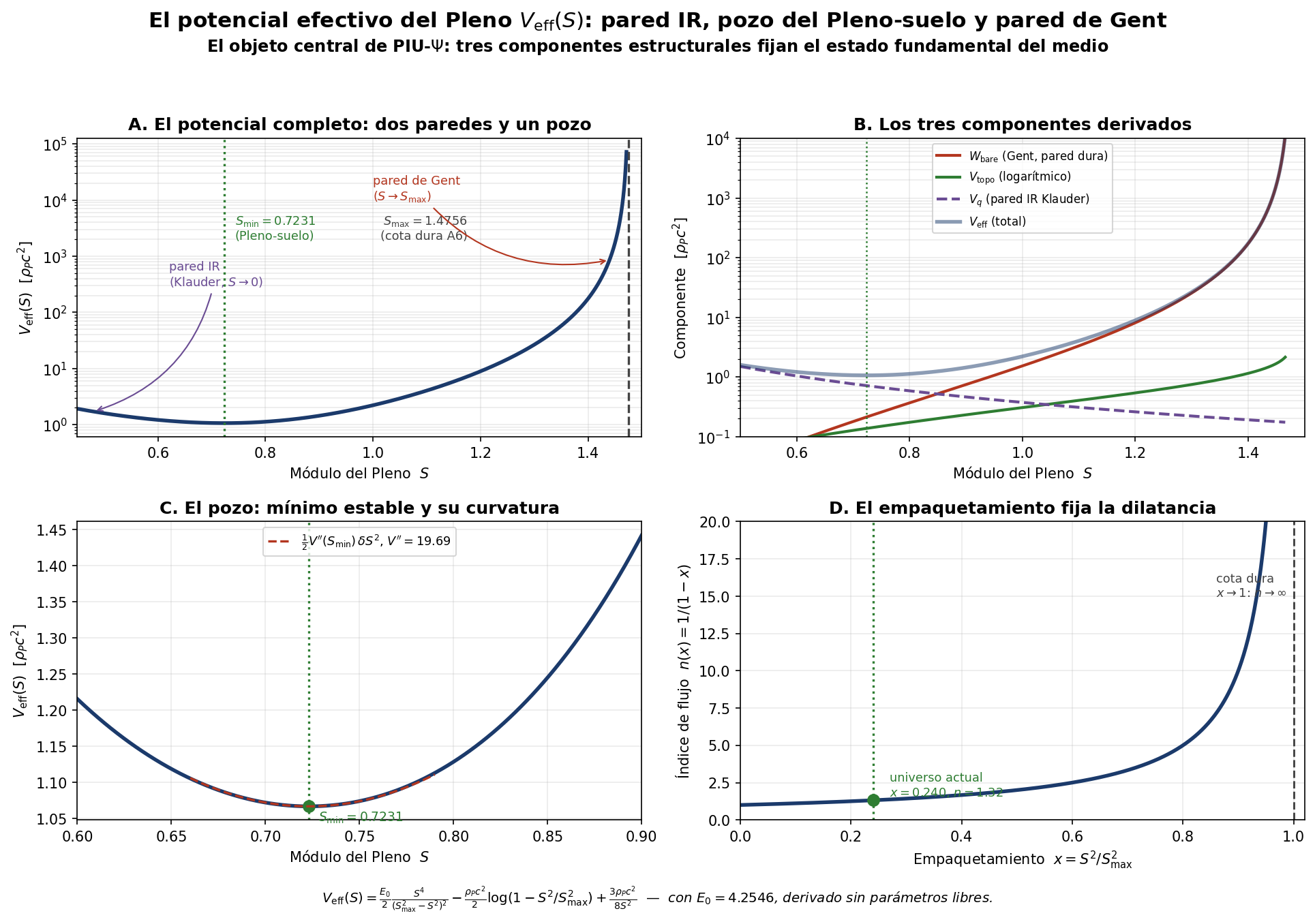
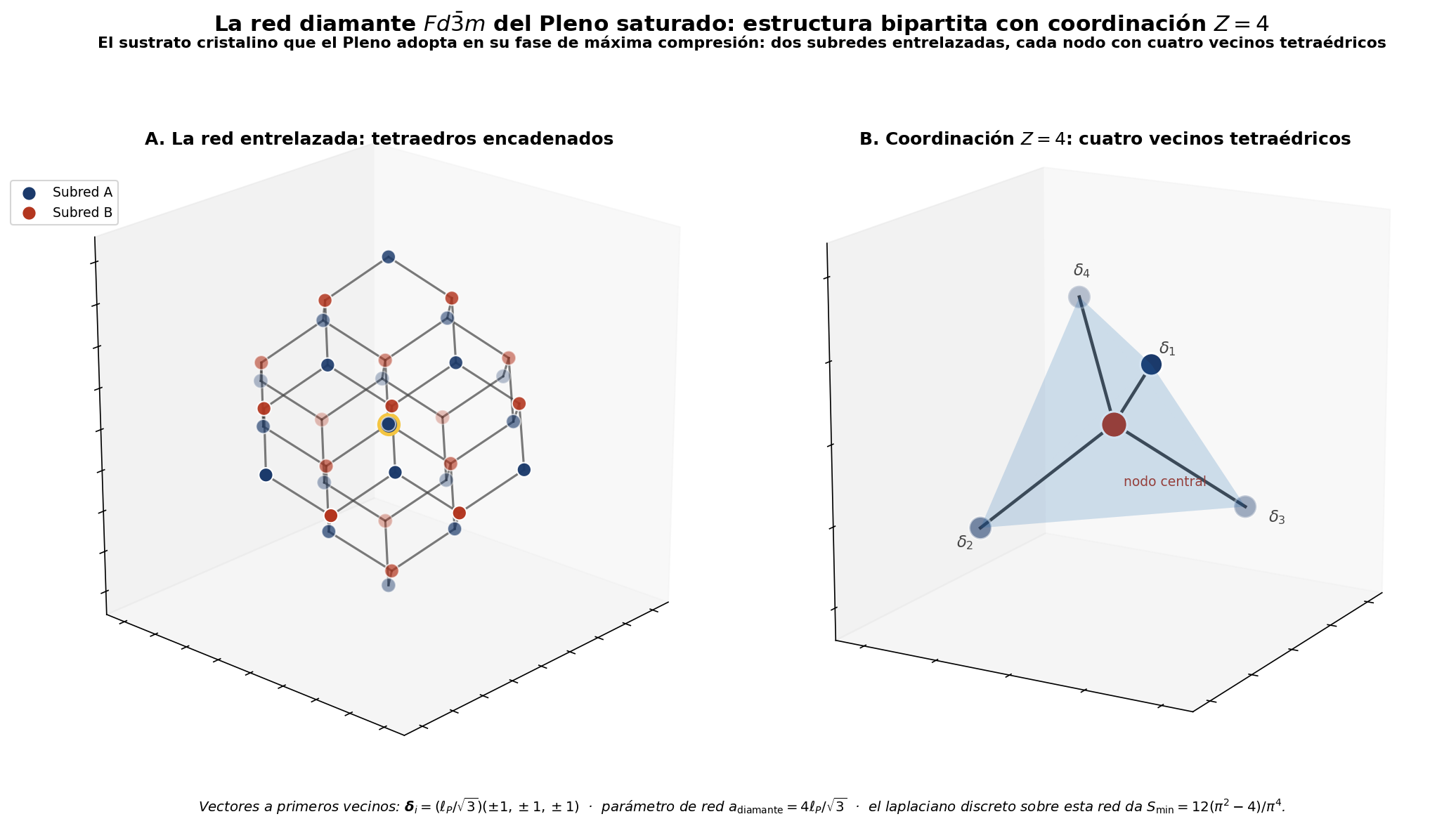
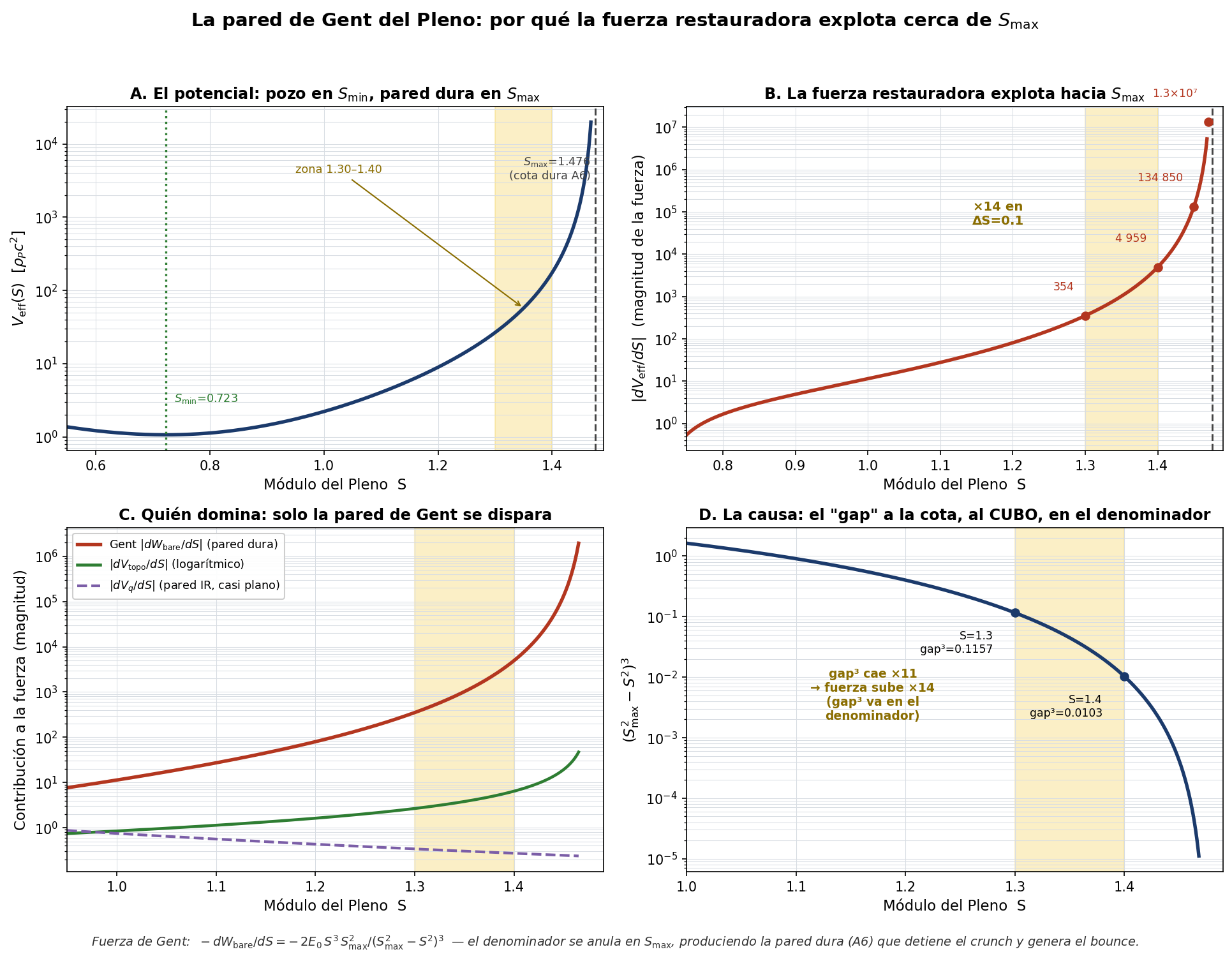
A root statement, six axioms, the F1 equation.
The complete derivational base of the corpus. F1 dissected term by term with visible anatomy: what each one physically represents, why it is there, what phenomena it produces, and its epistemic classification.
A single statement sustains the whole theory
The universe is energy: a single substrate —the Pleno—, homogeneous (the same laws at every point, with no privileged place) and isotropic (with no privileged direction). That energy is finite everywhere —at each point, $0 < E < \infty$— and conserved: it is neither created nor destroyed, only transformed and redistributed.
From this statement follows the whole apparatus of the program —the two walls of the potential, the flexural term, the speed $c$, the origin of time, covariance, the phase symmetry and the very form of F1 (§I.4, foundational SLD)—, and with it the ontological unity of the cosmos. Space, time, matter and forces are ways of being of the Pleno, not tenants. Gravity and quantum mechanics are not two theories to be unified: they are two effective descriptions of the same Pleno.
From the root statement to the equation, in three stages
- Stage 1 · The being. Energy is defined by pure identities, without dynamics. Read per region it is the density $\rho_E(x)$, finite at every point, $0<\rho_E(x)<\infty$, with scale $\rho_P$. Read as inertia it is the mass $M$, and as substance it is $E$: in the units of the medium itself the three readings collapse into a single identity, $\rho_P\equiv M\equiv E$. There is no causal arrow among them; there is a chain of identities. $\ell_P$, the coherence scale —the minimal grain of structure—, is the second substantive property of the medium.
- Stage 2 · The two branches. The branch of quantity is the modulus, $S\in(0,S_{\max})$: the floor $S>0$ comes from $E>0$ and the ceiling $S<S_{\max}$ from $E<\infty$, and neither wall is attained. The branch of change is $C\in[0,c]$: $C=0$ is energy at rest, rest mass; $C=c$ is change at the ceiling, the massless mode. $c$ is not a speed —a speed presupposes space and time already given—: it is the maximum rate of change of energy, and time emerges from it as accumulated change. The two branches are orthogonal, and the imaginary unit is the $90^\circ$ rotation that keeps them so: $\Psi=S\,e^{i\theta}$.
- Stage 3 · The doing. Conservation (A1-ii) is a balance between branches, $\Delta E_\text{conf}+\Delta E_\text{prop}=0$, that is $\partial_t\rho_E+\nabla\cdot j_E=0$. Its conversion factor is fixed by the ceiling $c$, once per branch: $E/c=Mc$, that is $E=Mc^2$. With matter in motion, the sharing between the confined and the propagating fractions is the constraint $E^2=(Mc^2)^2+(pc)^2$, from which the Lorentz factor follows, $\gamma=1/\sqrt{1-v^2/c^2}$: covariance (A3) emerges from that balance.
- Closure · F1. The kinetic term splits into the two branches: $(\partial S)^2$ is the permanence and $S^2(\partial\theta)^2$ the change. The ultraviolet Gent wall sustains the ceiling ($E<\infty$, A6) and the infrared Klauder wall the floor ($E>0$, A2): the two walls are the two bounds of the same finiteness. The flexural term is that finiteness read on curvature: an unbounded curvature would give an unbounded local energy, which A1 forbids, and $\ell_P$ fixes at what scale curvature begins to cost.
Every symmetry of the Pleno is the reverse of a conservation law (Noether), and every conservation law follows from A1: time translation, from energy conservation (A1-ii); spatial translation and isotropy, from momentum and angular momentum (single, homogeneous substrate); Lorentz covariance (A3), from causal structure (A1-i and A1-ii); the U(1) phase symmetry (A5), from charge (A1-i: $E>0$ keeps the phase always defined). The six axioms are thus ordered into one root (A1), one independent technical axiom —the continuity and differentiability of the field, part of A2— and five that are read from A1.
Status: foundational SLD. The genesis contributes origin, coherence and structure; the magnitudes are delivered by F1. The form $\Psi=S\,e^{i\theta}$ is fixed by A2 and A5, and the genesis gives its why; the derivation of the Lorentz factor from F1 is in §III.9.5. What is inherited carries its attribution: energy conservation Mayer · Joule · Helmholtz 1847, the theorem of Noether 1918, phase invariance and charge Weyl, the Fubini-Study metric Provost–Vallée 1980 and the quantum speed limits Mandelstam–Tamm 1945 · Margolus–Levitin 1998.
Minimum structure of the Pleno
There exists a single continuous physical substrate that fills the whole universe at every instant: the Pleno. There are no regions without Pleno, and everything that happens in the cosmos is its internal behaviour. Its energy is finite and strictly positive at every point (A1-i) and is conserved.
The modulus $S > 0$ is continuous and differentiable: the Pleno cannot switch off at any point. Strict positivity sustains the IR wall at $S \to 0^+$ and keeps the phase defined. Enables the Lagrangian formulation.
The laws that describe the Pleno's evolution are the same for every observer. Lorentz invariance is not postulated: it springs from that covariance as a low-energy limit, and all the modes of F1 propagate at the same $c$ of the causal structure.
The Pleno has a microscopic scale $\ell_P$ acting as a lower bound: shorter lengths are not physical configurations, and the ultraviolet divergences of the standard theory are artefacts of treating the substrate as continuous down to zero scale. On the lattice, evolution is unitary, exact and non-perturbative.
Global $U(1)$ phase symmetry $\Rightarrow$ conserved current and charge (Noether). The vacuum breaks it spontaneously, and its Goldstone opens the gapless channel of the photon. The electric charge of the constituents is the topological one, the winding quantum; the Noether charge is global and does not couple to the photon.
There exists an inaccessible $S_{\max,\text{geom}}$ bounding the modulus from above. $V_\text{eff}$ exceeds any finite value before reaching it, and with finite total energy the modulus never gets there (E-vol-3): there are no singularities, neither in the bounce nor in the core of black holes. A6 bounds the value of the modulus, not its rate.
The structural count
$S_{\min}^\text{estr}$ has a closed form, $12(\pi^2-4)/\pi^4$, from the spectral average of the Laplacian over the diamond lattice, and $S_{\max,\text{geom}}^2$ is a packing theorem (Kepler-Hales applied to the saturated Pleno). What is not derived separates into two classes, and neither is a law parameter. The first is the yardstick calibration: the Pleno works in pure ratios and has no units of its own, so reading it in human units requires a dictionary, and that dictionary costs exactly two numbers —$\ell_P$ in metres and $\rho_P$ in kilograms per cubic metre—. It is not content of the theory: it is the translation. The second is the positional state quantity: the datum of where the system sits on its trajectory, not a number of the Lagrangian —just like $H_0$ in any cosmology—. The ledger of the positional (§V.5) counts them: the modulus sector costs zero, because its dynamics has an attractor that erases the initial datum, and so does the phase sector, because $w=-1$ is exact; what remains is two state quantities, one infrared scale and the yardstick. In the compendium, the 37 calibrated marks out of 337 are the complete inventory of what the program does not derive, spread across those two families and no others. On that basis, the master catalogue runs to $P37$ without adding any parameter:
The three primaries do not cost the same, and that is why the dictionary costs two numbers and not three. $\rho_P$ cancels: it is the only one of the three with a mass dimension, which forces its exponent to one in every writable term, and F1 is homogeneous of degree one in it. $\ell_P$ survives: it cancels nowhere, and it is the only real scale of the theory. And $c$ costs zero numbers: it cancels, it is absorbed into the coordinate $x^0=ct$, and its value is an exact SI convention. Hence $\hbar=1$ is not a fourth choice but the identity, whereas $k_B=1$ is an additional convention, because temperature carries a base dimension the three primaries do not fix.
F1 dissected term by term
F1 combines four terms of the Pleno, each with its own structural role: the kinetic stiffness allowing propagation, the elastic potential containing the amplitude, the flexural stiffness regulating the ultraviolet curvature of the complete field, and the Klauder wall enforcing strict positivity of the modulus.
$\mathcal{L}_{F1}$: the reading of the Pleno in a single Lagrangian density
TERM 1 · Kinetic stiffness derived
The energy associated with the gradients of the complete field $\Psi$: that of the modulus, which is the structural propagation of the medium, and that of the phase, weighted by $S^2$, which is that of the induced gauge sector. The kinetic stiffness $K_{\text{kin}} = \frac{1}{2}\rho_P c^2 \ell_P^2$ is the Pleno's resistance to deformation.
Covariance (A3) and the action principle require it. Without it there is no propagation. It is the most basic term of any field theory.
All wave propagation of the Pleno: gravitational waves, light, matter waves, propagation of perturbations.
$K_{\text{kin}} = \tfrac12\rho_P c^2\ell_P^2$, the kinetic stiffness of the medium written with its primaries alone; translated, $c^4/(2G)$. It is not the Einstein-Hilbert prefactor, $c^4/(16\pi G)$: the two share the structural scale $\rho_P c^2\ell_P^2$, and the $8\pi=2\times4\pi$ is set by the measure of the sphere in the long-range response of the lattice and by trace reversal. The scale of gravity is inscribed in the Pleno from the start.
TERM 2 · Elastic stiffness (potential) derived
The potential combines two physically distinct contributions, each with its own derivation:
- $W_{\text{bare}}(S) = \frac{E_0}{2}\frac{S^4}{(S_{\max}^2-S^2)^2}$ — hyperelastic potential, like the energy function of a solid that cannot be stretched indefinitely; it exceeds any finite value before $S_{\max,\text{geom}}$.
- $V_{\text{topo}}(S) = -\frac{\rho_P c^2}{2}\log(1 - S^2/S_{\max}^2)$ — Gent topological potential Gent 1996. Together with $W_\text{bare}$ it carries the ultraviolet saturation wall, and it sustains the solitonic configurations, the particles, as topologically stable minima.
With the Klauder wall it forms the effective potential $V_\text{eff}=W_\text{bare}+V_q+V_\text{topo}$, whose absolute minimum is the Pleno floor. On that floor the two dark sectors are read: dark energy, the coherent fraction of the excess over the curtain, and dark matter, Q-ball-type configurations without topological charge. One equation, both sectors.
The minimum of the effective potential sits at $S_{\min}^{\text{estr}} = 12(\pi^2-4)/\pi^4 \approx 0.7231$, which comes from the spectral average of the Laplacian over the diamond lattice without touching the potential. In exchange the dynamics delivers $E_0 = 4.2546\,\rho_P c^2$ in closed form in $\pi$ and $\sqrt6$, and with it the well curvature, $\xi=19.6899$, with no freedom left.
TERM 3 · Flexural stiffness derived
The fourth-order term that regulates the curvature of the complete field $\Psi=S\,e^{i\theta}$, modulus and phase: the $(\Box S)^2$ of F1 is its compact writing. The phase enters weighted by $S_0^2$, exactly as in the kinetic term. The flexural rigidity is the native identity $\gamma_\kappa = \rho_P c^2 \ell_P^4/40 = \hbar c/40 = 7.9038 \times 10^{-28}$ J·m; after Euler-Lagrange the coefficient appears as $\rho_P c^2 \ell_P^4/20$ in the equation of motion (factor of 2).
A4 requires it, the ultraviolet regulation of the configurations of the field, and it is the simplest canonical form compatible with the symmetries. The $1/40$ is fixed by the diamond lattice, by Taylor expansion and $SO(3)$ angular average, and it is the same invariant in the modulus sector and in the phase sector.
The Lee-Wick regulation pole at $M_{LW} = \sqrt{20}/\ell_P$, a fakeon —a pole with no asymptotic state, purely virtual— Anselmi-Piva 2017. The regulator lives entirely in that pole and does not correct the massless branch, which is exactly luminal: the ultraviolet correction of gravitational waves and photon, $-(k\ell_P)^2/20$, belongs to the lattice.
$\gamma_\kappa = \rho_P c^2 \ell_P^4/40$ — written with the primaries of the medium. Translated, that same quantity is $\hbar c/40$: a direct consequence of $\hbar = \rho_P c\, \ell_P^4$, which shows the genuinely quantum nature of the term rather than an added classical regularization. It penalizes curvature at the scale $\ell_P$; the absence of singularities rests on A6 and on the finiteness of the energy.
TERM 4 · The Klauder wall derived
The affine term enforcing strict positivity of the modulus, $S>0$: it grows as $1/S^2$ as $S$ approaches zero, so the medium can never vanish. This is the Klauder wall of axiom A2. Its coefficient is the energy density of the medium itself, $\rho_P c^2$, times $3/8$, and it contains no length.
Required by affine quantization on the open half-line $S\in(0,\infty)$ Klauder: without it, the modulus could cross zero and lose physical meaning. Its coefficient $3/8$ and its sign are fixed, with no ordering freedom.
The infrared quantum wall of the effective potential. With the ultraviolet wall carried by $W_\text{bare}$ and $V_\text{topo}$, it leaves the modulus in the open interval $(0, S_{\max,\text{geom}})$, with both walls inaccessible, and it enters the balance that fixes the minimum $S_{\min}$.
$3/8$ — one of the three pure numbers of F1 ($\tfrac12$, $\tfrac1{40}$, $\tfrac38$), read from the structure of the medium, with no fit to data.
The diamond lattice comes from A1 and from F1: the $Z=4$ coordination of the isotropy A1 requires and the minimum of the flexural functional. From its geometry come the two pure ratios of the medium, $S_{\min}^\text{estr}$ and $S_{\max,\text{geom}}^2$ Kepler–Hales 2005; from its spectrum, the band ceiling and unitarity; from its plaquettes, the $8/9$ of Maxwell; from its A/B sublattice doublet, Yang-Mills; from the site group $T_d$, the Dirac structure; from its crystalline route, the number three of the baryon. The phase of F1 gives $\hbar$, the quantized charge, the Born rule and the Tsirelson bound; its modulus gives $G$, the wall that turns collapse into bounce Gent 1996 and the finite core of black holes. There is no second source.
The potential, the lattice and the containment wall
The three figures of the base structure of the Pleno: the effective potential, the diamond lattice the saturated medium adopts, and the Gent wall that bounds the modulus from above.
Mecánica cuántica y relatividad general, integradas desde F1.
Las dos teorías más exitosas y mutuamente incompatibles de la historia de la física son, en PIU, dos descripciones efectivas del mismo campo $\Psi$ en dos límites distintos. Las dos cadenas derivacionales —Pleno → Einstein y Pleno → Schrödinger— salen del mismo F1; $G$ y $\hbar$ son identidades del medio con coeficiente unidad; el límite de Chandrasekhar y la unitariedad exacta sobre la red cierran el puente (§05.03); y el sector gauge —Maxwell, Yang-Mills y el confinamiento $\mathbb{Z}_3$— es circulación de la fase del medio (§05.07).
Dos cadenas, un solo origen
El problema de conciliar relatividad general y mecánica cuántica se ha planteado durante un siglo como búsqueda de una teoría de gravedad cuántica: tomar las dos teorías como dadas y encontrar el marco que las contiene. PIU resuelve la cuestión por otra vía: ambas teorías son regímenes efectivos del mismo Pleno, obtenidos desde F1 por dos límites complementarios.
Pleno → Einstein
Promediado sobre escalas grandes, la respuesta del Pleno se lee como geometría: la vía inducida de Sakharov da el término proporcional al escalar de Ricci, y la vía de árbol fija su coeficiente.
- F1 + Madelung → flujo hidrodinámico relativista del Pleno. $\rho \propto S^2$, $u^\mu \propto \partial^\mu\theta$. Madelung 1927 derivado
- Sakharov: gravedad inducida. Las fluctuaciones inducen $\mathcal{L}_{\text{ind}} \propto R$. Esa vía entrega el signo, la escala $\rho_P c^2\ell_P^2$ y la no-contaminación del modo TT —conteo $2\ell+1=5$ por dos vías, residuo del polo físico $+1$, y la corrección de red viviendo en $a_0$ y no en el $a_1$ que fija $G$—. El coeficiente no es asunto suyo: el cálculo del $a_1$ inducido da $\gamma_G = N/12\pi = 0.1326$, dependiente de esquema, y el valor $\gamma_G=1$ lo fija la vía de árbol. Sakharov 1967 derivado
- Cierre tensorial covariante. La fórmula efectiva escalar se eleva a tensor de Einstein por consistencia variacional y conservación de energía-momento. La métrica $g_{\mu\nu}^{\text{eff}}$ emerge como propiedad del campo. derivado
- El coeficiente, a nivel de árbol. El $8\pi$ del acoplo es $2\times4\pi$ (E35-oct): el $2$ es la reversión de traza, con control negativo que entrega $4\pi$ al suprimirla; el $4\pi$ es la medida de la esfera en la respuesta de largo alcance de la red. De ahí $\alpha = \rho_P c^2\ell_P^2/(16\pi)$ y ningún otro valor, la rigidez del canal de espín 2 $K_\text{TT} = \rho_P c^2\ell_P^2/(8\pi)$, y el coeficiente $1/4$ de la entropía de Bekenstein-Hawking como consecuencia de una normalización derivada. derivado
- Identificación de $G$ y recuperación de RG. $G = c^2/(\rho_P\ell_P^2)$: entre las infinitas combinaciones de $(\rho_P,\ell_P,c)$ con dimensión de $G$, la dinámica de F1 selecciona esta y no otra. El canal gravitacional es el TT, sin masa, y el coeficiente unidad, $\kappa_G=1$, es el diccionario del programa, declarado una sola vez (E3-kappa); el canal del módulo es masivo, de alcance $0.2589\,\ell_P$, y no hay quinta fuerza. Las ecuaciones $G_{\mu\nu} = (8\pi G/c^4)T_{\mu\nu}$ se obtienen como régimen efectivo IR del Pleno. derivado
- Unitariedad cerrada. El término flexural produce el polo de Lee-Wick en $M_{LW} = \sqrt{20}/\ell_P$, un fakeon Anselmi–Piva 2017. Sobre la red, esa raíz de regulación queda por encima del techo de banda, fuera del espectro, y la evolución es unitaria de forma exacta y no perturbativa (§05.03). derivado
UN SOLO
CAMPO
Pleno → Schrödinger
La descomposición de Madelung aplicada al campo $\Psi$ en régimen no-relativista entrega la ecuación de Schrödinger con el potencial cuántico de Bohm, por equivalencia matemática exacta.
- Descomposición $\Psi = S\,e^{i\theta}$ aplicada al campo del Pleno. Madelung 1927 derivado
- Régimen no-relativista de F1: la dinámica se reduce a una ecuación de continuidad para $|\Psi|^2$ y a Hamilton-Jacobi para la fase.
- Potencial cuántico de Bohm $Q = -(\hbar^2/2m)\nabla^2 S/S$, como término de gradiente. Bohm 1952 derivado
- Identificación de $\hbar$. $\hbar = \rho_P c\, \ell_P^4$: la escala nativa de la acción, una celda del medio actuando durante un tic, con coeficiente unidad, $\kappa_\hbar=1$. derivado
- Regla de Born como consecuencia. La contabilidad de la corriente de Noether de A5 produce la interpretación probabilística, y el equilibrio cuántico es un atractor (teorema-H). La única pieza sin demostración cerrada es la forma difusiva del ruido. derivado DLF
- Incertidumbre y Bell. La relación de incertidumbre sale con su piso $\hbar/2$ exacto, y el grano del medio añade un déficit ultravioleta de coeficiente $3/80$, de signo contrario al de la fenomenología GUP. Las correlaciones de Bell respetan la cota de Tsirelson $2\sqrt2$, sin señal superluminal. derivado
- Decoherencia en lugar de colapso. No hay reducción del estado: la fase se descorrelaciona por el ruido de regulación del medio. La escala $t_\text{dec}^\text{Planck}$ es del programa; el exponente del tiempo de decoherencia queda calibrado —$n=2$ es lo compatible y $n=1$ está excluido por el dato—, con cabo de derivación declarado: obtenerlo del acoplo del ruido de regulación de F1. cabo
Respuesta de largo alcance de la red, no coeficiente local
El $8\pi$ es $2\times4\pi$. El $2$ es la reversión de traza: sin ella, el mismo cálculo entrega $4\pi G/c^4$ y no $8\pi G/c^4$. El $4\pi$ es la medida de la esfera en $d=3$, que el teorema de Gauss lee en la respuesta de largo alcance de la red (E35-sex): la configuración estática del módulo cae como $1/r$, y la función de Green de la red diamante tiende a $1/(4\pi r)$ —$4\pi r\,G_{AA}(r)\to 4/\sqrt3$ en unidades de $\ell_P$, verificado al $0.3\,\%$ en $r\simeq10\,\ell_P$—.
No es un coeficiente local de la red. Con acoplos de alcance finito —cinético a primeros vecinos, flexural a segundos—, todo coeficiente local lleva $\pi$ solo en potencias pares (criterio de paridad), y $1/(8\pi)$ lo lleva en potencia impar. La red fija la escala $\rho_P c^2\ell_P^2$, el índice del canal —$E\oplus T_2$ bajo el grupo del sitio $T_d$, ausente de los primeros vecinos y presente exactamente una vez en los doce de segundos vecinos, de modo que por Schur la normalización queda fijada hasta un único escalar—, la dispersión y el polo del modo TT; su función de Green fija el $4\pi$. La predicción P-gammaG, que pedía ese número a un coeficiente local, queda retirada (§III.3.2-bis). derivado
Las dos constantes, del Pleno al laboratorio
Las dos cadenas terminan cada una en una constante que la física mide y acepta como dato. El recorrido completo: qué entrega la derivación, con qué se evalúa, qué número sale y contra qué se compara.
$\rho_P = 5.1548\times10^{96}\ \mathrm{kg/m^3}$ · $\ell_P = 1.6163\times10^{-35}\ \mathrm{m}$ · $c = 2.9979\times10^{8}\ \mathrm{m/s}$
Todo lo demás sale de estas tres más la geometría de la red. $c$ es estructura causal y convención del SI; las dos que llevan dimensiones propias son $\rho_P$ y $\ell_P$.
| Constante de Newton | Cuanto de acción | |
|---|---|---|
| Lo que entrega la derivación | $G = \dfrac{c^2}{\rho_P\ell_P^{2}}$ linealización de F1, función de Green y canal TT |
$\hbar = \rho_P\,c\,\ell_P^{4}$ rotor $U(1)$ de la celda: $I_\theta = \rho_P\ell_P^5$, $\omega_P = c/\ell_P$ |
| Qué la fija entre las infinitas combinaciones | La dinámica de F1. La linealización y la función de Green dan la forma $1/r$ y la escala $\rho_P c^2\ell_P^2$; el coeficiente lo fija el canal TT, donde no hay carga libre que normalizar, con el $8\pi$ de árbol. La normalización $q_i=\sqrt{4\pi}\,m_ic^2$ es la convención racionalizada declarada que traduce ese $G$ al lenguaje de carga del canal del módulo. Las demás combinaciones dimensionalmente compatibles no las produce F1. | La escala nativa de la acción, $\mathcal A = I_\theta\,\omega_P = \rho_P c\,\ell_P^4$, sale del esqueleto dimensional con número puro $1$; el escalonado entero del espectro, $p_\theta = n\hbar$, de que $\theta$ es una coordenada compacta ($\Psi=S\,e^{i\theta}$ y A5). Lo único prestado es el formalismo operatorial, y así queda declarado. |
| Estatus | derivado $\kappa_G=1$; ningún parámetro ajustado a $G$ observado |
derivado $\kappa_\hbar=1$; ningún parámetro ajustado a $\hbar$ observado |
| Evaluado en las primarias | $\dfrac{(2.9979\times10^{8})^{2}}{5.1548\times10^{96}\cdot(1.6163\times10^{-35})^{2}}$ | $5.1548\times10^{96}\cdot 2.9979\times10^{8}\cdot(1.6163\times10^{-35})^{4}$ |
| Resultado | $6.6743\times10^{-11}\ \mathrm{m^3\,kg^{-1}\,s^{-2}}$ | $1.0546\times10^{-34}\ \mathrm{J\,s}$ |
| Valor medido | $6.67430(15)\times10^{-11}$ CODATA 2022 |
$1.054571817\ldots\times10^{-34}$ SI 2019, exacto por definición |
| Diferencia | Exacta por construcción: la aritmética del diccionario es exacta, y lo que la fila confronta es el coeficiente, $\kappa_G=1$ | Lo que la fila confronta es el coeficiente, que sale uno sin nada que ajustar, $\kappa_\hbar=1$ |
Los dos números del diccionario —$\ell_P$ en metros y $\rho_P$ en kilogramos por metro cúbico— se infieren operacionalmente de $(G, \hbar, c)$, porque no existe una medida directa del grano del medio ni de su densidad. Por eso, al sustituirlos en la identidad, el resultado devuelve las constantes medidas: a precisión plena la igualdad es exacta por construcción del diccionario, y lo que ese cierre comprueba es la aritmética, no la física. El contenido falsable está en que el mismo par $(\rho_P,\ell_P)$ devuelva a la vez $G$ y $\hbar$ —dos constantes de dos cantidades, un sistema exacto y agotado, sin libertad residual— y en que la combinación sea $c^2/(\rho_P\ell_P^2)$ y no otra.
Esa inferencia es un artefacto metodológico, no un enunciado ontológico. En el orden lógico del programa los primarios del Pleno son anteriores a las constantes que derivan de ellos: $G$ no se mide y se inserta en la ley, sino que el coeficiente cinético de F1 —ya fijado por $\rho_P$ y $\ell_P$— es $c^4/G$. La ley de fuerza y su constante emergen juntas de la mecánica del medio. Por eso la clasificación es derivado y no calibrado: no hay ningún parámetro ajustado al valor observado.
Por lo mismo, la columna de acuerdo de $G$ y $\hbar$ no lleva porcentaje, y no por omisión: la coincidencia numérica no es una confirmación independiente. Esa confirmación llega cuando $\rho_P$ o $\ell_P$ se midan por vía propia, desde física no gravitacional y no cuántica, y la vía está trazada: la densidad gravitante del núcleo regular de un objeto compacto, $\rho_{\max,g}\approx 1.6545\,\rho_P$. Lo que la gravedad del núcleo mide es el producto $G\rho_{\max,g}=1.6545\,c^2/\ell_P^2$, que da $\ell_P$ sin usar el valor de $G$ ni el de $\hbar$. Es el cabo falsable C-meta-1.b, el único de categoría nativa del inventario, y no es precondición del estatus actual. Rinde doble: medir uno de los dos primarios convierte estas dos identidades en dos confrontaciones independientes.
Invirtiendo, $1/G = K/c^4$ con $K = \rho_P c^2\ell_P^2 \approx 1.2103\times10^{44}$ N — la tensión estructural del medio. $G$ no es una intensidad de fuerza: es la blandura del Pleno, el inverso de su rigidez.
La gravedad es débil porque el Pleno es densísimo y por tanto rigidísimo. La debilidad gravitacional deja de ser un misterio de jerarquía y pasa a ser la lectura macroscópica de la rigidez extrema del medio.
Con la sustitución hecha, la escala de Planck se lee como lo que es en el programa —la celda del medio—: $m_P = \rho_P\ell_P^3 = 2.1764\times10^{-8}$ kg es la masa de una celda, $E_P = \rho_P c^2\ell_P^3 = 1.9561\times10^{9}$ J su energía, y $t_P = \ell_P/c = 5.3912\times10^{-44}$ s el tiempo que tarda una perturbación en cruzarla.
Ni la métrica ni la función de onda son fundamentales: lo es $\Psi$
El resultado conceptual de las dos cadenas tiene tres escalones, cada uno con un estatus epistémico distinto:
Primer escalón — lo derivado. De F1 se obtienen, por cálculo explícito, dos límites: promediado coherentemente sobre escalas grandes, $\Psi$ produce las ecuaciones de Einstein; observado no-relativísticamente sobre escalas pequeñas, produce la ecuación de Schrödinger con potencial cuántico de Bohm. Esto es derivación: dos teoremas, cada uno con su clasificación. La métrica $g_{\mu\nu}$ y la función de onda $\psi$ aparecen así como formas efectivas del mismo campo, cada una válida en su régimen.
Segundo escalón — la co-emergencia. Que ambas emerjan del mismo $\Psi$ no las vuelve idénticas entre sí: son proyecciones complementarias que no se solapan (una vive en el límite IR coherente, la otra en el no-relativístico). Decir "$g_{\mu\nu}$ es $\psi$" sería un error de identidad. Lo correcto es que ninguna de las dos es fundamental: ambas se apoyan en un sustrato común que sí lo es.
Tercer escalón — la identificación ontológica. Que ese sustrato común sea el único campo físico fundamental no es un teorema que se demuestre desde dentro: es el axioma A1, el punto de partida del programa. La fuerza del resultado está en que ese punto de partida rinde ambas teorías por cálculo, no en que las dos cadenas "prueben" A1 — eso sería circular. Los escalones uno y dos son derivados; el tercero es el compromiso ontológico declarado que los sostiene.
Con esa precisión, la incompatibilidad histórica entre RG y MQ se disuelve: nunca fueron teorías rivales, sino dos descripciones parciales del mismo sustrato. El problema de "cuantizar la gravedad" se reformula: no hay que cuantizar la métrica porque no es fundamental; emerge del campo $\Psi$, cuyo régimen cuántico es Madelung-Bohm, y la evolución del medio es unitaria de forma exacta sobre su red.
Una masa estelar y una evolución unitaria, desde el mismo medio
El límite de Chandrasekhar combina tres ingredientes que la física ordinaria toma de tres teorías distintas: el principio de exclusión, la presión de degeneración relativista y el equilibrio hidrostático gravitacional. En PIU-Ψ los tres son comportamientos del mismo medio, y el coeficiente completo sale de él, sin parámetro de ajuste. Una sola magnitud entra desde fuera, y no es física prestada: la masa de materia por electrón degenerado, $\mu_e m_u$, que dice de qué está hecha la estrella y no qué es el Pleno.
La ecuación de Emden no se importa: se obtiene de F1
El gas degenerado es de electrones, y el electrón es un defecto extenso de winding $-1$ cuya estructura de Dirac, con unicidad de Pauli y spin-estadística, entrega la degeneración $g=2$ y la ocupación truncada en uno: la exclusión es consecuencia, no postulado. La presión de degeneración es incertidumbre, con el $\hbar$ del medio. La gravedad es la respuesta macroscópica del Pleno, y el equilibrio es el límite estático de la mecánica de fluidos que F1 entrega en el infrarrojo, cerrado con la Poisson derivada. De ahí salen la ecuación de Emden de índice $3$ y el prefactor $\sqrt{3\pi}/2$, desde $K^{3/2}$. derivado
$\xi_1 = 6.8968486$, $I_3 = 2.0182360$, $(\sqrt{3\pi}/2)\,I_3 = 3.0980$
Sin el espín $\tfrac12$ —con $g=1$— la masa sube exactamente en $\sqrt2$, a $2.06\,M_\odot$; en el régimen no relativista no existe masa límite; la corrección de red al conteo vale $2.8\times10^{-44}$ a la densidad de una enana blanca. Y $\mu_e m_u$, dato de la estrella, fija un escalado exacto, $M_\text{Ch}\propto\mu_e^{-2}$: $5.83\,M_\odot$ para hidrógeno, $1.456\,M_\odot$ para helio y carbono-oxígeno, $1.256\,M_\odot$ para $^{56}$Fe, falsable con poblaciones de enanas blancas de composición distinta. derivado
La dinámica microscópica del Pleno es la de su red —variables $(S_n,\theta_n)$ por sitio, inercia de primer orden en el tiempo, energía de enlace y de sitio—, y el término flexural de F1 es la forma continua de su cuarto orden, válida bajo el techo de banda $\omega_{\max}=\sqrt{12}\,c/\ell_P$. Las raíces de regulación de esa forma no están en el espectro de la red: la de fase y TT cumple $\omega\ge\sqrt{20}\,c/\ell_P$ para todo $k$, por encima del techo, y en la red el modo radial es real. El hamiltoniano de cada sitio es autoadjunto —en la pared de Klauder el coeficiente es exactamente el crítico $3/4$ de Weyl; en la de Gent, $E_0S^2_{\max,\text{geom}}/4=2.32$— y acotado inferiormente, y el enlace es una perturbación acotada por A6. La evolución es unitaria de forma exacta y no perturbativa, sin enunciado orden a orden. derivado
Materia ordinaria, materia oscura, agujeros negros — todos modos de $\Psi$
La misma estructura derivacional produce las cuatro identificaciones ontológicas centrales del corpus:
Skyrmión con invariante de Hopf $B = 1$
La materia bariónica es una configuración topológica estable del Pleno con número bariónico unidad: el invariante de Hopf del doblete A/B, $B\in\pi_3(S^2)=\mathbb{Z}$, sobre el target $\mathbb{CP}^1$ que A2 hace global Gudnason–Nitta. La rotación de $2\pi$ da el factor $(-1)^B$, y para $B=1$ la cuantización fermiónica es obligatoria Wilczek–Zee 1983. Sus tres vórtices portan windings fraccionales —protón $(+\tfrac23,+\tfrac23,-\tfrac13)$, neutrón $(+\tfrac23,-\tfrac13,-\tfrac13)$—, cada uno con un tercio de número bariónico. derivado
Q-ball generalizada
La materia oscura es una configuración excitada del Pleno sin carga topológica: un solitón de tipo Q-ball cuya fase interna rota, y esa rotación es su carga de Noether, global Coleman 1985. Target topológicamente contractible $\Rightarrow$ cuantización bosónica forzada por F-R: $\chi_{FR}^{MO} = +1$. Su oscuridad es ausencia de acoplamiento gauge: no emite ni absorbe luz, y la curva. derivado
Pleno-suelo + depleción cuántica $f_c$
La energía oscura es la fracción coherente del exceso sobre el telón; el telón mismo, $V_\text{eff}(S_{\min})=1.0670\,\rho_Pc^2$, es el cero de la escala y no gravita. La identificación $\Omega_{EO} \equiv f_c = 0.6869$ es P17 del catálogo: la estructura del cociente está derivada y su valor, el numerador $S^2_{\max,\text{eff}}$, es posicional y calibrado. Lectura ontológica EO-Telón: estado estructural del Pleno-suelo, no entidad atraíble Bogoliubov 1947 · Yukalov 2007, con acuerdo de $0.30\sigma$ contra Planck 2018. derivado calibrado
Núcleo a densidad máxima y halo de campo radial
El interior del agujero negro está resuelto, sin singularidad. Lo que gravita es el exceso de ocupación sobre el reposo, y A6 lo acota en la densidad gravitante $\rho_{\max,g}=1.6545\,\rho_P$ (supremo de ocupación $2.1773\,\rho_P$). El núcleo guarda $M/4$, el halo $\rho_g\propto r^{-4}$ el resto, y la curvatura nunca supera $120/\ell^4$, con $\ell=0.2686\,\ell_P$. El objeto retiene la luz desde $M_*=0.3489\,m_P$; la masa mínima de la región saturada es $M_{\min}=0.1343\,m_P$. derivado
Consecuencia observacional: la materia oscura es transparente a la luz porque su carga de fase es global y no se acopla al fotón, y gravita, de ahí su detección por curvas de rotación y lentes. Las búsquedas de detección directa —XENON, LUX, PandaX— no han producido detección Arcadi et al. 2018. La pestaña dedicada al sector oscuro desarrolla este punto en detalle: §06 Sector Oscuro.
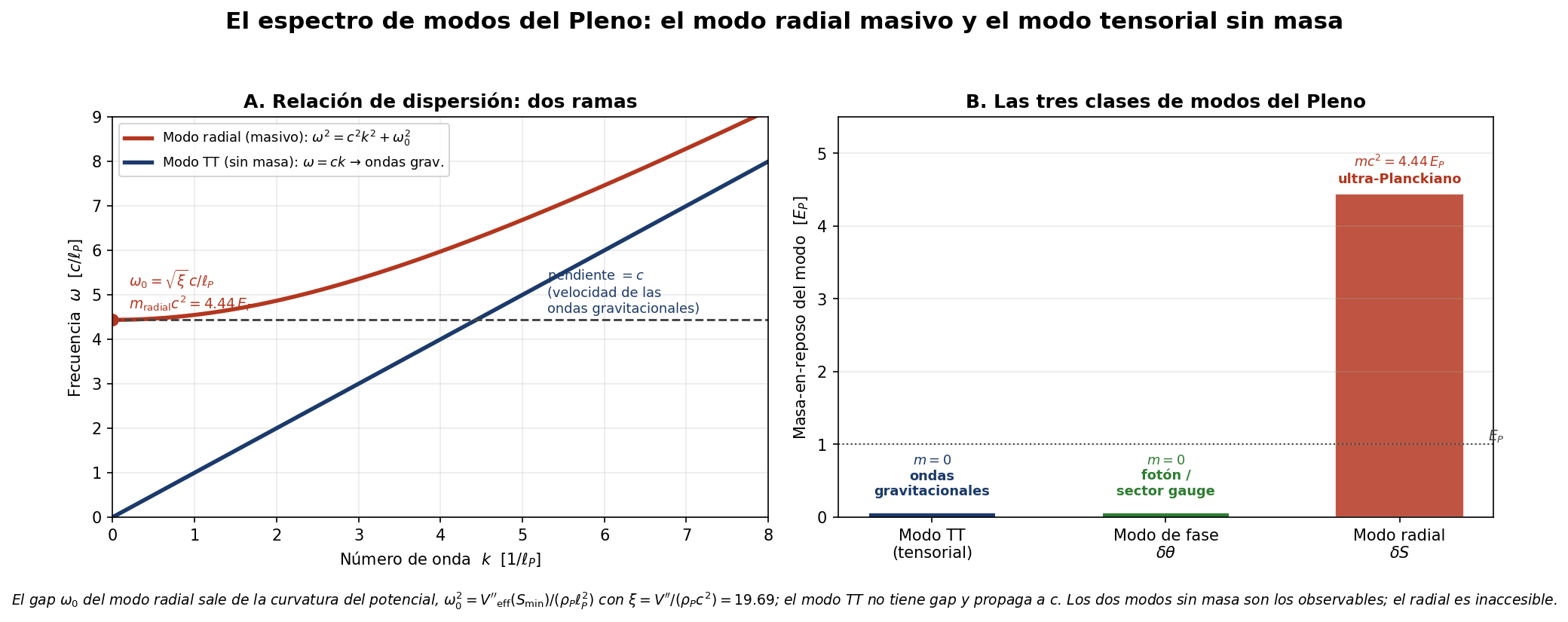
PIU es matemáticamente continuo con física de laboratorio bien establecida
El corpus PIU-Ψ establece formalmente la correspondencia F1 ↔ Gross-Pitaevskii: la ecuación de campo cuántico macroscópico mejor validada experimentalmente en la historia de la física (BECs, superfluidos) es el límite no-relativista exacto de F1. PIU es la extensión relativista de una física de laboratorio establecida, llevada al régimen cosmológico.
Cinco pasos de reducción F1 → GP
- Régimen no-relativista: $S = S_{\min} + \delta S$, $|\delta S| \ll S_{\min}$, dinámica lenta frente a $\omega_P=c/\ell_P$.
- Sustitución del campo: $\psi = \delta S\,\ell_P^{-3/2}\,e^{-i\omega_0 t}$, con $|\psi|^2$ densidad numérica de cuantos.
- Expansión del potencial: $V_{\text{eff}}(S_{\min}+\delta S)$ a cuarto orden.
- Masa efectiva: $m_{\text{eff}}c^2 = \hbar\sqrt{V''_\text{eff}/(\rho_P\ell_P^2)} = \sqrt{\xi}\,E_P$.
- Constante de acoplamiento: $g_{\text{eff}} = \tfrac{1}{12}V^{(4)}_\text{eff}\,\ell_P^6\,\bigl[1-\tfrac53 (V'''_\text{eff})^2/(V''_\text{eff}V^{(4)}_\text{eff})\bigr] \approx 5.43\times10^{-94}$ J·m³.
Resultado: $i\hbar\,\partial_t\psi = -\frac{\hbar^2}{2m_{\text{eff}}}\nabla^2\psi + g_{\text{eff}}|\psi|^2\psi$ — exactamente GP. derivado
Validación experimental indirecta
- Bosenova — colapso-explosión-remanente oscilante de BECs Donley-Cornell-Wieman 2001 · Nature.
- Solitones de respiración con resucitaciones — los átomos emitidos al ambiente por un solitón brillante regresan e interfieren con él, y producen revivals periódicos con asimetría temporal. Análogo del programa: información topológica preservada entre ciclos cosmológicos. Sroyngoen–Anglin 2026.
- Cavitación Rayleigh-Plesset — forma estructural idéntica a Friedmann durante el rebote.
- Ostwald-Liesegang ripening — paralelo del mecanismo de concentración asintótica Lifshitz-Slyozov-Wagner.
- Cristalización cíclica — análogo del crecimiento monotónico de complejidad entre ciclos.
La correspondencia F1 $\leftrightarrow$ GP es derivado, con cómputo explícito y dimensionalmente consistente de la masa efectiva y de la constante de acoplamiento; $g_{\text{eff}}$, completo a segundo orden con la renormalización cúbica, queda como razón pura de las derivadas del potencial, sin parámetros libres. De ahí que toda predicción de GP validada experimentalmente —espectros de Bogoliubov-de Gennes, dinámica de solitones brillantes, colapso-rebote en Bosenovas— sea predicción derivable del Pleno en su régimen efectivo correspondiente.
El alcance de esa afirmación es preciso. Se trata de un mapeo paramétrico: la fenomenología de GP es predicción del Pleno condicional a que GP sea correcta en su régimen de validez, lo cual está experimentalmente establecido sin disputa. Eso convierte a los experimentos en condensados cuánticos macroscópicos en validación experimental indirecta del programa — estatus de evidencia, no un cabo de derivación, y tampoco una predicción nueva que el programa arriesgue.
La energía oscura es estado estructural del Pleno-suelo, no entidad atraíble
La energía oscura es estado estructural permanente del Pleno-suelo —la lectura EO-Telón—, no una entidad que se diluya, se concentre o sea atraída por la gravedad. Su densidad es la fracción coherente del exceso sobre el telón, $\rho_{EO}=f_c\,\Theta\,\rho_Pc^2$; el telón mismo, $V_\text{eff}(S_{\min})=1.0670\,\rho_Pc^2$, es el cero de la escala y no gravita. Es no aglomerable —su velocidad del sonido es $c$ y no admite crecimiento de perturbaciones—, y no aglomerable no es inerte: con $w=-1$ tiene $\rho+3p<0$ y antigravita, y es por ese efecto de fondo que se la mide.
Reductio por uniformidad
Si la EO fuera atraíble por gravedad, habría "pozos de EO" alrededor de agujeros negros supermasivos y cúmulos. No se observan. La uniformidad extrema que confirman Planck 2018 y DESI es exactamente lo que predice la lectura EO-Telón.
Desde F6
$\rho_{\text{materia}} = \rho_P[S^2 - S_{\min}^2]$ (E32-bis) dice literalmente que la materia es la perturbación sobre el fondo $S_{\min}$. Eso solo es consistente si $S_{\min}$ es estructural, no material: la energía oscura es ese fondo, leído como exceso coherente sobre el telón.
$T_{\mu\nu}^{(w=-1)} \propto g_{\mu\nu}$
Con $w = -1$, el término $(\rho + p)u_\mu u_\nu$ se anula exactamente: la EO no tiene marco de reposo dinámico. No se mueve, no fluye, no se acumula. Propiedad estructural homogénea del medio.
Las cifras no dependen de esta lectura. $\Omega_{EO} \equiv f_c = 0.6869$ es P17 del catálogo, con acuerdo de $0.30\sigma$: estructura derivada, valor calibrado. Lo que la lectura fija es la interpretación ontológica del observable: la ecuación de estado del sector tardío es $w = -1$ exacto —el estado fundamental tiene $\dot\theta_0=0$ y $T_{\mu\nu} \propto g_{\mu\nu}$, sin cinética que lo desplace—, de modo que cualquier señal $w(z) \neq -1$ que infiera DESI es un artefacto de la parametrización $w_0$–$w_a$ aplicada a un medio con $w = -1$ exacto, no una dinámica física de la energía oscura. Sobre $F_\text{AP}$ desnudo la señal baja de $2.8$–$4.2\sigma$ a $1.3\sigma$; la capa del análisis combinado es el cabo falsable F-cosmo, con predicción de disolución en observables crudos.
El electromagnetismo y las fuerzas gauge como circulación de fase del Pleno
El campo del Pleno es $\Psi = S\cdot e^{i\theta}$. Las cuatro ecuaciones de Maxwell del campo libre, la estructura algebraica de Yang-Mills y el confinamiento del color brotan de un solo mecanismo: la circulación orientada de la fase $\theta$ sobre la red diamante.
Maxwell desde la circulación de fase
Una perturbación de fase $\delta\theta$ se descompone, según su rango tensorial, en tres sectores irreducibles: escalar (el Goldstone de A5), vectorial transverso (el sector electromagnético, dos polarizaciones) y tensorial transverso sin traza (el modo TT). Los tres son la misma flexión de fase de $\Psi$ en rangos contiguos, y el índice de cada rango lo porta la resolución por enlaces de la red —por eso el fotón y el modo TT comparten exactamente la velocidad $c$ y la corrección de red $(k\ell_P)^2/20$—.
El fotón, contado sobre la red. El vacío rompe espontáneamente la $U(1)$ global de A5, y su Goldstone abre el canal sin gap del fotón. Sus dos polarizaciones son dos ciclos del espacio de enlaces: la celda primitiva del diamante tiene dos sitios y cuatro enlaces, y la descomposición de Hodge los reparte en $\theta_-$ (con gap), $\theta_+$ (longitudinal) y dos ciclos transversos (E-Maxwell-H1). La circulación sobre los hexágonos de la red, doce por sitio, es invariante gauge exacta, y sus dos autovalores transversos son degenerados e isótropos, $\propto k^2$ (E-Maxwell-H2); de ahí $\Box\,\mathbf a_\perp=0$ y $\omega=ck$ para las dos polarizaciones (E-Maxwell-H3). derivado
El sector vectorial admite dos energías ortogonales sobre la red, separadas por $90^\circ$:
- Energía de enlace $|\Psi_n-\Psi_m|^2$ → tensor simétrico (término cruzado $+2$): es una deformación elástica, un fonón vectorial. No es Maxwell. derivado
- Circulación orientada $\oint a$ sobre las plaquetas → tensor antisimétrico (término cruzado $-32/9$): es el tensor de campo $F_{\mu\nu}$ de Maxwell. derivado
De esta energía y de la definición de $F_{\mu\nu}$ se siguen las cuatro ecuaciones del campo libre: las homogéneas (identidad de Bianchi, automática) y las inhomogéneas en vacío (Euler-Lagrange del término $(8/9)F^2$), ambas derivado. El $8/9$ sale directamente de la suma de áreas orientadas sobre las plaquetas, con la construcción en red de variables de enlace y circulación de plaqueta Wilson 1974 · Kogut–Susskind 1975: su $1/9$ es el $(1/\sqrt3)^2$ que aporta cada enlace, y el signo opuesto ($-32/9$ antisimétrico frente a $+2$ simétrico) está verificado simbólicamente. Las inhomogéneas con fuente toman como fuente la corriente de carga topológica de los defectos cargados —la carga de Noether de A5 es global y no se acopla al fotón—; el acoplamiento está identificado estructuralmente y su coeficiente explícito, ligado al embedding de hipercarga, es cómputo pendiente. DLF
El $90^\circ$ y la $i$ de $\Psi$. El módulo $|\Psi_n-\Psi_m|^2$ pierde el sentido de giro; la circulación orientada lo conserva. La unidad imaginaria $i$ de $e^{i\theta}$ es el operador de rotación de $90^\circ$ que convierte circulación de fase en campo perpendicular — la estructura misma de la ley de Ampère. Por eso el electromagnetismo es intrínsecamente complejo y nativo de $U(1)$: no se postula, ya está en $\Psi$. derivado
Yang-Mills: el límite no abeliano
El mismo mecanismo con una fase matricial $\theta_-\in SU(2)$ —que el programa posee desde la bipartición A/B— produce la estructura algebraica completa de Yang-Mills. La holonomía de plaqueta no abeliana, expandida por Baker-Campbell-Hausdorff, da:
El término $i[A_\mu,A_\nu]$ nace solo, de la no conmutatividad de los generadores; no se postula. El límite abeliano recupera Maxwell exacto. Maxwell y Yang-Mills son la misma palabra del medio —circulación de fase sobre plaquetas— distinguidas solo por si la fase conmuta (U(1) → Maxwell) o no (SU(2)/SU(3) → Yang-Mills). derivado
Confinamiento como obstrucción de centro $\mathbb{Z}_3$
El confinamiento topológico del programa —los vórtices de winding $1/3$ del cluster Borromean— es exactamente la obstrucción de centro $\mathbb{Z}_3$ de la teoría $SU(3)$:
- Un vórtice $1/3$ aislado tiene holonomía de centro $e^{2\pi i/3}\neq\mathbb{I}$ → no cierra → confinado: el coste de separarlo crece linealmente con la distancia.
- El cluster tripartito $\tfrac13+\tfrac13+\tfrac13$ tiene holonomía total $=\mathbb{I}$ → singlete de color, libre y observable.
La regla de singlete ($\sum$ winding $\equiv 0 \bmod 3$) reproduce exactamente la fenomenología de la cromodinámica: $qqq$ y $q\bar q$ libres; el quark solo y el diquark, confinados. El confinamiento del rebote (topología de vórtices congelados) y el de Yang-Mills (centro $\mathbb{Z}_3$) son el mismo mecanismo. La construcción explícita del campo $SU(3)$ completo más allá del centro es cómputo pendiente. derivado
Una sola palabra del medio. Las estructuras gauge del Modelo Estándar son el mismo fenómeno del Pleno sobre los sectores que el programa provee: $\theta_+\in U(1)$ da el electromagnetismo, y los vórtices $\mathbb{Z}_3$ de los clusters tripartitos dan el color $SU(3)$. Electromagnetismo, confinamiento y formación de partículas en el rebote quedan unificados bajo la circulación de fase. La corriente de A5 no tiene anomalía —la simetría actúa sitio a sitio y se localiza exactamente con una conexión de enlace—, y las relaciones que el Modelo Estándar obtiene de la cancelación de anomalías son aquí consecuencias de la topología. El sector débil sobre el doblete es otra cosa, y lo que resta de él es una confrontación con el dato, no una brecha estructural: el sector débil observado exige una violación custodial $\lesssim10^{-3}$, y el coeficiente del operador custodial en la teoría efectiva a la escala electrodébil está sin computar. Ése es el criterio de cierre, y ningún cabo del inventario tiene severidad alta. Los acoplamientos renormalizados en $M_Z$ no son cabo sino frontera declarada: no son objetos del Pleno sino la salida de un ajuste hecho con otra teoría, y el puente hasta la escala de red son diecisiete décadas que el programa publica como traducción documentada, con su orden y su piso.
Quantum mechanics and general relativity, integrated from F1.
The two most successful and mutually incompatible theories in the history of physics are, in PIU, two effective descriptions of the same field $\Psi$ in two different limits. The two derivational chains —Pleno → Einstein and Pleno → Schrödinger— come from the same F1; $G$ and $\hbar$ are identities of the medium with unit coefficient; the Chandrasekhar limit and exact unitarity on the lattice close the bridge (§05.03); and the gauge sector —Maxwell, Yang-Mills and $\mathbb{Z}_3$ confinement— is phase circulation of the medium (§05.07).
Two chains, one single origin
The problem of reconciling general relativity and quantum mechanics has been posed for a century as the search for a quantum theory of gravity: take the two theories as given and find the framework that contains them. PIU settles the question another way: both theories are effective regimes of the same Pleno, obtained from F1 by two complementary limits.
Pleno → Einstein
Averaged over large scales, the response of the Pleno reads as geometry: Sakharov's induced route gives the term proportional to the Ricci scalar, and the tree-level route fixes its coefficient.
- F1 + Madelung → relativistic hydrodynamic flow of the Pleno. $\rho \propto S^2$, $u^\mu \propto \partial^\mu\theta$. Madelung 1927 derived
- Sakharov: induced gravity. Fluctuations induce $\mathcal{L}_{\text{ind}} \propto R$. That route delivers the sign, the scale $\rho_P c^2\ell_P^2$ and the non-contamination of the TT mode —counting $2\ell+1=5$ by two routes, physical-pole residue $+1$, and the lattice correction living in $a_0$ and not in the $a_1$ that fixes $G$—. The coefficient is not its business: the computation of the induced $a_1$ gives $\gamma_G = N/12\pi = 0.1326$, scheme-dependent, and the value $\gamma_G=1$ is fixed by the tree-level route. Sakharov 1967 derived
- Covariant tensorial closure. The effective scalar formula is lifted to the Einstein tensor by variational consistency and energy-momentum conservation. The effective metric $g_{\mu\nu}^{\text{eff}}$ emerges as a property of the field. derived
- The coefficient, at tree level. The $8\pi$ of the coupling is $2\times4\pi$ (E35-oct): the $2$ is trace reversal, with a negative control that returns $4\pi$ when it is suppressed; the $4\pi$ is the measure of the sphere in the long-range response of the lattice. Hence $\alpha = \rho_P c^2\ell_P^2/(16\pi)$ and no other value, the stiffness of the spin-2 channel $K_\text{TT} = \rho_P c^2\ell_P^2/(8\pi)$, and the $1/4$ coefficient of the Bekenstein-Hawking entropy as a consequence of a derived normalization. derived
- Identification of $G$ and full GR recovery. $G = c^2/(\rho_P\ell_P^2)$: among the infinitely many combinations of $(\rho_P,\ell_P,c)$ with the dimensions of $G$, the dynamics of F1 selects this one and no other. The gravitational channel is the TT one, massless, and the unit coefficient, $\kappa_G=1$, is the program's dictionary, declared once (E3-kappa); the modulus channel is massive, with range $0.2589\,\ell_P$, and there is no fifth force. The equations $G_{\mu\nu} = (8\pi G/c^4)T_{\mu\nu}$ are obtained as the effective IR regime of the Pleno. derived
- Unitarity closed. The flexural term produces the Lee-Wick pole at $M_{LW} = \sqrt{20}/\ell_P$, a fakeon Anselmi–Piva 2017. On the lattice, that regulation root lies above the band ceiling, outside the spectrum, and evolution is unitary, exactly and non-perturbatively (§05.03). derived
ONE SINGLE
FIELD
Pleno → Schrödinger
Madelung's decomposition applied to the field $\Psi$ in the non-relativistic regime delivers the Schrödinger equation with Bohm's quantum potential, by exact mathematical equivalence.
- Decomposition $\Psi = S\,e^{i\theta}$ applied to the Pleno field. Madelung 1927 derived
- Non-relativistic regime of F1: the dynamics reduces to a continuity equation for $|\Psi|^2$ and to Hamilton-Jacobi for the phase.
- Bohm's quantum potential $Q = -(\hbar^2/2m)\nabla^2 S/S$, as a gradient term. Bohm 1952 derived
- Identification of $\hbar$. $\hbar = \rho_P c\, \ell_P^4$: the native scale of action, one cell of the medium acting during one tick, with unit coefficient, $\kappa_\hbar=1$. derived
- Born rule as a consequence. The accounting of the Noether current of A5 produces the probabilistic interpretation, and quantum equilibrium is an attractor (H-theorem). The only piece without a closed proof is the diffusive form of the noise. derived SLD
- Uncertainty and Bell. The uncertainty relation comes out with its exact $\hbar/2$ floor, and the grain of the medium adds an ultraviolet deficit of coefficient $3/80$, with the sign opposite to that of GUP phenomenology. Bell correlations respect the Tsirelson bound $2\sqrt2$, with no superluminal signal. derived
- Decoherence instead of collapse. There is no state reduction: the phase decorrelates through the regulation noise of the medium. The scale $t_\text{dec}^\text{Planck}$ belongs to the program; the exponent of the decoherence time is calibrated —$n=2$ is what is compatible and $n=1$ is excluded by the datum—, with a declared derivation open end: obtaining it from the coupling of the regulation noise of F1. open end
Long-range response of the lattice, not a local coefficient
The $8\pi$ is $2\times4\pi$. The $2$ is trace reversal: without it, the same computation returns $4\pi G/c^4$ and not $8\pi G/c^4$. The $4\pi$ is the measure of the sphere in $d=3$, which Gauss's theorem reads in the long-range response of the lattice (E35-sex): the static configuration of the modulus falls as $1/r$, and the Green function of the diamond lattice tends to $1/(4\pi r)$ —$4\pi r\,G_{AA}(r)\to 4/\sqrt3$ in units of $\ell_P$, verified to $0.3\,\%$ at $r\simeq10\,\ell_P$—.
It is not a local coefficient of the lattice. With finite-range couplings —kinetic to first neighbours, flexural to second—, every local coefficient carries $\pi$ only in even powers (parity criterion), and $1/(8\pi)$ carries it in an odd power. The lattice fixes the scale $\rho_P c^2\ell_P^2$, the index of the channel —$E\oplus T_2$ under the site group $T_d$, absent from the first neighbours and present exactly once in the twelve second neighbours, so that by Schur the normalization is fixed up to a single scalar—, the dispersion and the pole of the TT mode; its Green function fixes the $4\pi$. The prediction P-gammaG, which asked a local coefficient for that number, is withdrawn (§III.3.2-bis). derived
The two constants, from the Pleno to the laboratory
Each chain ends in a constant that physics measures and accepts as a datum. The full route: what the derivation delivers, what it is evaluated with, what number comes out, and against what it is compared.
$\rho_P = 5.1548\times10^{96}\ \mathrm{kg/m^3}$ · $\ell_P = 1.6163\times10^{-35}\ \mathrm{m}$ · $c = 2.9979\times10^{8}\ \mathrm{m/s}$
Everything else follows from these three plus the geometry of the lattice. $c$ is causal structure and an SI convention; the two carrying dimensions of their own are $\rho_P$ and $\ell_P$.
| Newton's constant | Quantum of action | |
|---|---|---|
| What the derivation delivers | $G = \dfrac{c^2}{\rho_P\ell_P^{2}}$ linearisation of F1, Green function and TT channel |
$\hbar = \rho_P\,c\,\ell_P^{4}$ $U(1)$ rotor of the cell: $I_\theta = \rho_P\ell_P^5$, $\omega_P = c/\ell_P$ |
| What fixes it among the infinitely many combinations | The dynamics of F1. Linearisation and the Green function give the $1/r$ form and the scale $\rho_P c^2\ell_P^2$; the coefficient is fixed by the TT channel, where there is no free charge to normalize, with the tree-level $8\pi$. The normalisation $q_i=\sqrt{4\pi}\,m_ic^2$ is the declared rationalised convention that translates that $G$ into the charge language of the modulus channel. The other dimensionally compatible combinations are not produced by F1. | The native scale of action, $\mathcal A = I_\theta\,\omega_P = \rho_P c\,\ell_P^4$, comes from the dimensional skeleton with pure number $1$; the integer stepping of the spectrum, $p_\theta = n\hbar$, from $\theta$ being a compact coordinate ($\Psi=S\,e^{i\theta}$ and A5). The only borrowed piece is the operator formalism, and it is declared as such. |
| Status | derived $\kappa_G=1$; no parameter fitted to the observed $G$ |
derived $\kappa_\hbar=1$; no parameter fitted to the observed $\hbar$ |
| Evaluated on the primaries | $\dfrac{(2.9979\times10^{8})^{2}}{5.1548\times10^{96}\cdot(1.6163\times10^{-35})^{2}}$ | $5.1548\times10^{96}\cdot 2.9979\times10^{8}\cdot(1.6163\times10^{-35})^{4}$ |
| Result | $6.6743\times10^{-11}\ \mathrm{m^3\,kg^{-1}\,s^{-2}}$ | $1.0546\times10^{-34}\ \mathrm{J\,s}$ |
| Measured value | $6.67430(15)\times10^{-11}$ CODATA 2022 |
$1.054571817\ldots\times10^{-34}$ SI 2019, exact by definition |
| Difference | Exact by construction: the arithmetic of the dictionary is exact, and what the row confronts is the coefficient, $\kappa_G=1$ | What the row confronts is the coefficient, which comes out one with nothing to fit, $\kappa_\hbar=1$ |
The two dictionary numbers —$\ell_P$ in metres and $\rho_P$ in kilograms per cubic metre— are operationally inferred from $(G, \hbar, c)$, because there is no direct measurement of the grain of the medium or of its density. That is why substituting them into the identity returns the measured constants: at full precision the equality is exact by construction of the dictionary, and what that closure checks is the arithmetic, not the physics. The falsifiable content lies in the same pair $(\rho_P,\ell_P)$ returning both $G$ and $\hbar$ —two constants from two quantities, an exact and exhausted system, with no residual freedom— and in the combination being $c^2/(\rho_P\ell_P^2)$ and no other.
That inference is a methodological artefact, not an ontological statement. In the logical order of the program the primaries of the Pleno come before the constants derived from them: $G$ is not measured and inserted into the law — rather the kinetic coefficient of F1, already fixed by $\rho_P$ and $\ell_P$, is $c^4/G$. The force law and its constant emerge together from the mechanics of the medium. Hence the classification is derived and not calibrated: no parameter is fitted to the observed value.
For the same reason, the agreement column for $G$ and $\hbar$ carries no percentage, and not by omission: the numerical coincidence is not an independent confirmation. That confirmation comes when $\rho_P$ or $\ell_P$ is measured by its own route, from non-gravitational, non-quantum physics, and the route is traced: the gravitating density of the regular core of a compact object, $\rho_{\max,g}\approx 1.6545\,\rho_P$. What the gravity of the core measures is the product $G\rho_{\max,g}=1.6545\,c^2/\ell_P^2$, which gives $\ell_P$ without using the value of $G$ or that of $\hbar$. It is the falsifiable open end C-meta-1.b, the only one of native category in the inventory, and it is not a precondition of the present status. It pays twice: measuring either primary turns these two identities into two independent confrontations.
Inverting it, $1/G = K/c^4$ with $K = \rho_P c^2\ell_P^2 \approx 1.2103\times10^{44}$ N — the structural tension of the medium. $G$ is not a force intensity: it is the compliance of the Pleno, the inverse of its stiffness.
Gravity is weak because the Pleno is extremely dense and therefore extremely stiff. Gravitational weakness stops being a hierarchy mystery and becomes the macroscopic reading of the extreme stiffness of the medium.
With the substitution made, the Planck scale reads as what it is in the program —the cell of the medium—: $m_P = \rho_P\ell_P^3 = 2.1764\times10^{-8}$ kg is the mass of one cell, $E_P = \rho_P c^2\ell_P^3 = 1.9561\times10^{9}$ J its energy, and $t_P = \ell_P/c = 5.3912\times10^{-44}$ s the time a perturbation takes to cross it.
Neither the metric nor the wavefunction is fundamental: $\Psi$ is
The conceptual result of the two chains has three steps, each with a distinct epistemic status:
First step — what is derived. From F1, two limits are obtained by explicit computation: coherently averaged over large scales, $\Psi$ produces Einstein's equations; observed non-relativistically on small scales, it produces the Schrödinger equation with Bohm's quantum potential. This is derivation: two theorems, each with its classification. The metric $g_{\mu\nu}$ and the wavefunction $\psi$ thus appear as effective forms of the same field, each valid in its regime.
Second step — the co-emergence. That both emerge from the same $\Psi$ does not make them identical to each other: they are complementary, non-overlapping projections (one lives in the coherent IR limit, the other in the non-relativistic one). To say "$g_{\mu\nu}$ is $\psi$" would be an error of identity. What is correct is that neither is fundamental: both rest on a common substrate that is.
Third step — the ontological identification. That this common substrate is the only fundamental physical field is not a theorem proved from within: it is axiom A1, the program's starting point. The strength of the result is that this starting point yields both theories by computation, not that the two chains "prove" A1 — that would be circular. Steps one and two are derived; the third is the declared ontological commitment that sustains them.
With that precision, the historic GR–QM incompatibility dissolves: they were never rival theories, but two partial descriptions of the same substrate. The problem of "quantizing gravity" is reformulated: the metric need not be quantized because it is not fundamental; it emerges from the field $\Psi$, whose quantum regime is Madelung-Bohm, and the evolution of the medium is exactly unitary on its lattice.
A stellar mass and a unitary evolution, from the same medium
The Chandrasekhar limit combines three ingredients that ordinary physics takes from three different theories: the exclusion principle, relativistic degeneracy pressure and gravitational hydrostatic equilibrium. In PIU-Ψ the three are behaviours of the same medium, and the full coefficient comes out of it, with no fitting parameter. A single magnitude enters from outside, and it is not borrowed physics: the mass of matter per degenerate electron, $\mu_e m_u$, which says what the star is made of and not what the Pleno is.
The Emden equation is not imported: it is obtained from F1
The degenerate gas is made of electrons, and the electron is an extended defect of winding $-1$ whose Dirac structure, with Pauli uniqueness and spin-statistics, delivers the degeneracy $g=2$ and the occupation truncated at one: exclusion is a consequence, not a postulate. Degeneracy pressure is uncertainty, with the $\hbar$ of the medium. Gravity is the macroscopic response of the Pleno, and the equilibrium is the static limit of the fluid mechanics F1 delivers in the infrared, closed with the derived Poisson equation. From there come the Emden equation of index $3$ and the prefactor $\sqrt{3\pi}/2$, from $K^{3/2}$. derived
$\xi_1 = 6.8968486$, $I_3 = 2.0182360$, $(\sqrt{3\pi}/2)\,I_3 = 3.0980$
Without spin $\tfrac12$ —with $g=1$— the mass rises by exactly $\sqrt2$, to $2.06\,M_\odot$; in the non-relativistic regime there is no limiting mass; the lattice correction to the counting is $2.8\times10^{-44}$ at white-dwarf density. And $\mu_e m_u$, a datum of the star, fixes an exact scaling, $M_\text{Ch}\propto\mu_e^{-2}$: $5.83\,M_\odot$ for hydrogen, $1.456\,M_\odot$ for helium and carbon-oxygen, $1.256\,M_\odot$ for $^{56}$Fe, falsifiable with white-dwarf populations of different composition. derived
The microscopic dynamics of the Pleno is that of its lattice —variables $(S_n,\theta_n)$ per site, first-order inertia in time, bond and site energy—, and the flexural term of F1 is the continuous form of its fourth order, valid below the band ceiling $\omega_{\max}=\sqrt{12}\,c/\ell_P$. The regulation roots of that form are not in the spectrum of the lattice: the phase and TT one satisfies $\omega\ge\sqrt{20}\,c/\ell_P$ for every $k$, above the ceiling, and on the lattice the radial mode is real. The Hamiltonian of each site is self-adjoint —at the Klauder wall the coefficient is exactly Weyl's critical $3/4$; at the Gent wall, $E_0S^2_{\max,\text{geom}}/4=2.32$— and bounded below, and the bond is a perturbation bounded by A6. Evolution is unitary, exactly and non-perturbatively, with no order-by-order statement. derived
Ordinary matter, dark matter, black holes — all modes of $\Psi$
The same derivational structure produces the four central ontological identifications of the corpus:
Skyrmion with Hopf invariant $B = 1$
Baryonic matter is a stable topological configuration of the Pleno with unit baryon number: the Hopf invariant of the A/B doublet, $B\in\pi_3(S^2)=\mathbb{Z}$, on the $\mathbb{CP}^1$ target that A2 makes global Gudnason–Nitta. A $2\pi$ rotation gives the factor $(-1)^B$, and for $B=1$ fermionic quantization is mandatory Wilczek–Zee 1983. Its three vortices carry fractional windings —proton $(+\tfrac23,+\tfrac23,-\tfrac13)$, neutron $(+\tfrac23,-\tfrac13,-\tfrac13)$—, each with one third of baryon number. derived
Generalized Q-ball
Dark matter is an excited configuration of the Pleno without topological charge: a Q-ball-type soliton whose internal phase rotates, and that rotation is its Noether charge, a global one Coleman 1985. Topologically contractible target $\Rightarrow$ bosonic quantization forced by F-R: $\chi_{FR}^{MO} = +1$. Its darkness is the absence of gauge coupling: it neither emits nor absorbs light, and it bends it. derived
Pleno floor + $f_c$ quantum depletion
Dark energy is the coherent fraction of the excess over the curtain; the curtain itself, $V_\text{eff}(S_{\min})=1.0670\,\rho_Pc^2$, is the zero of the scale and does not gravitate. The identification $\Omega_{EO} \equiv f_c = 0.6869$ is P17 of the catalogue: the structure of the ratio is derived and its value, the numerator $S^2_{\max,\text{eff}}$, is positional and calibrated. DE-Curtain ontological reading: structural state of the Pleno floor, not an attractable entity Bogoliubov 1947 · Yukalov 2007, with $0.30\sigma$ agreement against Planck 2018. derived calibrated
Core at maximum density and halo of radial field
The interior of the black hole is solved, with no singularity. What gravitates is the excess of occupation over rest, and A6 bounds it at the gravitating density $\rho_{\max,g}=1.6545\,\rho_P$ (occupation supremum $2.1773\,\rho_P$). The core holds $M/4$, the halo $\rho_g\propto r^{-4}$ the rest, and the curvature never exceeds $120/\ell^4$, with $\ell=0.2686\,\ell_P$. The object retains light from $M_*=0.3489\,m_P$; the minimum mass of the saturated region is $M_{\min}=0.1343\,m_P$. derived
Observational consequence: dark matter is transparent to light because its phase charge is global and does not couple to the photon, and it gravitates, hence its detection through rotation curves and lensing. Direct-detection searches —XENON, LUX, PandaX— have produced no detection Arcadi et al. 2018. The tab dedicated to the dark sector develops this point in detail: §06 Dark Sector.
PIU is mathematically continuous with well-established laboratory physics
The PIU-Ψ corpus formally establishes the F1 ↔ Gross-Pitaevskii correspondence: the experimentally best-validated macroscopic quantum field equation in the history of physics (BECs, superfluids) is the exact non-relativistic limit of F1. PIU is the relativistic extension of established laboratory physics, carried into the cosmological regime.
Five reduction steps F1 → GP
- Non-relativistic regime: $S = S_{\min} + \delta S$, $|\delta S| \ll S_{\min}$, slow dynamics compared with $\omega_P=c/\ell_P$.
- Field substitution: $\psi = \delta S\,\ell_P^{-3/2}\,e^{-i\omega_0 t}$, with $|\psi|^2$ the number density of quanta.
- Potential expansion: $V_{\text{eff}}(S_{\min}+\delta S)$ to fourth order.
- Effective mass: $m_{\text{eff}}c^2 = \hbar\sqrt{V''_\text{eff}/(\rho_P\ell_P^2)} = \sqrt{\xi}\,E_P$.
- Coupling constant: $g_{\text{eff}} = \tfrac{1}{12}V^{(4)}_\text{eff}\,\ell_P^6\,\bigl[1-\tfrac53 (V'''_\text{eff})^2/(V''_\text{eff}V^{(4)}_\text{eff})\bigr] \approx 5.43\times10^{-94}$ J·m³.
Result: $i\hbar\,\partial_t\psi = -\frac{\hbar^2}{2m_{\text{eff}}}\nabla^2\psi + g_{\text{eff}}|\psi|^2\psi$ — exactly GP. derived
Indirect experimental validation
- Bosenova — collapse-explosion-oscillating-remnant of BECs Donley-Cornell-Wieman 2001 · Nature.
- Breathing solitons with resuscitations — atoms emitted into the environment by a bright soliton return and interfere with it, producing periodic revivals with temporal asymmetry. Analogue in the program: topological information preserved between cosmological cycles. Sroyngoen–Anglin 2026.
- Rayleigh-Plesset cavitation — structural form identical to Friedmann during the bounce.
- Ostwald-Liesegang ripening — parallel of the asymptotic concentration mechanism Lifshitz-Slyozov-Wagner.
- Cyclical crystallization — analogue of monotonic complexity growth between cycles.
The F1 $\leftrightarrow$ GP correspondence is derived, with an explicit, dimensionally consistent computation of the effective mass and of the coupling constant; $g_{\text{eff}}$, complete to second order with the cubic renormalization, comes out as a pure ratio of the derivatives of the potential, with no free parameters. Hence every experimentally validated GP prediction —Bogoliubov-de Gennes spectra, bright-soliton dynamics, Bosenova collapse-rebound— is a derivable prediction of the Pleno in its corresponding effective regime.
The scope of that claim is precise. It is a parametric mapping: GP phenomenology is a prediction of the Pleno conditional on GP being correct in its regime of validity, which is experimentally established without dispute. That makes experiments on macroscopic quantum condensates an indirect experimental validation of the program — evidence status, not a derivational open end, and not a new prediction the program risks either.
Dark energy is a structural state of the Pleno floor, not an attractable entity
Dark energy is a permanent structural state of the Pleno floor —the DE-Curtain reading—, not an entity that dilutes, concentrates or is attracted by gravity. Its density is the coherent fraction of the excess over the curtain, $\rho_{EO}=f_c\,\Theta\,\rho_Pc^2$; the curtain itself, $V_\text{eff}(S_{\min})=1.0670\,\rho_Pc^2$, is the zero of the scale and does not gravitate. It is non-clustering —its sound speed is $c$ and it admits no growth of perturbations—, and non-clustering is not inert: with $w=-1$ it has $\rho+3p<0$ and antigravitates, and it is through that background effect that it is measured.
Reductio by uniformity
If EO were attractable by gravity, there would be "EO wells" around supermassive black holes and clusters. None is observed. The extreme uniformity confirmed by Planck 2018 and DESI is exactly what the DE-Curtain reading predicts.
From F6
$\rho_{\text{matter}} = \rho_P[S^2 - S_{\min}^2]$ (E32-bis) literally says matter is the perturbation over the background $S_{\min}$. That is consistent only if $S_{\min}$ is structural, not material: dark energy is that background, read as the coherent excess over the curtain.
$T_{\mu\nu}^{(w=-1)} \propto g_{\mu\nu}$
With $w = -1$, the term $(\rho + p)u_\mu u_\nu$ vanishes exactly: EO has no dynamical rest frame. It does not move, flow, or accumulate. Homogeneous structural property of the medium.
The figures do not depend on this reading. $\Omega_{EO} \equiv f_c = 0.6869$ is P17 of the catalogue, agreeing to $0.30\sigma$: structure derived, value calibrated. What the reading fixes is the ontological interpretation of the observable: the equation of state of the late sector is $w = -1$ exact —the ground state has $\dot\theta_0=0$ and $T_{\mu\nu} \propto g_{\mu\nu}$, with no kinetics to displace it—, so any $w(z) \neq -1$ signal that DESI infers is an artefact of the $w_0$–$w_a$ parametrization applied to a medium with $w = -1$ exact, not a physical dynamics of dark energy. On bare $F_\text{AP}$ the signal drops from $2.8$–$4.2\sigma$ to $1.3\sigma$; the combined-analysis layer is the falsifiable open end F-cosmo, with a prediction of dissolution in raw observables.
Electromagnetism and gauge forces as phase circulation of the Pleno
The Pleno field is $\Psi = S\cdot e^{i\theta}$. The four free-field Maxwell equations, the algebraic structure of Yang-Mills and colour confinement all spring from a single mechanism: the oriented circulation of the phase $\theta$ over the diamond lattice.
Maxwell from phase circulation
A phase perturbation $\delta\theta$ decomposes, by its tensor rank, into three irreducible sectors: scalar (the Goldstone of A5), transverse vector (the electromagnetic sector, two polarizations) and transverse traceless tensor (the TT mode). All three are the same phase flexure of $\Psi$ in contiguous ranks, and the index of each rank is carried by the bond resolution of the lattice —which is why the photon and the TT mode share exactly the speed $c$ and the lattice correction $(k\ell_P)^2/20$—.
The photon, counted on the lattice. The vacuum spontaneously breaks the global $U(1)$ of A5, and its Goldstone opens the gapless channel of the photon. Its two polarizations are two cycles of the bond space: the primitive cell of diamond has two sites and four bonds, and the Hodge decomposition splits them into $\theta_-$ (gapped), $\theta_+$ (longitudinal) and two transverse cycles (E-Maxwell-H1). The circulation over the hexagons of the lattice, twelve per site, is exactly gauge invariant, and its two transverse eigenvalues are degenerate and isotropic, $\propto k^2$ (E-Maxwell-H2); hence $\Box\,\mathbf a_\perp=0$ and $\omega=ck$ for both polarizations (E-Maxwell-H3). derived
The vector sector admits two orthogonal energies over the lattice, separated by $90^\circ$:
- Bond energy $|\Psi_n-\Psi_m|^2$ → symmetric tensor (cross term $+2$): an elastic deformation, a vector phonon. Not Maxwell. derived
- Oriented circulation $\oint a$ over the plaquettes → antisymmetric tensor (cross term $-32/9$): Maxwell's field tensor $F_{\mu\nu}$. derived
From this energy and the definition of $F_{\mu\nu}$ the four free-field equations follow: the homogeneous ones (Bianchi identity, automatic) and the inhomogeneous in vacuum (Euler-Lagrange of the $(8/9)F^2$ term), both derived. The $8/9$ comes directly from the sum of oriented areas over the plaquettes, with the lattice construction of link variables and plaquette circulation Wilson 1974 · Kogut–Susskind 1975: its $1/9$ is the $(1/\sqrt3)^2$ each bond contributes, and the opposite sign ($-32/9$ antisymmetric vs $+2$ symmetric) is symbolically verified. The inhomogeneous with source take as source the topological charge current of the charged defects —the Noether charge of A5 is global and does not couple to the photon—; the coupling is structurally identified and its explicit coefficient, tied to the hypercharge embedding, is a pending computation. SLD
The $90^\circ$ and the $i$ of $\Psi$. The modulus $|\Psi_n-\Psi_m|^2$ loses the sense of rotation; oriented circulation preserves it. The imaginary unit $i$ of $e^{i\theta}$ is the $90^\circ$ rotation operator that turns phase circulation into a perpendicular field — the very structure of Ampère's law. This is why electromagnetism is intrinsically complex and native to $U(1)$: it is not postulated, it is already in $\Psi$. derived
Yang-Mills: the non-Abelian limit
The same mechanism with a matrix phase $\theta_-\in SU(2)$ —which the program holds from the A/B bipartition— produces the complete algebraic structure of Yang-Mills. The non-Abelian plaquette holonomy, expanded by Baker-Campbell-Hausdorff, gives:
The term $i[A_\mu,A_\nu]$ arises on its own, from the non-commutativity of the generators; it is not postulated. The Abelian limit recovers Maxwell exactly. Maxwell and Yang-Mills are the same word of the medium —phase circulation over plaquettes— distinguished only by whether the phase commutes (U(1) → Maxwell) or not (SU(2)/SU(3) → Yang-Mills). derived
Confinement as a $\mathbb{Z}_3$ center obstruction
The topological confinement of the program —the $1/3$-winding vortices of the Borromean cluster— is exactly the $\mathbb{Z}_3$ center obstruction of the $SU(3)$ theory:
- An isolated $1/3$ vortex has center holonomy $e^{2\pi i/3}\neq\mathbb{I}$ → does not close → confined: the cost of separating it grows linearly with distance.
- The tripartite cluster $\tfrac13+\tfrac13+\tfrac13$ has total holonomy $=\mathbb{I}$ → colour singlet, free and observable.
The singlet rule ($\sum$ winding $\equiv 0 \bmod 3$) exactly reproduces the phenomenology of chromodynamics: $qqq$ and $q\bar q$ free; the lone quark and the diquark, confined. The confinement of the bounce (frozen vortex topology) and that of Yang-Mills ($\mathbb{Z}_3$ center) are the same mechanism. The explicit construction of the complete $SU(3)$ field beyond the center is a pending computation. derived
A single word of the medium. The gauge structures of the Standard Model are the same phenomenon of the Pleno over the sectors the program provides: $\theta_+\in U(1)$ gives electromagnetism, and the $\mathbb{Z}_3$ vortices of the tripartite clusters give colour $SU(3)$. Electromagnetism, confinement and particle formation in the bounce are unified under phase circulation. The current of A5 has no anomaly —the symmetry acts site by site and is localized exactly with a bond connection—, and the relations the Standard Model obtains from anomaly cancellation are here consequences of topology. The weak sector on the doublet is another matter, and what remains of it is a confrontation with data, not a structural gap: the observed weak sector requires a custodial violation $\lesssim10^{-3}$, and the coefficient of the custodial operator in the effective theory at the electroweak scale is uncomputed. That is the closure criterion, and no open end of the inventory has high severity. The renormalized couplings at $M_Z$ are not an open end but a declared frontier: they are not objects of the Pleno but the output of a fit made with another theory, and the bridge down to the lattice scale is seventeen decades that the program publishes as a documented translation, with its order and its floor.
El sector oscuro, derivado desde el mismo Pleno.
Cuarenta años de búsquedas directas no han detectado ninguna partícula de materia oscura. La constante cosmológica es el mayor desajuste cuantitativo de la historia entre teoría y observación. PIU da una respuesta estructuralmente distinta: la materia oscura y la energía oscura no son entidades exóticas separadas, sino dos configuraciones del mismo Pleno, derivadas desde el mismo F1. La razón $\Omega_{MO}/\Omega_M = \sqrt{3}\pi$ sale de la geometría de la red sin ningún dato y cae a $0.86\sigma$ de Planck 2018; la fracción de energía oscura $\Omega_{EO} = f_c$ tiene estructura derivada y un valor que lee la ocupación presente del medio, a $0.30\sigma$.
Cómo descubrimos que el 95% del universo nos era invisible
El sector oscuro no es una invención teórica: emerge de mediciones astronómicas robustas y reproducibles, hechas a lo largo de casi un siglo por equipos independientes con instrumentos completamente distintos. La acumulación de evidencia es uno de los pasos más sólidos del programa observacional de la física moderna.
Zwicky observa galaxias que se mueven demasiado rápido
Fritz Zwicky Zwicky 1933 mide la dispersión de velocidades de las galaxias del cúmulo de Coma. Aplicando el teorema del virial, encuentra que la masa luminosa total es insuficiente por un factor ~400 para mantener el cúmulo gravitacionalmente ligado. Postula que existe materia adicional invisible: la primera mención histórica de materia oscura.
Rubin y Ford confirman: la materia oscura está en todas las galaxias
Vera Rubin y Kent Ford miden las curvas de rotación de docenas de galaxias espirales. Encuentran sistemáticamente que las velocidades orbitales se mantienen aproximadamente constantes hasta el borde visible de cada galaxia, en lugar de decaer como predice la materia luminosa. La explicación: cada galaxia está embebida en un halo de materia oscura mucho más masivo que la materia luminosa.
Perlmutter, Riess y Schmidt: la expansión del universo se acelera
Tres equipos independientes Perlmutter–Riess–Schmidt 1998 miden distancias a supernovas tipo Ia (candelas estándar) y descubren que las supernovas distantes están más lejos de lo esperado. La interpretación: la expansión del universo se está acelerando. Esto requiere una componente energética con presión negativa que llena el espacio. Nace el concepto de energía oscura. Premio Nobel de Física 2011.
Planck mide las fracciones del universo al ~1%
La colaboración Planck Planck 2018 publica el análisis final del fondo cósmico de microondas: $\Omega_M = 0.315 \pm 0.007$ (materia total), $\Omega_b = 0.049 \pm 0.001$ (materia bariónica), $\Omega_\Lambda = 0.685 \pm 0.007$ (energía oscura). De aquí: $\Omega_{DM} = \Omega_M - \Omega_b \approx 0.265$. La materia bariónica conocida es apenas el 5% del cosmos. El 95% restante es la suma de materia oscura y energía oscura.
Una señal en la energía oscura — su lectura en PIU-Ψ
El experimento DESI DESI 2024-25 publica resultados sobre oscilaciones acústicas de bariones (BAO) que, ajustados con la parametrización $w_0$–$w_a$, arrojan una preferencia por una ecuación de estado evolutiva ($w_0 > -1$) en lugar de la constante cosmológica $w = -1$ estricta. La lectura de PIU-Ψ es distinta: la ecuación de estado del sector tardío es $w = -1$ exacto —el condensado de fase en $S_{\min}$ tiene $T_{\mu\nu} \propto g_{\mu\nu}$, sin marco de reposo ni cinética que lo desplace—, y la señal $w_0$–$w_a$ es un artefacto de forzar un medio con $w = -1$ exacto en ese molde de ajuste, no una desviación física. Sobre el dato desnudo la señal baja de $2.8$–$4.2\sigma$ a $1.3\sigma$ (P35). Lo que resta, el cabo F-cosmo, es la capa del análisis combinado: confrontación con catálogos de terceros, no teoría.
Estas mediciones, hechas con instrumentos completamente distintos por equipos independientes, convergen en la misma conclusión cuantitativa: el contenido material del universo está dominado por dos componentes —materia oscura y energía oscura— cuya naturaleza física el modelo estándar no deriva. Esa es la pregunta que PIU responde.
La opción dominante: postular dos componentes independientes
El modelo cosmológico estándar ΛCDM, combinado con el Modelo Estándar de partículas, responde al sector oscuro mediante dos hipótesis independientes:
Materia oscura — hipótesis de partícula
Se asume que existe una partícula nueva fuera del Modelo Estándar (WIMP, axión, neutralino, neutrino estéril, etc.) con las propiedades requeridas: masiva, fría (no relativista en la época del desacople), eléctricamente neutra, débilmente interactuante. La densidad $\Omega_{DM}$ es un parámetro libre del modelo, ajustado a las observaciones.
Estado experimental tras 40 años de búsqueda:
- Detección directa: XENON, LUX, PandaX, DAMA — sin detección concluyente; cotas progresivamente más estrictas que han ido excluyendo las regiones de parámetros más naturales.
- Detección indirecta: Fermi-LAT, IceCube, AMS-02 buscan productos de aniquilación — sin señal robusta.
- Colisionadores: el LHC busca producción directa — sin detección.
Energía oscura — la constante cosmológica $\Lambda$
Se asume que existe una densidad de energía constante del vacío $\rho_\Lambda$, con ecuación de estado $w = -1$. Su valor observado es $\rho_\Lambda \approx 6 \times 10^{-10}$ J/m³. La densidad $\Omega_\Lambda$ es otro parámetro libre, ajustado a observaciones.
El problema cuantitativo: el cálculo desde QFT del vacío produce una densidad de energía $\sim 10^{113}$ J/m³, que excede al valor observado en 123 órdenes de magnitud. Es la peor predicción cuantitativa de la historia de la física moderna. Para que ΛCDM funcione, el cálculo natural debe cancelarse contra un contratérmino con precisión de $10^{-123}$: ajuste fino extremo sin justificación derivada.
Lo que ΛCDM no responde
- ¿Qué es ontológicamente la materia oscura?
- ¿Qué es ontológicamente la energía oscura?
- ¿Por qué tienen las proporciones específicas $\Omega_{DM} \approx 0.265$ y $\Omega_\Lambda \approx 0.685$?
- ¿Por qué $\Lambda$ no es cero, ni planckiana, sino exactamente el valor observado?
- ¿Por qué tras 40 años de búsqueda no se detecta la partícula de materia oscura?
ΛCDM funciona como ajuste fenomenológico exitoso, pero deja todas estas preguntas abiertas. La búsqueda de respuestas físicas a estas preguntas es uno de los problemas centrales de la física contemporánea.
Una sola sustancia, dos configuraciones — derivadas desde F1
La respuesta de PIU es estructuralmente distinta: no hay dos entidades exóticas separadas, hay una sola sustancia —el Pleno— en dos configuraciones físicamente distintas. Ambas provienen del mismo potencial efectivo $V_\text{eff}(S)$ de F1: la misma estructura matemática da la materia oscura y la energía oscura.
Q-balls del Pleno: solitones sin carga topológica
La materia oscura es la clase MO de solitones del Pleno: configuraciones tipo Q-ball Coleman 1985, con $\delta S > 0$ sobre el Pleno-suelo y sin alcanzar la saturación. Su fase interna rota, y esa rotación es su carga de Noether $U(1)$, global, no la carga gauge que se acopla al fotón.
Estabilidad: la simetría $U(1)$ del axioma A5 da una corriente conservada de Noether; la carga total impide el decaimiento de la Q-ball al Pleno-suelo. derivado
Cuantización: subtarget topológicamente contractible Hatcher 2002 $\Rightarrow$ Finkelstein-Rubinstein 1968 $\Rightarrow$ $\chi_{FR}^{MO} = +1$ (estadística bosónica forzada).
Consecuencia observacional: no es partícula puntual ni tiene acoplamiento gauge. No emite ni absorbe luz: la curva (gravita) sin absorberla. Por eso XENON, LUX y PandaX no la detectan, y cuarenta años de resultados nulos son lo que el programa predice.
El Pleno-suelo y su fracción coherente
La energía oscura es el Pleno-suelo: la configuración mínima coherente $S \equiv S_{\min}$ con fase global y $\dot\theta_0 = 0$. No es una partícula ni una entidad agregada: es el estado base del medio mismo.
El telón y el exceso: el suelo del potencial, $V_\text{eff}(S_{\min}) = 1.0670\,\rho_Pc^2$, es el telón: el cero de la escala, que no gravita. Lo que gravita es el exceso sobre él, $\Theta\,\rho_Pc^2$, y la energía oscura es la fracción coherente de ese exceso, $\rho_{EO} = f_c\,\Theta_0\,\rho_Pc^2$ (E-EO-esc). Es la lectura EO-Telón.
La fracción: la fracción de condensado $f_c$ de la teoría de Bogoliubov-Yukalov Bogoliubov 1947 · Yukalov 2007 mide qué parte de ese exceso sigue en el modo coherente frente a la que se ha depletado en excitaciones. La identificación $\Omega_{EO} \equiv f_c = 0.6869$ es P17 del catálogo: la estructura es derivada —el denominador $S_{\max,\text{geom}}^2$ sale de Kepler-Hales— y el valor hereda el estatus de su numerador $S_{\max,\text{eff}}^2$, la ocupación presente del medio, del mismo tipo que $H_0$. derivado calibrado
Consecuencia conceptual: el telón vale $4.9433\times10^{113}$ J/m³ y la energía oscura observada $5.25\times10^{-10}$ J/m³: la discrepancia de $123.0$ órdenes es exactamente la distancia entre el suelo que no gravita y el exceso que sí gravita, y sólo aparece si se confunden. Separados, no hay nada que cancelar.
Segunda vía: la densidad cosmológica adimensional admite una factorización exacta, $\Theta_0 = \dfrac{3}{8\pi\,N_{\text{tic}}^2}$, donde $N_{\text{tic}} = 1/(H_0\tau_P) = 8.4918\times10^{60}$ es la edad de Hubble medida en tics de Planck (con $H_0 = 67.4$ km s⁻¹ Mpc⁻¹, $\Theta_0 = 1.6553\times10^{-123}$). El célebre «$10^{-123}$» es, salvo la razón geométrica del acoplamiento, el inverso del cuadrado de la edad del universo en tics. No hay ajuste fino de 123 órdenes: hay un universo viejo. La identidad está derivada; el valor de $\Theta_0$ es una cantidad de estado leída del universo actual, y en ella queda confinada toda la libertad observacional. derivado calibrado
La misma estructura matemática genera ambos sectores. El potencial $V_\text{eff}(S)$ tiene su mínimo en $S_{\min}$, donde reposa el Pleno-suelo, cuyo exceso coherente es la energía oscura, y admite excitaciones $\delta S > 0$ por encima de él, las Q-balls de la materia oscura. Un único objeto matemático da dos consecuencias observacionales que la cosmología estándar trata como independientes.
ΛCDM no se sustituye: se fundamenta
El paper cosmológico del programa (publicado en Zenodo) establece una tesis precisa: ΛCDM es el límite efectivo de PIU-Ψ, del mismo modo que la termodinámica resultó ser el límite macroscópico de la mecánica estadística. No es un modelo rival; es la descripción que emerge cuando la cinética del medio se apaga y las paredes del potencial quedan fuera de alcance.
ΛCDM : PIU :: termodinámica : mecánica estadística
La ecuación de fondo del Pleno es de segundo orden, la de un oscilador no lineal contra una pared dura; su límite lineal cerca del suelo reproduce la restricción de primer orden de Friedmann, con la fuente $\rho_{m,0}(1+z)^3 + \rho_{EO}$, que es la forma de ΛCDM en toda la época observable. La corrección no lineal de las paredes a $H(z)$ tardío es nula, no pequeña: a los corrimientos al rojo del BAO el medio lleva $\sim10^{60}$ tiempos de Planck en reposo. derivado
Toda la tesis cabe en una sola ecuación de fondo: la dinámica del medio colapsa a la ecuación de Friedmann en el límite en que su cinética se apaga, y la divergencia con FLRW vive en el régimen no lineal de las paredes, lejos de la época que se observa.
No son anomalías: son lecturas bajo una plantilla ajena
Las tensiones vivas de la cosmología no aparecen como fallos sin causa, sino como el borde donde una descripción efectiva se usa fuera de su dominio. La de Hubble y la señal de DESI son artefactos de analizar un medio con $w = -1$ exacto bajo la plantilla ΛCDM; la de $S_8$ es un arrastre de fase cuyo signo local está derivado.
Es el corazón de por qué «el 95% es geometría»: el sector oscuro no es ignorancia parametrizada, sino dos configuraciones de un medio con su naturaleza derivada y su proporción fijada por la geometría.
$H_0$ como lectura de estado (tipo A)
$H_0$ no es una constante de la naturaleza, sino la hora de un reloj: una cantidad posicional de tipo A, que depende del arco recorrido. La tensión de Hubble es un artefacto de método (P32): el $H_0$ «primordial» es el que ΛCDM necesita para reproducir el fondo de microondas, y analizar un medio con $w=-1$ exacto bajo esa plantilla sesga la inferencia. La tensión se disuelve en observables modelo-independientes. DLF
La señal $w_0$–$w_a$ como artefacto del molde
La señal de energía oscura dinámica aparece al forzar un medio con $w=-1$ exacto en la parametrización $w_0$–$w_a$; no es una evolución del fondo. Sobre el cociente $F_\text{AP}=D_M/D_H$, que cancela $r_d$ y toda escala absoluta, el fondo con $w=-1$ exacto da $\chi^2 = 6.669$ en seis puntos de DESI DR2 con cero parámetros ajustados, y la señal $w_0$–$w_a$ baja de $2.8$–$4.2\sigma$ a $1.3\sigma$: se atenúa sin anularse (P35).
Supresión del crecimiento por arrastre de fase
Las perturbaciones de fase $\delta\theta$ arrastran a la materia por una fuerza ponderomotriz, un acoplamiento de transferencia de momento puro cuyo efecto neto sobre la tasa de crecimiento es de supresión: la dirección de la amplitud observada de $S_8$. El signo local de la fuerza está derivado y su localización en $z\to0$ es DLF; la magnitud exige la dinámica acoplada completa y forma parte del cabo F-cosmo.
Una cota que el marco impone: con el reparto $\Omega_m = 1-f_c$, el mismo fondo fija un techo a la edad adimensional del universo, $A(1-f_c) = H_0 t_0 = 0.9526$ (E-LM-4). Superarlo exige una densidad de energía oscura creciente —la región fantasma $w < -1$, que la positividad de la cinética veta—, y ni siquiera basta: hace falta $w \lesssim -1.44$. El enunciado exacto no es que la estructura de la fuente prohíba $A>1$ sino que lo prohíbe con el reparto $\Omega_m = 1-f_c$, y con margen de cuatro a uno: el techo se mueve un $1.8\,\%$ en todo el rango plausible de $\Omega_m$, mientras el $H_0$ local exigiría $A = 1.0293$, un $8.1\,\%$ por encima; fuera de ese rango la cota se pierde, y $\Omega_m = 0.2629$ ya da $A=1$ con $w=-1$. Como el blanco $t_0$ es salida de un ajuste, la exclusión del valor local como fondo es DLF
De dónde sale cada número
Cada resultado cuantitativo del sector oscuro en PIU tiene una derivación trazable hasta F1, la red diamante y resultados matemáticos establecidos. Las atribuciones son explícitas: cada teorema usado lleva el nombre del autor y el año.
Tres preguntas, con su respuesta
Pregunta 1 — ¿Es post-hoc? Una fórmula compacta como $\sqrt{3}\pi$ que coincide con un valor observado sería numerología si sus componentes se hubieran elegido después de conocer el valor objetivo. Aquí cada factor sale de un pilar establecido: el peso termodinámico de cada clase es proporcional a su área; el factor espinorial $1/2$ es el cociente exacto de los volúmenes de Haar de $SO(3)$ y $SU(2)$ Peter–Weyl 1927; y las dos áreas son la de la esfera, $4\pi R^2$, que el teorema isoperimétrico impone al defecto sin carga, y la del tetraedro de coordinación de la red diamante, $(8\sqrt{3}/3)R^2$, al que el winding ancla el defecto con carga. La cadena de razonamiento es lo que distingue una derivación de una coincidencia numérica.
Pregunta 2 — ¿Qué geometrías alternativas se excluyen? La esfera es forzada por la isotropía de F1. El tetraedro depende de la red, y la red diamante $Z=4$ está derivada en sus dos piezas —coordinación y apilamiento— por cuatro argumentos de dominios independientes: la cota DGS sobre 2-diseños, la condensación de la fase, Finkelstein-Rubinstein y Russo-Tanaka (§III.6.4). $\sqrt{3}\pi$ descansa sobre una geometría derivada, no sobre una elección motivada. Además, la enumeración de 3778 expresiones algebraicas de complejidad comparable da un factor $K_c \approx 6.71\times10^5$ contra la lectura de $\sqrt{3}\pi$ y $f_c$ como fórmulas afortunadas.
Pregunta 3 — ¿De qué depende $f_c$, y cuál de sus dos piezas está calibrada? $f_c$ es la razón $S_{\max,\text{eff}}^2/S_{\max,\text{geom}}^2$, y las dos piezas tienen estatus distinto. El denominador $S_{\max,\text{geom}}^2 = (8/3)\sqrt{2/3} = 2.1773$ es teorema derivado: sale del empaquetamiento de Kepler-Hales aplicado a la red diamante saturada, sin dato de por medio. El numerador $S_{\max,\text{eff}}^2 = 1.4956$ es el nivel de ocupación efectiva del condensado: su naturaleza física está derivada y su valor es una cantidad de estado, la posición del medio sobre su curva de relajación, anclada a la partición presente. Por eso el $0.30\sigma$ de $\Omega_{EO}$ es consistencia de la calibración —su margen, $0.32\,\%$, es menor que la barra de Planck trasladada al numerador, $1.07\,\%$—, y lo que se contrasta es la estructura: que el reparto exista y que sus dos poblaciones sean configuraciones del mismo medio.
Un matiz que fortalece la confrontación. No todos los «valores de Planck» tienen el mismo estatus, y PIU confronta cada resultado contra el nivel adecuado. La razón $\Omega_{MO}/\Omega_M = \omega_{dm}/\omega_b$ es robusta: el factor $h^2$ se cancela en el cociente, de modo que se compara contra las alturas relativas de los picos acústicos del fondo cósmico, casi sin asumir nada sobre la cosmología tardía. ΛCDM no puede elegir ese número para coincidir con PIU: los picos lo fijan con poca libertad. En el otro extremo, $\Omega_{EO}=f_c$ se confronta contra un parámetro dependiente del modelo. Los dos acuerdos no pesan lo mismo, y la jerarquía va escrita junto a cada cifra.
Nativo del Pleno frente a vara humana. Las tres razones de esta sección —$\sqrt{3}\pi$, $f_c$, $S_{\min}$— son números adimensionales: el Pleno los fija por su geometría, sin que aparezca ningún metro ni segundo. Son el Pleno hablando en su propio lenguaje. La vara humana entra únicamente al final, cuando comparamos contra lo que Planck mide. Con una salvedad dentro de $f_c$: su numerador $S_{\max,\text{eff}}^2$ no es una vara dimensional sino una cantidad posicional —el estado del medio hoy, análoga a $H_0$—; por eso $f_c$ lleva la etiqueta calibrado en su valor, y no por ajuste a Planck. El denominador, $S_{\max,\text{geom}}^2$, está derivado.
$\Omega_{MO}/\Omega_M = \sqrt{3}\pi$
Cero parámetros libres · cero input observacional · acuerdo 0.86σ contra Planck 2018
No es un producto de tres constantes, es un cociente que se simplifica. La razón no se construye multiplicando piezas. Se obtiene comparando las funciones de partición de los dos sectores del Pleno —la materia bariónica (M) y la materia oscura (MO)—: se escribe el cociente completo, y casi todo se cancela. Lo que sobrevive es $\sqrt{3}\pi$. El corpus lo demuestra factor por factor (P16 del catálogo, §III.6.3 y §III.6.5):
Lo que se cancela
La acción clásica y la normalización son idénticas en ambos sectores —mismo nivel de saturación, mismas fronteras asintóticas— y se cancelan exactamente a 1. No aportan al resultado.
El factor 1/2 — volumen de moduli
$\text{Vol}(SO(3))/\text{Vol}(SU(2)) = \pi^2/2\pi^2 = 1/2$, cociente exacto de Haar. Afecta solo a la materia ordinaria M, fermiónica, que sufre esa reducción al proyectar a observables. En la fórmula aparece dividiendo en el denominador de M, no como factor suelto.
Pilar: teorema de Peter–Weyl 1927 sobre grupos compactos, $SO(3)\cong SU(2)/\mathbb{Z}_2$. Exacto, sin aproximación.
El cociente de áreas — superficie
La pared de Gent confina las fluctuaciones del módulo a una cáscara: domina la superficie, y el determinante de superficie da el cociente de áreas esfera/tetraedro, $A_S/A_T = 4\pi R^2/(8\sqrt{3}/3)R^2$, con el mismo $R = \ell_P$ en los dos. La igualdad de los factores de superficie está protegida por Gauss-Bonnet: esfera y tetraedro son topológicamente $S^2$.
Pilar: tetraedro de coordinación de la red diamante —los cuatro enlaces de norma $\ell_P$— para M; esfera isoperimétrica para MO (§III.6.4).
Lo que distingue pero no cuenta
La estadística de Finkelstein-Rubinstein hace a M fermiónica y a MO bosónica ($\chi_{FR}=-1$ frente a $+1$), pero en las densidades medias entra como $|\chi_{FR}|^2 = 1$: no contribuye al cociente. Distingue la naturaleza cuántica, no la razón cosmológica.
Teorema: Finkelstein–Rubinstein 1968; estabilidad por Peierls 1940 · Nabarro 1947.
Por eso $\sqrt{3}\pi$ no es el producto heurístico de tres constantes: es el resultado de un cómputo termodinámico controlado donde dos factores se cancelan a uno, uno no contribuye, y lo que sobrevive es el cociente de áreas con la penalización espinorial dividiendo en el sector M. Cada factor tiene origen derivacional explícito.
PIU: $\sqrt{3}\pi = 5.4414$ · Planck 2018: $5.375 \pm 0.077$ · Acuerdo: 0.86σ · Parámetros libres: 0
Resultado del corpus, P16 del catálogo maestro (§III.6.3), derivado. La enumeración del espacio de fórmulas algebraicas simples desfavorece fuertemente la lectura de esta razón como coincidencia algebraica: la probabilidad de que dos expresiones de complejidad comparable reproduzcan a la vez $\sqrt{3}\pi$ y $f_c$ dentro de $2\sigma$ es menor que $3\times10^{-4}$, un factor $K_c \approx 6.71\times 10^5$. Esa cifra acota fórmulas, no marcos; la evaluación del conjunto del programa se computa aparte (§V.2.6) y las dos no se combinan. Bibliografía completa con atribuciones en §12.
$\Omega_{EO} = f_c = 0.6869$
Estructura derivada · valor calibrado (posicional) · acuerdo 0.30σ contra Planck 2018
De dónde sale cada pieza:
Fracción condensada
En un condensado cuántico con interacciones repulsivas, $f_c$ es la fracción que permanece en el estado fundamental coherente, frente a la depletada por fluctuaciones cuánticas. En el Pleno, $f_c$ es la fracción de cuantos planckianos que sigue en el modo condensado frente al total que la geometría de la red diamante puede albergar.
Origen: teoría de Bogoliubov 1947; extensión moderna y cómputos detallados en Yukalov 2007.
Ocupación efectiva del régimen actual
El nivel de ocupación efectiva del modo coherente del Pleno-suelo bajo depleción cuántica. No es una vara dimensional sino una cantidad de estado posicional: su naturaleza física está derivada, y su valor de hoy codifica dónde está el medio sobre su curva de relajación, igual que $H_0$ en cualquier cosmología. Es el único ingrediente anclado a dato de toda esta cadena.
Cota dura geométrica
La ocupación máxima geométrica del Pleno, cota dura de saturación del axioma A6. Es un teorema derivado —Kepler-Hales aplicado al Pleno saturado—, no una referencia ajustada: $S_{\max,\text{geom}}^2 = (8/3)\sqrt{2/3} = 2.1773$ sale de la geometría del empaquetamiento y de ningún dato.
Modelo: potencial topológico saturable de Gent 1996 para medios elásticos.
$\Omega_{EO} \equiv f_c$
La energía oscura observada es la fracción coherente del exceso sobre el telón, no la energía total del suelo. La fracción $f_c$ fija la magnitud observable. Esta identificación es el resultado del corpus recogido como P17; su compañera, $\Omega_m = 1 - f_c = 0.3131$, es P27.
PIU: $f_c = 0.6869$ · Planck 2018: $0.6847 \pm 0.0073$ · Acuerdo: 0.30σ · Un ingrediente anclado a dato ($S_{\max,\text{eff}}^2$, posicional)
Por planitud, $\Omega_m = 1 - f_c = 0.3131$ frente a $0.3153 \pm 0.0073$ es la misma comparación, a $0.30\sigma$, no un segundo acuerdo. El margen cae por debajo de la barra de Planck trasladada al numerador, de modo que se lee como consistencia de la calibración; lo que se contrasta es la estructura de dos poblaciones del mismo medio. La razón $\sqrt{3}\pi$, en cambio, no tiene ingrediente anclado y es confrontación plena.
Resultados del corpus P17 y P27 del catálogo maestro, estructura derivado, valor calibrado. Separar el telón, que no gravita, del exceso que sí gravita disuelve estructuralmente el problema de los 123 órdenes.
$S_{\min}^{\text{estr}} = \dfrac{12(\pi^2-4)}{\pi^4} = 0.7231$
Forma cerrada derivada · teorema estructural, no parámetro
Una forma cerrada, de un solo cociente espectral. El factor de forma espectral de la banda —el promedio del laplaciano discreto real dividido por el de su aproximación parabólica, sobre la zona de la subred cúbica $a\mathbb{Z}^3$— da directamente $12(\pi^2-4)/\pi^4$, sin referencia al potencial. Lo que el potencial efectivo añade son tres comprobaciones que podían fallar y no fallan:
El cociente sobre la celda cúbica
Con el laplaciano discreto $D_{\text{lat}} = 16 - |f(\mathbf{k})|^2$, el cociente $\langle D_\text{lat}\rangle_\text{cub}/\langle D_\text{lat}^\text{par}\rangle_\text{cub}$ sobre la zona de la subred cúbica da $S_{\min}^{\text{estr}} = 12(\pi^2-4)/\pi^4$ como forma cerrada, sin referencia al potencial.
Marco: promedio analítico sobre la celda recíproca cúbica $[-\pi/a,\pi/a]^3$, verificado por integración numérica: $\langle D_\text{lat}\rangle_\text{cub} = 12 - 48/\pi^2 \approx 7.1366$ (§II.3.8), con el aparato de la dinámica de redes cristalinas Maradudin–Montroll–Weiss–Ipatova 1971.
Mínimo del potencial
Resolver $V'(S) = 0$ sobre el potencial efectivo completo —potencial desnudo, pared de Klauder y cota de Gent— da el mismo mínimo, por un camino completamente distinto.
Qué prueba, y qué no prueba
Ambos caminos dan el mismo número porque $E_0$ se despeja de esa igualdad —una ecuación, una incógnita—, y el residuo, $8.4\times10^{-18}$, mide la exactitud del despeje. Un ajuste de un parámetro a un dato nunca confirma ese dato.
Qué sí queda establecido
Tres comprobaciones que sí pueden fallar, y las tres pasan: que $E_0$ salga positivo y de orden unidad —$4.2546\,\rho_P c^2$—; que el extremo no sea degenerado —la derivada del despeje en $S_{\min}$ vale $-54.16$—; y que el cruce sea único en $(0,\,S_{\max,\text{geom}})$. El potencial tripartito admite el mínimo espectral como su único suelo bien definido.
$S_{\min}^\text{estr}$ es derivado estructural, no un parámetro (P18). Su forma cerrada, $12(\pi^2-4)/\pi^4$, es el factor de forma espectral de la red, sin referencia al potencial. La coincidencia de las dos vías es identidad por construcción —$E_0$ se despeja de ella—; lo que el potencial confirma son las tres comprobaciones que podían fallar.
Del rebote al reposo: la ley de relajación y el telón
El fondo homogéneo del Pleno satisface una ecuación de segundo orden, la de un oscilador no lineal contra una pared dura, con el amortiguamiento viscoso que F1 deriva del sector flexural: $\ddot{\bar S} = \dot{\bar S}^2/\bar S - \tfrac34\,\bar S^2\,V'_\text{eff}(\bar S) - \dfrac{\gamma_0}{1-x}\,\dot{\bar S}$, con $\gamma_0 = 0.1027/t_P$ (E-LM-1). De ella sale todo el fondo cosmológico: el rebote sin singularidad, el asentamiento en $S_{\min}$, la ley de relajación y la forma de $H(z)$.
Sin cizalla, sin techo de tasa propio
El fondo homogéneo e isótropo tiene tasa de deformación $D_{kk} = 3H$ y parte sin traza idénticamente nula (E-vol-1): el fondo no tiene cizalla. La cota $\dot\gamma_{\max} = c/\ell_P$ es una cota de cizalla, y sobre el fondo se cumple de manera vacía; A6 acota el valor del módulo, no su ritmo. derivado
La tasa del fondo la fija la energía: $x^2 = 6T/(\rho_Pc^2)$ (E-vol-2), cota superior rigurosa para toda trayectoria, finita desde cualquier punto de suelta y sin techo fijo. El supremo de $H$ en el vínculo de Friedmann, evaluado en la densidad que gravita en el tope, es $H_{\max} = 6.9056\times10^{43}$ s⁻¹ con horizonte mínimo $\ell = 0.2686\,\ell_P$ (P20), y su cociente con la cota de cizalla es la razón exacta $H_{\max}/\dot\gamma_{\max} = \sqrt{8\pi/3}\,\sqrt{S^2_{\max,\text{geom}}-S^2_{\min}} = 3.7230$ (P33): una razón, no una igualdad. derivado
$\dot{\bar S} = -\tfrac12\,\bar S\,x(\bar S)$ y $|H| = x/3$
La ecuación se integra una vez sin aproximación (E-slow-1), y la ley completa queda como una ecuación autónoma de primer orden en la tasa de deformación $x$, con $\dot{\bar S} = f(\bar S) = -\tfrac12\bar S\,x(\bar S)$ (E-slow-2), que reproduce la integración temporal en $3\times10^{-9}$; sobre la rama impulsada la tasa tiene forma explícita (E-slow-3). DLF
La ley de continuidad y la definición de $x$ dan una identidad: la tasa de deformación es el ritmo de expansión, $|H| = x/3$ (E-slow-4, P37). derivado Sobre la trayectoria dilatante el máximo es $|H| = 0.3317\,c/\ell_P$, el medio sobrepasa $S_{\min}$ hasta $\bar S = 0.6222$ —el mismo punto de retorno para toda suelta con $S^*\gtrsim0.90$— y se asienta dentro del $1\,\%$ de $S_{\min}$ en $39.9\,t_P$. DLF
$V_\text{eff}$ supera cualquier valor finito antes de $S_{\max,\text{geom}}$. Con la energía total finita y no creciente, $\bar S(t) \le V_\text{eff}^{-1}(E_\text{tot}) < S_{\max,\text{geom}}$ para todo $t$ (E-vol-3): la dinámica respeta A6 sin mecanismo añadido. El freno lo aportan el componente hiperelástico $W_\text{bare}$ y el término de Gent $V_\text{topo}$ —la pared de $V_\text{eff}$—; ni el amortiguamiento viscoso ni su factor dilatante intervienen. derivado
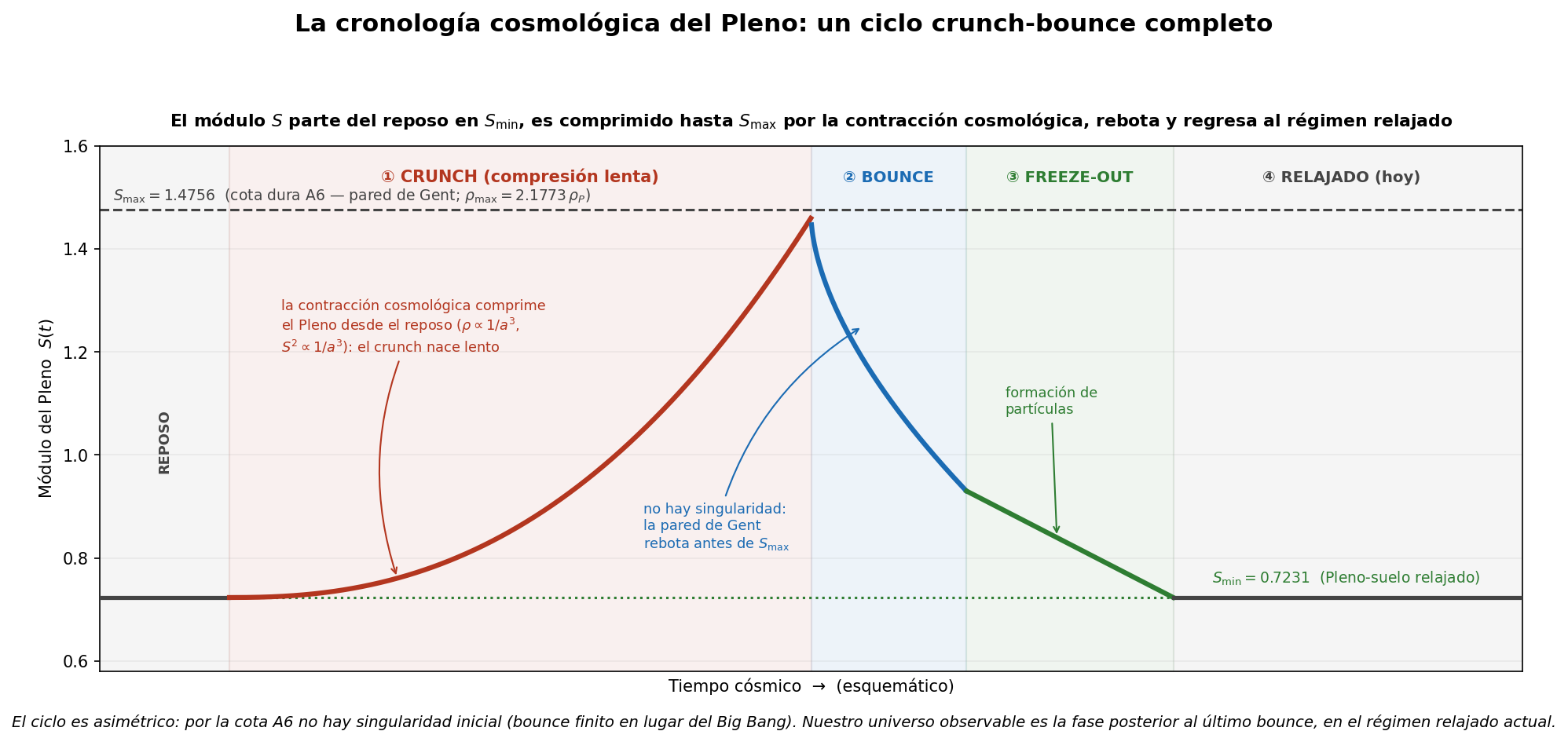
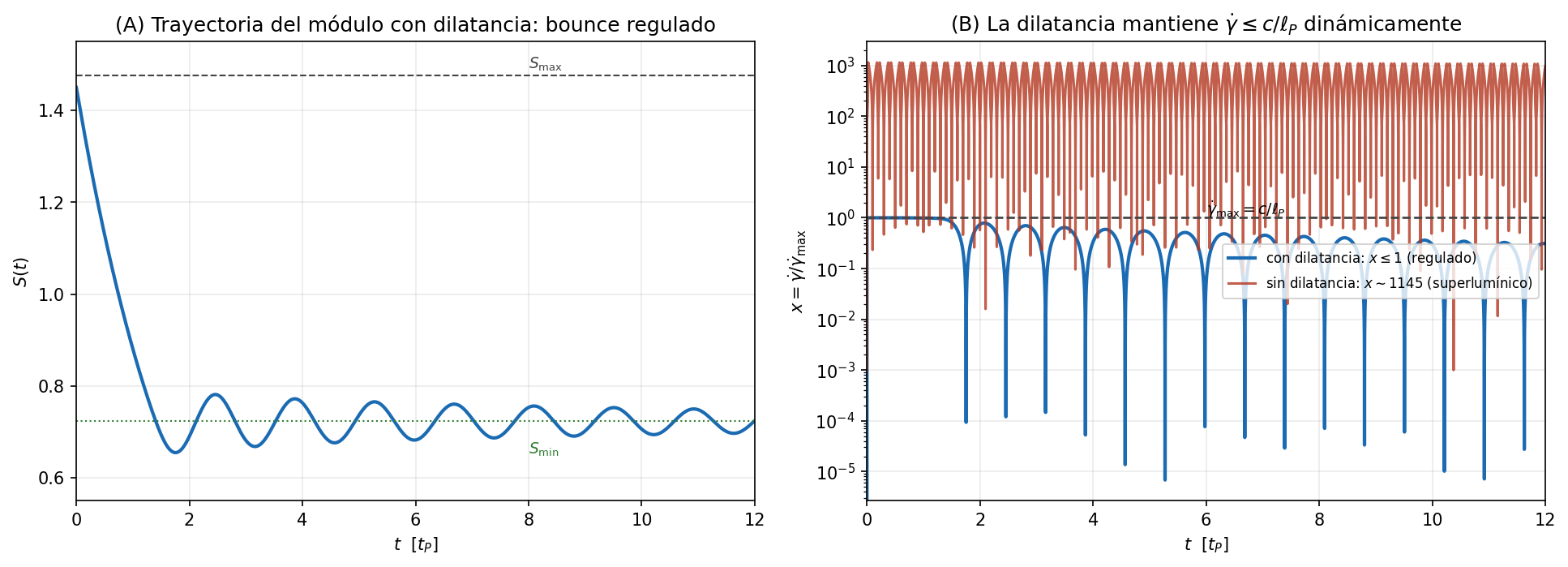
$V_\text{eff}(S_{\min}) = 1.0670\,\rho_Pc^2$: el cero de la escala
El telón es la densidad de energía del suelo del medio: lo que queda de $\rho_\text{Pleno}$ cuando el medio está en reposo. Un telón es el fondo permanente, lo que está detrás de todo y no es parte de la escena. Que el suelo no produce movimiento es teorema: la ecuación de fondo contiene $V'_\text{eff}$ y no $V_\text{eff}$, y es exactamente invariante frente a dónde se ponga el cero de la energía. derivado
Que al vínculo de Friedmann entre el exceso sobre el suelo, y no el suelo mismo, es la lectura EO-Telón: una declaración estructural sobre la fuente, cuyo cero es el coeficiente $a_0$ de la acción inducida, cantidad posicional. calibrado
La forma de $H(z)$, forzada por el potencial
La fuente es $\rho_e = \rho_{m,0}(1+z)^3 + \rho_{EO}$: la materia diluye y la energía oscura, fracción coherente del exceso sobre el telón, es constante en el régimen tardío, con $w = -1$ exacto. El único parámetro de la familia de fondo, $\delta_0$, tiene valor derivado cero. Frente a las cinco distancias $D_H/r_d$ de DESI DR2, ese fondo da $\chi^2 = 6.54$ contra $6.53$ de ΛCDM (P28), con menos libertad. derivado
Lo que evoluciona no es $f_c$ sino el peso relativo $\Omega_{EO}(z) = f_c/[f_c + (1-f_c)(1+z)^3]$, por dilución de la materia.
Tres hechos, y basta uno. Primero: las paredes de Gent y de Klauder solo entran en la dinámica mientras el módulo desciende de $S^*$ al punto de retorno, un tramo de $1.366\,t_P$ (DLF), y a los corrimientos al rojo del BAO el medio lleva $\sim10^{60}$ tiempos de Planck en reposo en $S_{\min}^\text{estr}$, con $\dot{\bar S} = 0$. Segundo: el sector de fase no la porta —su estado fundamental tiene $\dot\theta_0 = 0$ y da $w = -1$ exacto, y las dos alternativas quedan vetadas por álgebra: un condensado que ganara densidad, por fantasma, y un modo de fase que rodara, que diluiría como polvo—. Tercero: el módulo congelado no rueda; oscila con $\omega_S/H_0 = 3.7681\times10^{61}$, y el promedio de $w$ sobre un ciclo de un mínimo cuadrático es cero: es polvo, no energía oscura. De ahí $\delta_0 = 0$ derivado.
Ningún parámetro de ley: dos cantidades de estado y la vara
Los resultados cosmológicos del programa salen sin ajuste, y medir una cantidad de estado del medio no es un ajuste fenomenológico. La ecuación de fondo es de segundo orden (E-LM-1) y pide dos datos iniciales, como toda teoría dinámica. La frontera correcta no es cuántas cantidades se miden, sino cuántas quedan libres después de que la dinámica actúa (§V.5).
| Tipo | Qué es | ¿Deuda? |
|---|---|---|
| Parámetro de ley | Número del lagrangiano ajustado a un dato | Sí — el programa no tiene ninguno |
| Vara | $\rho_P$, $\ell_P$: relación entre el medio y la unidad humana | No |
| Posicional | Dónde está el sistema sobre su trayectoria | No |
El módulo y la fase no aportan lecturas
Sector de módulo: la ecuación de fondo tiene fricción positiva y un solo mínimo en el pozo; toda trayectoria cae a $S_{\min}$ y permanece ahí $\sim10^{60}$ tics. Un atractor borra el dato inicial. derivado Con el factor dilatante la entrada permanente en el $1\,\%$ de $S_{\min}$ llega en unos $40\,t_P$ desde cualquier punto del pozo. DLF
Sector de fase: el estado fundamental tiene $\dot\theta_0 = 0$ y $T_{\mu\nu}\propto g_{\mu\nu}$, con $w = -1$ exacto; $w_0 = -1$ no es una lectura. derivado
El arco y la ocupación
El arco es una sola cantidad escrita en tres unidades: $H_0 = \sqrt{8\pi/3}\,(c/\ell_P)\sqrt{\Theta_0}$, $\Theta_0 = 3/(8\pi N_\text{tic}^2)$, $N_\text{tic} = 1/(H_0\tau_P)$. Con $H_0 = 67.4$ km s⁻¹ Mpc⁻¹, $N_\text{tic} = 8.4918\times10^{60}$ y $\Theta_0 = 1.6553\times10^{-123}$. La identidad es derivado; el valor, calibrado
La ocupación $S^2_{\max,\text{eff}}(t_0)$ fija $f_c$, y la densidad de energía oscura de hoy no es una lectura aparte: $\rho_{EO}/(\rho_Pc^2) = f_c\,\Theta_0 = 1.137\times10^{-123}$ (E-LM-2).
Dos cantidades de estado —el arco y la ocupación—, una escala infrarroja —la congelada del constituyente, anclada a $m_p$— y la vara $\rho_P$, $\ell_P$. Ningún parámetro de ley. derivado
La ocupación, contra un dato ajeno al fondo de microondas
En un fondo plano con $w = -1$, el cociente $F_\text{AP} = D_M/D_H$ depende sólo de $\Omega_m$. Con $\Omega_m = 1 - f_c = 0.3131$ y las seis medidas de DESI DR2, $\chi^2 = 6.669$ sin mover ningún parámetro. La prueba discrimina —$\Delta\chi^2 = 6.86$ para $\Omega_m = 0.35$— y es de compatibilidad, no de selección: $\Omega_m = 0.2975$ da $6.04$.
El arco, contra un reloj que no es el ajuste de otro modelo
La edad adimensional del fondo es $A(1-f_c) = H_0 t_0 = 0.9526$, y una cota inferior sobre la edad fijada por estrellas acota el $H_0$ de fondo: $t_0 \ge 13.5$ Gyr da $H_0 \le 69.0$; $t_0 \ge 13.0$ Gyr, $H_0 \le 71.7$; $t_0 \ge 12.5$ Gyr, $H_0 \le 74.5$ km s⁻¹ Mpc⁻¹. La forma es derivada; las cotas heredan la entrada $\Omega_m$.
Un objeto lleno y acotado: el interior del agujero negro
El Pleno no admite vacío (A1, A2) ni magnitudes sin cota (A6): lo que cae en un agujero negro no desaparece, comprime. El exterior es la métrica de Schwarzschild, leída de la configuración estática del módulo y forzada en su forma por las ecuaciones de Einstein emergentes. El interior lo fija F1, descrito desde el centro hacia fuera (§III.1.10).
Densidad gravitante $1.6545\,\rho_P$; supremo de ocupación $2.1773\,\rho_P$
Gravita el exceso de ocupación sobre el reposo, $\rho_g = \rho_P(S^2 - S^2_{\min})$, como ya se cuenta la energía oscura. Con A6, la densidad gravitante máxima es $\rho_{\max,g} = (S^2_{\max,\text{geom}} - S^2_{\min})\,\rho_P = 1.6545\,\rho_P$. La ocupación total queda por debajo de su supremo, $S^2_{\max,\text{geom}}\,\rho_P = 2.1773\,\rho_P$, tope que ninguna configuración alcanza. derivado
La compresión es tensión: un estado estático y uniforme tiene $T_{\mu\nu}\propto g_{\mu\nu}$ y esfuerzo $p = -\rho_gc^2$. El medio comprimido no empuja, tira, y esa tensión sostiene el objeto contra su propio peso. A la densidad gravitante máxima el radio es $\ell = \sqrt{3c^2/(8\pi G\rho_{\max,g})} = 0.2686\,\ell_P$ (E-AN-1).
$M_{\min} = 0.1343\,m_P$ y $M_* = 0.3489\,m_P$
Una región saturada de radio $\ell$ tiene la masa mínima $M_{\min} = m_P\sqrt{3/[32\pi(S^2_{\max,\text{geom}}-S^2_{\min})]} = 0.1343\,m_P = 2.923\times10^{-9}$ kg (E-AN-2). derivado
La masa decide la clase: con $M_* = m_P\sqrt{81/[128\pi(S^2_{\max,\text{geom}}-S^2_{\min})]} = 0.3489\,m_P$ (E-AN-6), un objeto con $M < M_*$ es compacto y no retiene la luz; con $M > M_*$ es un agujero negro regular, con superficie externa en $r_+ \simeq 2GM/c^2$ e interna en $r_- = \ell$ (P19). derivado
Núcleo a densidad gravitante máxima, que guarda $M/4$; halo de campo radial saturado con $\rho_g \propto r^{-4}$, que guarda $3M/4$ (E-AN-3, E-AN-4). Donde $1 - x_g$ se anula, el cero es de la carta de coordenadas: el invariante de Kretschmann vale $24/\ell^4$ en el núcleo y nunca supera $120/\ell^4$, para ninguna masa. No hay singularidad. El horizonte es la superficie sónica del medio, donde la velocidad de escape iguala la de sus modos (P22, DLF): se pierde la transmisión, no el cambio. derivado
Lo que se observa. Fuera de $r_+$ el objeto coincide con la solución de Schwarzschild salvo por $(Q/M)^2 = 9/(4\lambda)$, que vale $5\times10^{-27}$ para $10\,M_\odot$ y $9\times10^{-31}$ para Sgr A*. La sombra predicha para Sgr A*, con la masa de las órbitas estelares, mide $53.2$ μas frente a un anillo de $51.8\pm2.3$ μas ($0.6\sigma$). El núcleo primordial tiene densidad gravitante universal y no singular, $1.6545\,\rho_P$ bajo el supremo $2.1773\,\rho_P$ (P26, DLF), y es la vía de cierre del cabo C-meta-1.b: lo que la gravedad del núcleo mide es $G\rho_{\max,g} = 1.6545\,c^2/\ell_P^2$.
El tilt: fórmula exacta, signo ligado a $w$
El espectro casi invariante de escala sale sin inflación: en el rebote de materia nativo del Pleno, con $w = 0$ derivado, la variable de Mukhanov-Sasaki escala como el factor de escala y da $n_s = 1$ a orden cero (P29). Un modo $k$ cruza el horizonte en $\eta_k$ cuando $ck = |\mathcal{H}(\eta_k)|$; el tilt lo imprime la ecuación de estado del medio en ese cruce.
$n_s - 1 = \dfrac{12\,w}{1+3w}$
Fórmula exacta · signo derivado · signo rojo como requisito · valor calibrado
El signo del tilt es el de $w_\text{eff}$
Para $-1/3 < w_\text{eff} < 1$, $n_s - 1$ y $w_\text{eff}$ tienen el mismo signo, sin aproximar (E-cosmo-1-bis). derivado
El signo rojo es un requisito
El tilt rojo exige $w_\text{eff} < 0$ en el cruce de horizonte: que los modos de gran escala crucen con el medio del lado diluido del pozo, $\bar S < S_{\min}$. Su realización depende de la cronología del cabo C-VII-05.
Un requisito con número
La banda observada $n_s = 0.965\pm0.004$ exige $w_\text{eff} = -0.0029\pm0.0003$, es decir una fracción de Klauder sobre materia $x = 0.0015\pm0.0002$ en el cruce. La pared de (E-cosmo-0) no la realiza en ningún estado que A6 admita ($x > 81/1024$): queda en C-VII-05.
$0.965$, posicional
El valor exacto depende de dónde sobre la trayectoria del rebote se imprimieron los modos del fondo de microondas: cantidad de estado de tipo B, como $H_0$ y $f_c$ lo son de tipo A. calibrado
No el valor sino la estructura. A medida que avanza el crunch la pared de Gent ($w > 0$) toma el control y los modos pequeños ven $w > 0$: el tilt rojo a gran escala pasa a azul a escala pequeña, y el running $dn_s/d\ln k$ es positivo si la transición se da, frente al negativo que predice la inflación de campo único. Transición contrastable con CMB-S4, LiteBIRD y Lyman-$\alpha$. DLF
ΛCDM vs PIU en el sector oscuro
Los dos marcos reproducen las observaciones cosmológicas dentro de los errores actuales. Lo que los separa no es el ajuste sino el estatus epistémico: qué se postula y qué se deriva en cada caso.
| Aspecto | ΛCDM + Modelo Estándar | PIU-Ψ |
|---|---|---|
| ¿Qué es la materia oscura? | Partícula desconocida fuera del Modelo Estándar (WIMP, axión, neutralino...) | Q-ball del Pleno: solitón sin carga topológica, clase MO ($\delta S > 0$) |
| ¿Por qué no se detecta? | Debería ser detectable — fracaso experimental sin explicación | No es partícula ni tiene acoplamiento gauge — cuarenta años de resultados nulos son lo predicho |
| ¿Qué es la energía oscura? | Constante cosmológica $\Lambda$ (densidad de energía del vacío) | Fracción coherente $f_c$ del exceso del Pleno-suelo sobre el telón ($S \equiv S_{\min}$) |
| Magnitud de $\Lambda$/$\Omega_{EO}$ | Ajuste fino de 123 órdenes frente al cálculo QFT del vacío | Los 123 órdenes son la distancia entre el telón, que no gravita, y el exceso, que sí gravita: el problema desaparece |
| Parámetros libres | $\Omega_{DM}$ y $\Omega_\Lambda$ ajustados independientemente | Ningún parámetro de ley — dos cantidades de estado, una escala infrarroja y la vara (§V.5) |
| Razón $\Omega_{MO}/\Omega_M$ | Ajustada a las observaciones | Derivada: $\sqrt{3}\pi$ — acuerdo $0.86\sigma$ con Planck 2018 |
| Fracciones $\Omega_{EO}$ y $\Omega_m$ | Ajustadas a las observaciones | Estructura derivada, valor calibrado: $f_c = 0.6869$ y $1-f_c = 0.3131$ — una sola comparación a $0.30\sigma$ |
| Estabilidad de la materia oscura | Postulada ad hoc — la partícula debe ser estable o cuasi-estable | Conservación $U(1)$ de Noether (axioma A5): la carga impide el decaimiento de la Q-ball al Pleno-suelo |
| Vía de falsación | Detección directa positiva confirmaría la partícula; sin detección, espera indefinida | Detección directa indiscutible refuta la materia oscura como Q-ball del Pleno; una desviación de las razones derivadas refuta P16 ($\sqrt3\pi$) o P17 ($\Omega_{EO}=f_c$) |
La diferencia clave no es cuál ajusta mejor (ambos ajustan dentro de los errores actuales) sino cuántos ajustes: ΛCDM ajusta dos parámetros libres independientes; PIU deriva la razón entre los dos sectores sin ningún dato y fija el reparto con la misma lectura de estado que fija $H_0$. Esa diferencia es estructural, no estilística.
Cuatro consecuencias para la física moderna
Cuatro reorganizaciones conceptuales
Las dos derivaciones cosmológicas centrales, confrontadas con Planck y con DESI, reorganizan cuatro piezas de la física moderna:
El fracaso de 40 años de búsqueda de materia oscura se explica
La materia oscura es una Q-ball del Pleno, no una partícula puntual, y no porta carga topológica que genere el sector gauge inducido: no emite, no absorbe ni refleja luz, y por eso se detecta solo por su gravedad. La ausencia de detección directa es la consecuencia estructural de lo que la materia oscura es.
Esos experimentos no han sido inútiles: sus resultados nulos han excluido el espacio de parámetros más natural para WIMP y axión y han reorientado la búsqueda hacia regímenes cada vez más exigentes. PIU explica por qué esa búsqueda no encuentra nada.
El problema de los 123 órdenes se disuelve estructuralmente
El ajuste fino de $10^{123}$ es el artefacto de comparar el suelo de energía del medio con la energía oscura observada como si fueran la misma cantidad física. En PIU no lo son: el telón, $V_\text{eff}(S_{\min}) = 1.0670\,\rho_Pc^2$, es el cero de la escala y no gravita; la energía oscura es la fracción coherente del exceso sobre el telón, $f_c\,\Theta_0\,\rho_Pc^2$.
Lo que en ΛCDM aparece como el peor desajuste cuantitativo de la historia de la física se reformula como pregunta legítima con respuesta $O(1)$, $f_c$, y un universo viejo en tics.
El 95 % del cosmos es output, no input
La razón $\Omega_{MO}/\Omega_M = \sqrt{3}\pi$ es un output calculado desde la geometría de la red, sin ningún dato. Las fracciones $\Omega_{EO} = f_c$ y $\Omega_m = 1-f_c$ tienen estructura derivada y un solo valor leído, la ocupación presente. Cantidades que la cosmología estándar trata como perillas libres son, en PIU, consecuencias de un medio único.
Las observaciones de Planck no se descartan ni se reinterpretan: se mantienen como referencia experimental. Lo que cambia es la dirección del flujo lógico: en ΛCDM las observaciones determinan los parámetros; en PIU, las observaciones confirman la razón derivada y leen la posición del medio.
Reducción drástica de parámetros de la cosmología estándar
El modelo cosmológico estándar requiere ajustar $\Omega_M$, $\Omega_b$, $\Omega_\Lambda$, $H_0$ y al menos una decena más de parámetros derivados. PIU deriva $\Omega_{MO}/\Omega_M$ sin ingrediente anclado a dato y fija las fracciones absolutas con uno solo —$S^2_{\max,\text{eff}}$, la posición del medio hoy—. El libro mayor completo cuenta dos cantidades de estado, una escala infrarroja y la vara $\rho_P$, $\ell_P$: ningún parámetro de ley, frente a los aproximadamente diecinueve parámetros libres del Modelo Estándar más los del ajuste cosmológico.
No es una mejora estadística (ambos modelos ajustan los datos comparablemente), sino una reducción radical de los grados de libertad teóricos que la cosmología observada requiere.
Cómo refutar PIU en el sector oscuro
Cuatro vías, cada una con lo que la rompería y con el resultado del corpus que expone.
Detección directa indiscutible de una partícula de materia oscura
Si XENONnT, LZ o cualquier experimento sucesor detecta de manera independientemente verificada una partícula de materia oscura con todas las propiedades requeridas, queda refutada la materia oscura como Q-ball del Pleno: sería partícula real y no configuración del medio.
Desviación de $\Omega_{MO}/\Omega_M = \sqrt{3}\pi$
Planck da $5.375\pm0.077$ y $\sqrt{3}\pi = 5.4414$ queda a $0.86\sigma$. Si CMB-S4, Euclid o Vera Rubin estrechan esa barra a la mitad y el valor central se aparta de $5.4414$ en más de $3\sigma$, queda refutada P16, que es una derivación estructural de la geometría de la red y no un ajuste. Refutarla refuta una pieza central del corpus.
Desviación de $\Omega_{EO} = f_c = 0.6869$
El contenido falsable de la densidad de energía oscura es, entero, $\Omega_{EO} = f_c$. Si refinamientos del análisis del fondo cósmico o experimentos independientes encuentran $\Omega_{EO}$ inconsistente con $f_c$ en más de $3\sigma$, o si $F_\text{AP}$ de DESI deja de ser compatible con $\Omega_m = 1-f_c$, queda refutada la identificación de P17. Como la fracción condensada está bien establecida en física de condensados, el fallo estaría en la identificación cosmológica.
Un residuo de DESI que persista sobre el dato desnudo y exija $\delta_0\neq0$
El programa deriva $\delta_0 = 0$, y ningún sector suyo puede portar otro valor: el módulo está congelado y un modo de fase que rodara diluiría como polvo. Si el residuo de DESI persiste sobre observables desnudos —con las covarianzas completas y sin plantilla CPL— y exige $\delta_0 \neq 0$, la predicción se rompe.
Lo que también rompería el sector
Que la señal $w_0$–$w_a$ persista en observables modelo-independientes en lugar de disolverse, o se consolide en $w_0 < -1$, región que la positividad de la cinética veta. Que el desplazamiento predicho de $S_8$ por el arrastre de fase contradiga el dato de lentes débiles: el signo está derivado, y un signo contrario no admite acomodo. Y que los valores de $S_{\min}$ inferidos de nucleosíntesis, fondo cósmico y BAO resulten mutuamente inconsistentes.
El fondo tiene $w = -1$ exacto —derivado, no ajustado: el condensado de fase en $S_{\min}$ da $T_{\mu\nu} \propto g_{\mu\nu}$, y la positividad de la cinética veta $w < -1$—. Frente a las cinco distancias $D_H/r_d$ de DESI DR2, ese fondo rígido da $\chi^2 = 6.54$ contra $6.53$ de $\Lambda$CDM. Y sobre el cociente de Alcock-Paczyński $F_\text{AP} = D_M/D_H$, que cancela $r_d$, la calibración de la muestra de supernovas y toda escala absoluta, da $\chi^2 = 6.669$ en seis puntos con cero parámetros ajustados (E-AP-2), con $\chi^2/\text{dof} = 1.111$, $p = 0.35$ y ningún residuo por encima de $1.69\sigma$. Medida ahí, la señal $w_0$–$w_a$ baja de $2.8$–$4.2\sigma$ a $1.3\sigma$: la disolución predicha se cumple en su forma débil —atenuación— y no en la fuerte.
El fondo, cerrado y confrontado; el crecimiento, en curso
Las razones del sector están fijadas —$\Omega_{MO}/\Omega_M = \sqrt3\pi$ a $0.86\sigma$, y $\Omega_{EO} = f_c$ con $\Omega_m = 1 - f_c = 0.3131$ en una sola comparación a $0.30\sigma$—, la forma de $H(z)$ la fuerza el potencial efectivo, la corrección no lineal de las paredes es nula, y $\delta_0$, único parámetro de la familia de fondo, tiene valor derivado cero. El libro mayor no cuenta ningún parámetro de ley. Lo que resta no es teoría del fondo: es la capa del análisis combinado, la amplitud de $S_8$ y la cronología del espectro primordial.
La capa del análisis combinado, y la amplitud de $S_8$
Falsable · confrontación · severidad baja · prioridad subordinadaSobre el dato desnudo la confrontación está hecha. Lo que permanece es la capa del análisis combinado —$r_d$ del fondo cósmico, muestra de supernovas, plantilla CPL—, donde la señal $w_0$–$w_a$ baja a $1.3\sigma$ sin anularse. Criterio de cierre: rehacer el análisis con las covarianzas completas y sin la plantilla CPL, y decidir cuál de las dos capas sostiene el residuo. Depende además de un dato móvil, el paso de DR2 a DR3.
Y la amplitud de $S_8$ desde el arrastre de fase: el mecanismo y el signo están derivados —una supresión del crecimiento en la dirección de la amplitud observada—, y la magnitud exige la dinámica acoplada de perturbaciones, contrastada contra distorsiones en el espacio de redshift y cizalla cósmica crudas.
Cronología de la impresión del espectro primordial
Subordinado a C-VII-01 · computacional · severidad media · prioridad mediaCuántos e-folds abarca cada rama del cruce $Z=12\to Z=4$. Junto con C-VII-01 decide si el tilt recorre su rango entero dentro de la ventana observable, y con él el running $dn_s/d\ln k$; es donde se realizan el signo rojo y la pequeñez que §06.09 fija como requisitos.
El inventario completo —veinte cabos, ninguno portante: cinco falsables y quince de enriquecimiento, más siete subordinados y una vía de verificación, cada uno con su categoría, su severidad y su criterio de cierre, y las cinco fronteras declaradas— está en §11 Abiertos, junto con la invitación a la comunidad científica a revisar, verificar y extender.
The dark sector, derived from the same Pleno.
Four decades of direct searches have not detected any dark-matter particle. The cosmological constant is the largest quantitative mismatch in history between theory and observation. PIU gives a structurally different answer: dark matter and dark energy are not separate exotic entities, but two configurations of the same Pleno, derived from the same F1. The ratio $\Omega_{MO}/\Omega_M = \sqrt{3}\pi$ follows from the geometry of the lattice with no datum at all and lands $0.86\sigma$ from Planck 2018; the dark-energy fraction $\Omega_{EO} = f_c$ has a derived structure and a value that reads the present occupation of the medium, at $0.30\sigma$.
How we discovered that 95% of the universe was invisible to us
The dark sector is not a theoretical invention: it emerges from robust and reproducible astronomical measurements made over nearly a century by independent teams using completely different instruments. The accumulation of evidence is one of the most solid steps in the observational program of modern physics.
Zwicky observes galaxies moving too fast
Fritz Zwicky Zwicky 1933 measures the velocity dispersion of galaxies in the Coma cluster. Applying the virial theorem, he finds the total luminous mass is insufficient by a factor ~400 to keep the cluster gravitationally bound. He postulates that additional invisible matter exists: the first historic mention of dark matter.
Rubin and Ford confirm: dark matter is in all galaxies
Vera Rubin and Kent Ford measure rotation curves of dozens of spiral galaxies. They systematically find that orbital velocities stay roughly constant out to the visible edge of each galaxy, rather than decaying as luminous matter predicts. The explanation: each galaxy is embedded in a dark-matter halo much more massive than the luminous matter.
Perlmutter, Riess and Schmidt: the universe's expansion accelerates
Three independent teams Perlmutter–Riess–Schmidt 1998 measure distances to Type Ia supernovae (standard candles) and discover that distant supernovae are farther away than expected. The interpretation: the universe's expansion is accelerating. This requires an energy component with negative pressure filling space. The concept of dark energy is born. Nobel Prize in Physics 2011.
Planck measures the universe's fractions to ~1%
The Planck collaboration Planck 2018 publishes the final analysis of the cosmic microwave background: $\Omega_M = 0.315 \pm 0.007$ (total matter), $\Omega_b = 0.049 \pm 0.001$ (baryonic matter), $\Omega_\Lambda = 0.685 \pm 0.007$ (dark energy). From here: $\Omega_{DM} = \Omega_M - \Omega_b \approx 0.265$. Known baryonic matter is barely 5% of the cosmos. The remaining 95% is the sum of dark matter and dark energy.
A signal in dark energy — its reading in PIU-Ψ
The DESI experiment DESI 2024-25 publishes results on baryon acoustic oscillations (BAO) that, fit with the $w_0$–$w_a$ parametrization, yield a preference for an evolving equation of state ($w_0 > -1$) instead of the strict cosmological constant $w = -1$. PIU-Ψ reads it differently: the equation of state of the late sector is $w = -1$ exact —the phase condensate at $S_{\min}$ has $T_{\mu\nu} \propto g_{\mu\nu}$, with no rest frame and no kinetics to displace it—, and the $w_0$–$w_a$ signal is an artifact of forcing a medium with $w = -1$ exact into that fitting template, not a physical deviation. On the bare datum the signal drops from $2.8$–$4.2\sigma$ to $1.3\sigma$ (P35). What remains, thread F-cosmo, is the combined-analysis layer: confrontation with third-party catalogues, not theory.
These measurements, made with completely different instruments by independent teams, converge on the same quantitative conclusion: the material content of the universe is dominated by two components —dark matter and dark energy— whose physical nature the standard model does not derive. That is the question PIU answers.
The dominant option: postulate two independent components
The standard cosmological model ΛCDM, combined with the Standard Model of particle physics, responds to the dark sector through two independent hypotheses:
Dark matter — particle hypothesis
It is assumed that there exists a new particle beyond the Standard Model (WIMP, axion, neutralino, sterile neutrino, etc.) with the required properties: massive, cold (non-relativistic at decoupling), electrically neutral, weakly interacting. The density $\Omega_{DM}$ is a free parameter of the model, fit to observations.
Experimental status after 40 years of search:
- Direct detection: XENON, LUX, PandaX, DAMA — no conclusive detection; progressively tighter bounds that have been excluding the most natural parameter regions.
- Indirect detection: Fermi-LAT, IceCube, AMS-02 look for annihilation products — no robust signal.
- Colliders: the LHC searches for direct production — no detection.
Dark energy — the cosmological constant $\Lambda$
It is assumed that there exists a constant vacuum energy density $\rho_\Lambda$, with equation of state $w = -1$. Its observed value is $\rho_\Lambda \approx 6 \times 10^{-10}$ J/m³. The density $\Omega_\Lambda$ is another free parameter, fit to observations.
The quantitative problem: the QFT calculation of the vacuum produces an energy density $\sim 10^{113}$ J/m³, which exceeds the observed value by 123 orders of magnitude. It is the worst quantitative prediction in the history of modern physics. For ΛCDM to work, the natural calculation must cancel against a counterterm with precision $10^{-123}$: extreme fine-tuning without derived justification.
What ΛCDM does not answer
- What ontologically is dark matter?
- What ontologically is dark energy?
- Why do they have the specific proportions $\Omega_{DM} \approx 0.265$ and $\Omega_\Lambda \approx 0.685$?
- Why is $\Lambda$ neither zero nor Planckian, but exactly the observed value?
- Why, after 40 years of searching, has the dark-matter particle not been detected?
ΛCDM works as a successful phenomenological fit, but leaves all these questions open. Searching for physical answers to them is one of the central problems of contemporary physics.
One single substance, two configurations — derived from F1
PIU's answer is structurally different: there are not two separate exotic entities, there is one single substance —the Pleno— in two physically distinct configurations. Both come from the same effective potential $V_\text{eff}(S)$ of F1: the same mathematical structure gives dark matter and dark energy.
Q-balls of the Pleno: solitons without topological charge
Dark matter is the MO class of solitons of the Pleno: Q-ball configurations Coleman 1985, with $\delta S > 0$ above the Pleno-ground and short of saturation. Its internal phase rotates, and that rotation is its $U(1)$ Noether charge, global, not the gauge charge that couples to the photon.
Stability: the $U(1)$ symmetry of axiom A5 gives a conserved Noether current; the total charge prevents the decay of the Q-ball to the Pleno-ground. derived
Quantization: topologically contractible sub-target Hatcher 2002 $\Rightarrow$ Finkelstein-Rubinstein 1968 $\Rightarrow$ $\chi_{FR}^{MO} = +1$ (bosonic statistics forced).
Observational consequence: it is neither a point particle nor gauge-coupled. It neither emits nor absorbs light: it bends it (it gravitates) without absorbing it. That is why XENON, LUX and PandaX do not detect it, and forty years of null results are what the program predicts.
The Pleno-ground and its coherent fraction
Dark energy is the Pleno-ground: the minimum coherent configuration $S \equiv S_{\min}$ with global phase and $\dot\theta_0 = 0$. It is neither a particle nor an aggregate entity: it is the base state of the medium itself.
The curtain and the excess: the floor of the potential, $V_\text{eff}(S_{\min}) = 1.0670\,\rho_Pc^2$, is the curtain: the zero of the scale, which does not gravitate. What gravitates is the excess over it, $\Theta\,\rho_Pc^2$, and dark energy is the coherent fraction of that excess, $\rho_{EO} = f_c\,\Theta_0\,\rho_Pc^2$ (E-EO-esc). This is the DE-Curtain reading.
The fraction: the condensate fraction $f_c$ of Bogoliubov-Yukalov theory Bogoliubov 1947 · Yukalov 2007 measures which part of that excess remains in the coherent mode against the part already depleted into excitations. The identification $\Omega_{EO} \equiv f_c = 0.6869$ is P17 of the catalogue: the structure is derived —the denominator $S_{\max,\text{geom}}^2$ follows from Kepler-Hales— and the value inherits the status of its numerator $S_{\max,\text{eff}}^2$, the present occupation of the medium, of the same type as $H_0$. derived calibrated
Conceptual consequence: the curtain amounts to $4.9433\times10^{113}$ J/m³ and the observed dark energy $5.25\times10^{-10}$ J/m³: the discrepancy of $123.0$ orders is exactly the distance between the floor that does not gravitate and the excess that does, and it appears only if the two are confused. Kept apart, there is nothing to cancel.
Second route: the dimensionless cosmological density admits an exact factorization, $\Theta_0 = \dfrac{3}{8\pi\,N_{\text{tic}}^2}$, where $N_{\text{tic}} = 1/(H_0\tau_P) = 8.4918\times10^{60}$ is the Hubble age measured in Planck ticks (with $H_0 = 67.4$ km s⁻¹ Mpc⁻¹, $\Theta_0 = 1.6553\times10^{-123}$). The famous "$10^{-123}$" is, up to the geometric ratio of the coupling, the inverse square of the age of the universe in ticks. There is no 123-order fine-tuning: there is an old universe. The identity is derived; the value of $\Theta_0$ is a state quantity read from the present universe, and all the observational freedom is confined to it. derived calibrated
The same mathematical structure generates both sectors. The potential $V_\text{eff}(S)$ has its minimum at $S_{\min}$, where the Pleno-ground rests, whose coherent excess is dark energy, and admits excitations $\delta S > 0$ above it, the Q-balls of dark matter. A single mathematical object gives two observational consequences that standard cosmology treats as independent.
ΛCDM is not replaced: it is grounded
The program's cosmological paper (published on Zenodo) establishes a precise thesis: ΛCDM is the effective limit of PIU-Ψ, just as thermodynamics turned out to be the macroscopic limit of statistical mechanics. It is not a rival model; it is the description that emerges when the medium's kinetics switches off and the walls of the potential fall out of reach.
ΛCDM : PIU :: thermodynamics : statistical mechanics
The background equation of the Pleno is second order, that of a nonlinear oscillator against a hard wall; its linear limit near the floor reproduces Friedmann's first-order constraint, with the source $\rho_{m,0}(1+z)^3 + \rho_{EO}$, which is the ΛCDM form over the whole observable epoch. The nonlinear correction of the walls to late $H(z)$ is zero, not small: at BAO redshifts the medium has been at rest for $\sim10^{60}$ Planck times. derived
The whole thesis fits in a single background equation: the medium's dynamics collapses to the Friedmann equation in the limit where its kinetics switches off, and the divergence from FLRW lives in the nonlinear regime of the walls, far from the epoch that is observed.
Not anomalies: readings under a foreign template
The live tensions of cosmology appear not as causeless failures, but as the edge where an effective description is used outside its domain. The Hubble tension and the DESI signal are artifacts of analysing a medium with $w = -1$ exact under the ΛCDM template; the $S_8$ tension is a phase drag whose local sign is derived.
This is the heart of why "95% is geometry": the dark sector is not parametrized ignorance, but two configurations of a medium with its nature derived and its proportion fixed by geometry.
$H_0$ as a state reading (type A)
$H_0$ is not a constant of nature but the time on a clock: a positional quantity of type A, which depends on the arc travelled. The Hubble tension is an artifact of method (P32): the "primordial" $H_0$ is the one ΛCDM needs to reproduce the microwave background, and analysing a medium with $w=-1$ exact under that template biases the inference. The tension dissolves in model-independent observables. SLD
The $w_0$–$w_a$ signal as an artifact of the template
The dynamical dark-energy signal appears when a medium with $w=-1$ exact is forced into the $w_0$–$w_a$ parametrization; it is not a background evolution. On the ratio $F_\text{AP}=D_M/D_H$, which cancels $r_d$ and any absolute scale, the $w=-1$ exact background gives $\chi^2 = 6.669$ over six DESI DR2 points with zero fitted parameters, and the $w_0$–$w_a$ signal drops from $2.8$–$4.2\sigma$ to $1.3\sigma$: it attenuates without vanishing (P35).
Growth suppression by phase drag
Phase perturbations $\delta\theta$ drag matter through a ponderomotive force, a pure momentum-transfer coupling whose net effect on the growth rate is suppression: the direction of the observed $S_8$ amplitude. The local sign of the force is derived and its localization at $z\to0$ is SLD; the magnitude requires the full coupled dynamics and is part of thread F-cosmo.
A bound the framework imposes: with the split $\Omega_m = 1-f_c$, the same background fixes a ceiling on the dimensionless age of the universe, $A(1-f_c) = H_0 t_0 = 0.9526$ (E-LM-4). Exceeding it requires a growing dark-energy density —the phantom region $w < -1$, which the positivity of the kinetics vetoes—, and even that is not enough: $w \lesssim -1.44$ is needed. The exact statement is not that the structure of the source forbids $A>1$ but that it forbids it with the split $\Omega_m = 1-f_c$, and by four to one: the ceiling moves $1.8\,\%$ over the whole plausible range of $\Omega_m$, while the local $H_0$ would require $A = 1.0293$, $8.1\,\%$ above it; outside that range the bound is lost, and $\Omega_m = 0.2629$ already gives $A=1$ with $w=-1$. Since the target $t_0$ is an output of a fit, the exclusion of the local value as background is SLD
Where each number comes from
Each quantitative result of the dark sector in PIU has a derivation traceable to F1, the diamond lattice and established mathematical results. Attributions are explicit: each theorem used carries the author's name and year.
Three questions, with their answer
Question 1 — Is it post hoc? A compact formula like $\sqrt{3}\pi$ matching an observed value would be numerology if its components had been chosen after the target value was known. Here each factor comes from an established pillar: the thermodynamic weight of each class is proportional to its area; the spinor factor $1/2$ is the exact ratio of the Haar volumes of $SO(3)$ and $SU(2)$ Peter–Weyl 1927; and the two areas are that of the sphere, $4\pi R^2$, which the isoperimetric theorem imposes on the uncharged defect, and that of the coordination tetrahedron of the diamond lattice, $(8\sqrt{3}/3)R^2$, to which the winding anchors the charged defect. The chain of reasoning is what distinguishes a derivation from a numerical coincidence.
Question 2 — Which alternative geometries are excluded? The sphere is forced by the isotropy of F1. The tetrahedron depends on the lattice, and the diamond lattice $Z=4$ is derived in its two pieces —coordination and stacking— by four arguments from independent domains: the DGS bound on 2-designs, the condensation of the phase, Finkelstein-Rubinstein and Russo-Tanaka (§III.6.4). $\sqrt{3}\pi$ rests on a derived geometry, not on a motivated choice. Moreover, enumerating 3778 algebraic expressions of comparable complexity gives a factor $K_c \approx 6.71\times10^5$ against reading $\sqrt{3}\pi$ and $f_c$ as lucky formulas.
Question 3 — What does $f_c$ depend on, and which of its two pieces is calibrated? $f_c$ is the ratio $S_{\max,\text{eff}}^2/S_{\max,\text{geom}}^2$, and the two pieces have different status. The denominator $S_{\max,\text{geom}}^2 = (8/3)\sqrt{2/3} = 2.1773$ is a derived theorem: it follows from Kepler-Hales packing applied to the saturated diamond lattice, with no datum involved. The numerator $S_{\max,\text{eff}}^2 = 1.4956$ is the effective occupation level of the condensate: its physical nature is derived and its value is a state quantity, the position of the medium on its relaxation curve, anchored to the present partition. That is why the $0.30\sigma$ of $\Omega_{EO}$ is consistency of the calibration —its margin, $0.32\,\%$, is smaller than Planck's bar carried over to the numerator, $1.07\,\%$—, and what is tested is the structure: that the split exists and that its two populations are configurations of the same medium.
A nuance that strengthens the confrontation. Not all "Planck values" have the same status, and PIU confronts each result against the appropriate level. The ratio $\Omega_{MO}/\Omega_M = \omega_{dm}/\omega_b$ is robust: the $h^2$ factor cancels in the quotient, so it is compared against the relative heights of the acoustic peaks of the cosmic background, almost without assuming anything about late-time cosmology. ΛCDM cannot choose that number to match PIU: the peaks fix it with little freedom. At the other extreme, $\Omega_{EO}=f_c$ is confronted against a model-dependent parameter. The two agreements do not weigh the same, and the hierarchy is written next to each figure.
Native to the Pleno versus human yardstick. The three ratios of this section —$\sqrt{3}\pi$, $f_c$, $S_{\min}$— are dimensionless numbers: the Pleno fixes them by its geometry, without any meter or second appearing. They are the Pleno speaking in its own language. The human yardstick enters only at the end, when we compare against what Planck measures. With one caveat inside $f_c$: its numerator $S_{\max,\text{eff}}^2$ is not a dimensional yardstick but a positional quantity —the medium’s state today, analogous to $H_0$—; that is why $f_c$ carries the calibrated label in its value, and not from fitting to Planck. The denominator, $S_{\max,\text{geom}}^2$, is derived.
$\Omega_{MO}/\Omega_M = \sqrt{3}\pi$
Zero free parameters · zero observational input · 0.86σ agreement against Planck 2018
Not a product of three constants, but a ratio that simplifies. The ratio is not built by multiplying pieces. It is obtained by comparing the partition functions of the Pleno's two sectors —baryonic matter (M) and dark matter (MO)—: the full quotient is written, and almost everything cancels. What survives is $\sqrt{3}\pi$. The corpus proves it factor by factor (P16 of the catalogue, §III.6.3 and §III.6.5):
What cancels
The classical action and the normalization are identical in both sectors —same saturation level, same asymptotic boundaries— and cancel exactly to 1. They do not contribute to the result.
The 1/2 factor — moduli volume
$\text{Vol}(SO(3))/\text{Vol}(SU(2)) = \pi^2/2\pi^2 = 1/2$, exact Haar ratio. It affects only ordinary matter M, fermionic, which suffers this reduction when projecting to observables. In the formula it appears dividing in M's denominator, not as a loose factor.
Pillar: Peter–Weyl 1927 theorem on compact groups, $SO(3)\cong SU(2)/\mathbb{Z}_2$. Exact, no approximation.
The area ratio — surface
The Gent wall confines the fluctuations of the modulus to a shell: the surface dominates, and the surface determinant gives the sphere/tetrahedron area ratio, $A_S/A_T = 4\pi R^2/(8\sqrt{3}/3)R^2$, with the same $R = \ell_P$ in both. The equality of the surface factors is protected by Gauss-Bonnet: sphere and tetrahedron are both topologically $S^2$.
Pillar: coordination tetrahedron of the diamond lattice —the four bonds of norm $\ell_P$— for M; isoperimetric sphere for MO (§III.6.4).
What distinguishes but does not count
Finkelstein-Rubinstein statistics make M fermionic and MO bosonic ($\chi_{FR}=-1$ vs $+1$), but in the mean densities it enters as $|\chi_{FR}|^2 = 1$: it does not contribute to the ratio. It distinguishes the quantum nature, not the cosmological ratio.
Theorem: Finkelstein–Rubinstein 1968; stability by Peierls 1940 · Nabarro 1947.
That is why $\sqrt{3}\pi$ is not the heuristic product of three constants: it is the result of a controlled thermodynamic computation where two factors cancel to one, one does not contribute, and what survives is the area ratio with the spinor penalty dividing in the M sector. Each factor has an explicit derivational origin.
PIU: $\sqrt{3}\pi = 5.4414$ · Planck 2018: $5.375 \pm 0.077$ · Agreement: 0.86σ · Free parameters: 0
Corpus result, P16 of the master catalogue (§III.6.3), derived. Enumerating the space of simple algebraic formulas strongly disfavours reading this ratio as an algebraic coincidence: the probability that two expressions of comparable complexity reproduce both $\sqrt{3}\pi$ and $f_c$ within $2\sigma$ is below $3\times10^{-4}$, a factor $K_c \approx 6.71\times 10^5$. That figure bounds formulas, not frameworks; the evaluation of the program as a whole is computed separately (§V.2.6) and the two are not combined. Full bibliography with attributions in §12.
$\Omega_{EO} = f_c = 0.6869$
Derived structure · calibrated (positional) value · 0.30σ agreement against Planck 2018
Where each piece comes from:
Condensed fraction
In a quantum condensate with repulsive interactions, $f_c$ is the fraction that remains in the coherent ground state, against the fraction depleted by quantum fluctuations. In the Pleno, $f_c$ is the fraction of Planckian quanta still in the condensed mode against the total that the geometry of the diamond lattice can hold.
Origin: theory of Bogoliubov 1947; modern extension and detailed computations in Yukalov 2007.
Effective occupation of the present regime
The effective occupation level of the coherent mode of the Pleno-ground under quantum depletion. It is not a dimensional yardstick but a positional state quantity: its physical nature is derived, and its present value encodes where the medium sits on its relaxation curve, just as $H_0$ does in any cosmology. It is the only ingredient anchored to data in this whole chain.
Geometric hard bound
The maximum geometric occupation of the Pleno, the hard saturation bound of axiom A6. It is a derived theorem —Kepler-Hales applied to the saturated Pleno—, not an adjusted reference: $S_{\max,\text{geom}}^2 = (8/3)\sqrt{2/3} = 2.1773$ follows from packing geometry and from no datum.
Model: saturable topological potential Gent 1996 for elastic media.
$\Omega_{EO} \equiv f_c$
Observed dark energy is the coherent fraction of the excess over the curtain, not the total energy of the floor. The fraction $f_c$ fixes the observable magnitude. This identification is the corpus result recorded as P17; its companion, $\Omega_m = 1 - f_c = 0.3131$, is P27.
PIU: $f_c = 0.6869$ · Planck 2018: $0.6847 \pm 0.0073$ · Agreement: 0.30σ · One ingredient anchored to data ($S_{\max,\text{eff}}^2$, positional)
By flatness, $\Omega_m = 1 - f_c = 0.3131$ against $0.3153 \pm 0.0073$ is the same comparison, at $0.30\sigma$, not a second agreement. The margin falls below Planck's bar carried over to the numerator, so it reads as consistency of the calibration; what is tested is the structure of two populations of the same medium. The ratio $\sqrt{3}\pi$, by contrast, has no anchored ingredient and is a full confrontation.
Corpus results P17 and P27 of the master catalogue, structure derived, value calibrated. Separating the curtain, which does not gravitate, from the excess, which does, structurally dissolves the 123-orders problem.
$S_{\min}^{\text{estr}} = \dfrac{12(\pi^2-4)}{\pi^4} = 0.7231$
Derived closed form · structural theorem, not a parameter
A closed form, from a single spectral ratio. The spectral form factor of the band —the average of the real discrete Laplacian divided by that of its parabolic approximation, over the zone of the cubic sublattice $a\mathbb{Z}^3$— yields $12(\pi^2-4)/\pi^4$ directly, with no reference to the potential. What the effective potential adds are three checks that could fail and do not:
The ratio over the cubic cell
With the discrete Laplacian $D_{\text{lat}} = 16 - |f(\mathbf{k})|^2$, the ratio $\langle D_\text{lat}\rangle_\text{cub}/\langle D_\text{lat}^\text{par}\rangle_\text{cub}$ over the zone of the cubic sublattice gives $S_{\min}^{\text{estr}} = 12(\pi^2-4)/\pi^4$ as a closed form, with no reference to the potential.
Framework: analytic average over the cubic reciprocal cell $[-\pi/a,\pi/a]^3$, verified by numerical integration: $\langle D_\text{lat}\rangle_\text{cub} = 12 - 48/\pi^2 \approx 7.1366$ (§II.3.8), with the apparatus of crystal-lattice dynamics Maradudin–Montroll–Weiss–Ipatova 1971.
Minimum of the potential
Solving $V'(S) = 0$ over the full effective potential —bare potential, Klauder wall and Gent bound— gives the same minimum, by a completely different route.
What it proves, and what it does not
Both paths give the same number because $E_0$ is solved from that equality —one equation, one unknown—, and the residue, $8.4\times10^{-18}$, measures the exactness of the solution. Fitting one parameter to a datum never confirms that datum.
What is established
Three checks that can fail, and all three pass: that $E_0$ come out positive and of order unity —$4.2546\,\rho_P c^2$—; that the extremum be non-degenerate —the derivative of the solution at $S_{\min}$ is $-54.16$—; and that the crossing be unique in $(0,\,S_{\max,\text{geom}})$. The tripartite potential admits the spectral minimum as its only well-defined floor.
$S_{\min}^\text{estr}$ is structurally derived, not a parameter (P18). Its closed form, $12(\pi^2-4)/\pi^4$, is the spectral form factor of the lattice, with no reference to the potential. The coincidence of the two routes is an identity by construction —$E_0$ is solved from it—; what the potential confirms are the three checks that could fail.
From bounce to rest: the relaxation law and the curtain
The homogeneous background of the Pleno satisfies a second-order equation, that of a nonlinear oscillator against a hard wall, with the viscous damping that F1 derives from the flexural sector: $\ddot{\bar S} = \dot{\bar S}^2/\bar S - \tfrac34\,\bar S^2\,V'_\text{eff}(\bar S) - \dfrac{\gamma_0}{1-x}\,\dot{\bar S}$, with $\gamma_0 = 0.1027/t_P$ (E-LM-1). The whole cosmological background follows from it: the singularity-free bounce, the settling at $S_{\min}$, the relaxation law and the form of $H(z)$.
No shear, no rate ceiling of its own
The homogeneous and isotropic background has deformation rate $D_{kk} = 3H$ and an identically vanishing traceless part (E-vol-1): the background has no shear. The bound $\dot\gamma_{\max} = c/\ell_P$ is a shear bound, and on the background it holds vacuously; A6 bounds the value of the modulus, not its rate. derived
The rate of the background is fixed by the energy: $x^2 = 6T/(\rho_Pc^2)$ (E-vol-2), a rigorous upper bound for every trajectory, finite from any release point and with no fixed ceiling. The supremum of $H$ in the Friedmann constraint, evaluated at the density that gravitates at the ceiling, is $H_{\max} = 6.9056\times10^{43}$ s⁻¹ with minimum horizon $\ell = 0.2686\,\ell_P$ (P20), and its quotient with the shear bound is the exact ratio $H_{\max}/\dot\gamma_{\max} = \sqrt{8\pi/3}\,\sqrt{S^2_{\max,\text{geom}}-S^2_{\min}} = 3.7230$ (P33): a ratio, not an equality. derived
$\dot{\bar S} = -\tfrac12\,\bar S\,x(\bar S)$ and $|H| = x/3$
The equation integrates once without approximation (E-slow-1), and the full law becomes an autonomous first-order equation in the deformation rate $x$, with $\dot{\bar S} = f(\bar S) = -\tfrac12\bar S\,x(\bar S)$ (E-slow-2), which reproduces the time integration to $3\times10^{-9}$; on the driven branch the rate has explicit form (E-slow-3). SLD
The continuity law and the definition of $x$ give an identity: the deformation rate is the expansion rate, $|H| = x/3$ (E-slow-4, P37). derived On the dilatant trajectory the maximum is $|H| = 0.3317\,c/\ell_P$, the medium overshoots $S_{\min}$ down to $\bar S = 0.6222$ —the same turning point for every release with $S^*\gtrsim0.90$— and settles within $1\,\%$ of $S_{\min}$ in $39.9\,t_P$. SLD
$V_\text{eff}$ exceeds any finite value before $S_{\max,\text{geom}}$. With the total energy finite and non-increasing, $\bar S(t) \le V_\text{eff}^{-1}(E_\text{tot}) < S_{\max,\text{geom}}$ for all $t$ (E-vol-3): the dynamics respects A6 with no added mechanism. The brake comes from the hyperelastic component $W_\text{bare}$ and the Gent term $V_\text{topo}$ —the wall of $V_\text{eff}$—; neither the viscous damping nor its dilatant factor intervenes. derived
$V_\text{eff}(S_{\min}) = 1.0670\,\rho_Pc^2$: the zero of the scale
The curtain is the energy density of the floor of the medium: what remains of $\rho_\text{Pleno}$ when the medium is at rest. A curtain is the permanent backdrop, what stands behind everything and is not part of the scene. That the floor produces no motion is a theorem: the background equation contains $V'_\text{eff}$ and not $V_\text{eff}$, and is exactly invariant under where the zero of energy is placed. derived
That the Friedmann constraint receives the excess over the floor, and not the floor itself, is the DE-Curtain reading: a structural declaration about the source, whose zero is the coefficient $a_0$ of the induced action, a positional quantity. calibrated
The form of $H(z)$, forced by the potential
The source is $\rho_e = \rho_{m,0}(1+z)^3 + \rho_{EO}$: matter dilutes and dark energy, the coherent fraction of the excess over the curtain, is constant in the late regime, with $w = -1$ exact. The only parameter of the background family, $\delta_0$, has derived value zero. Against the five $D_H/r_d$ distances of DESI DR2, that background gives $\chi^2 = 6.54$ against $6.53$ for ΛCDM (P28), with less freedom. derived
What evolves is not $f_c$ but the relative weight $\Omega_{EO}(z) = f_c/[f_c + (1-f_c)(1+z)^3]$, through the dilution of matter.
Three facts, and one suffices. First: the Gent and Klauder walls enter the dynamics only while the modulus descends from $S^*$ to the turning point, a stretch of $1.366\,t_P$ (SLD), and at BAO redshifts the medium has spent $\sim10^{60}$ Planck times at rest at $S_{\min}^\text{estr}$, with $\dot{\bar S} = 0$. Second: the phase sector does not carry it —its ground state has $\dot\theta_0 = 0$ and gives $w = -1$ exactly, and the two alternatives are vetoed by algebra: a condensate that gained density, by going phantom, and a phase mode that rolled, which would dilute as dust—. Third: the frozen modulus does not roll; it oscillates with $\omega_S/H_0 = 3.7681\times10^{61}$, and the average of $w$ over a cycle of a quadratic minimum is zero: it is dust, not dark energy. Hence $\delta_0 = 0$ derived.
No law parameter: two state quantities and the yardstick
The cosmological results of the program come out without fitting, and measuring a state quantity of the medium is not a phenomenological fit. The background equation is second order (E-LM-1) and asks for two initial data, as every dynamical theory does. The right boundary is not how many quantities are measured, but how many remain free after the dynamics acts (§V.5).
| Type | What it is | Debt? |
|---|---|---|
| Law parameter | A number of the Lagrangian fitted to a datum | Yes — the program has none |
| Yardstick | $\rho_P$, $\ell_P$: relation between the medium and the human unit | No |
| Positional | Where the system sits on its trajectory | No |
The modulus and the phase contribute no readings
Modulus sector: the background equation has positive friction and a single minimum in the well; every trajectory falls to $S_{\min}$ and stays there for $\sim10^{60}$ ticks. An attractor erases the initial datum. derived With the dilatant factor the permanent entry within $1\,\%$ of $S_{\min}$ arrives in about $40\,t_P$ from any point of the well. SLD
Phase sector: the ground state has $\dot\theta_0 = 0$ and $T_{\mu\nu}\propto g_{\mu\nu}$, with $w = -1$ exact; $w_0 = -1$ is not a reading. derived
The arc and the occupation
The arc is a single quantity written in three units: $H_0 = \sqrt{8\pi/3}\,(c/\ell_P)\sqrt{\Theta_0}$, $\Theta_0 = 3/(8\pi N_\text{tic}^2)$, $N_\text{tic} = 1/(H_0\tau_P)$. With $H_0 = 67.4$ km s⁻¹ Mpc⁻¹, $N_\text{tic} = 8.4918\times10^{60}$ and $\Theta_0 = 1.6553\times10^{-123}$. The identity is derived; the value, calibrated
The occupation $S^2_{\max,\text{eff}}(t_0)$ fixes $f_c$, and today's dark-energy density is not a separate reading: $\rho_{EO}/(\rho_Pc^2) = f_c\,\Theta_0 = 1.137\times10^{-123}$ (E-LM-2).
Two state quantities —the arc and the occupation—, one infrared scale —the frozen scale of the constituent, anchored to $m_p$— and the yardstick $\rho_P$, $\ell_P$. No law parameter. derived
The occupation, against a datum foreign to the microwave background
In a flat background with $w = -1$, the ratio $F_\text{AP} = D_M/D_H$ depends only on $\Omega_m$. With $\Omega_m = 1 - f_c = 0.3131$ and the six DESI DR2 measurements, $\chi^2 = 6.669$ without moving any parameter. The test discriminates —$\Delta\chi^2 = 6.86$ for $\Omega_m = 0.35$— and it is one of compatibility, not selection: $\Omega_m = 0.2975$ gives $6.04$.
The arc, against a clock that is not another model's fit
The dimensionless age of the background is $A(1-f_c) = H_0 t_0 = 0.9526$, and a lower bound on the age set by stars bounds the background $H_0$: $t_0 \ge 13.5$ Gyr gives $H_0 \le 69.0$; $t_0 \ge 13.0$ Gyr, $H_0 \le 71.7$; $t_0 \ge 12.5$ Gyr, $H_0 \le 74.5$ km s⁻¹ Mpc⁻¹. The form is derived; the bounds inherit the input $\Omega_m$.
A full and bounded object: the black-hole interior
The Pleno admits no vacuum (A1, A2) and no unbounded magnitude (A6): what falls into a black hole does not disappear, it compresses. The exterior is the Schwarzschild metric, read from the static configuration of the modulus and forced in its form by the emergent Einstein equations. The interior is fixed by F1, described from the centre outwards (§III.1.10).
Gravitating density $1.6545\,\rho_P$; occupation supremum $2.1773\,\rho_P$
What gravitates is the excess of occupation over rest, $\rho_g = \rho_P(S^2 - S^2_{\min})$, just as dark energy is counted. With A6, the maximum gravitating density is $\rho_{\max,g} = (S^2_{\max,\text{geom}} - S^2_{\min})\,\rho_P = 1.6545\,\rho_P$. The total occupation stays below its supremum, $S^2_{\max,\text{geom}}\,\rho_P = 2.1773\,\rho_P$, a ceiling no configuration reaches. derived
Compression is tension: a static, uniform state has $T_{\mu\nu}\propto g_{\mu\nu}$ and stress $p = -\rho_gc^2$. The compressed medium does not push, it pulls, and that tension holds the object up against its own weight. At the maximum gravitating density the radius is $\ell = \sqrt{3c^2/(8\pi G\rho_{\max,g})} = 0.2686\,\ell_P$ (E-AN-1).
$M_{\min} = 0.1343\,m_P$ and $M_* = 0.3489\,m_P$
A saturated region of radius $\ell$ has the minimum mass $M_{\min} = m_P\sqrt{3/[32\pi(S^2_{\max,\text{geom}}-S^2_{\min})]} = 0.1343\,m_P = 2.923\times10^{-9}$ kg (E-AN-2). derived
The mass decides the class: with $M_* = m_P\sqrt{81/[128\pi(S^2_{\max,\text{geom}}-S^2_{\min})]} = 0.3489\,m_P$ (E-AN-6), an object with $M < M_*$ is compact and does not trap light; with $M > M_*$ it is a regular black hole, with outer surface at $r_+ \simeq 2GM/c^2$ and inner surface at $r_- = \ell$ (P19). derived
A core at maximum gravitating density, holding $M/4$; a halo of saturated radial field with $\rho_g \propto r^{-4}$, holding $3M/4$ (E-AN-3, E-AN-4). Where $1 - x_g$ vanishes, the zero belongs to the coordinate chart: the Kretschmann invariant is $24/\ell^4$ in the core and never exceeds $120/\ell^4$, for any mass. There is no singularity. The horizon is the sonic surface of the medium, where the escape velocity equals that of its modes (P22, SLD): transmission is lost, not change. derived
What is observed. Outside $r_+$ the object coincides with the Schwarzschild solution except for $(Q/M)^2 = 9/(4\lambda)$, which is $5\times10^{-27}$ for $10\,M_\odot$ and $9\times10^{-31}$ for Sgr A*. The predicted shadow of Sgr A*, with the mass from stellar orbits, measures $53.2$ μas against a ring of $51.8\pm2.3$ μas ($0.6\sigma$). The primordial core has a universal, non-singular gravitating density, $1.6545\,\rho_P$ under the supremum $2.1773\,\rho_P$ (P26, SLD), and it is the closure route of thread C-meta-1.b: what the gravity of the core measures is $G\rho_{\max,g} = 1.6545\,c^2/\ell_P^2$.
The tilt: exact formula, sign tied to $w$
The nearly scale-invariant spectrum comes out without inflation: in the Pleno's native matter bounce, with $w = 0$ derived, the Mukhanov-Sasaki variable scales as the scale factor and gives $n_s = 1$ at zeroth order (P29). A mode $k$ crosses the horizon at $\eta_k$ when $ck = |\mathcal{H}(\eta_k)|$; the tilt is imprinted by the equation of state of the medium at that crossing.
$n_s - 1 = \dfrac{12\,w}{1+3w}$
Exact formula · derived sign · red sign as a requirement · calibrated value
The sign of the tilt is that of $w_\text{eff}$
For $-1/3 < w_\text{eff} < 1$, $n_s - 1$ and $w_\text{eff}$ have the same sign, without approximation (E-cosmo-1-bis). derived
The red sign is a requirement
A red tilt requires $w_\text{eff} < 0$ at the horizon crossing: that the large-scale modes cross with the medium on the dilute side of the well, $\bar S < S_{\min}$. Its realization depends on the chronology of thread C-VII-05.
A requirement with a number
The observed band $n_s = 0.965\pm0.004$ requires $w_\text{eff} = -0.0029\pm0.0003$, that is, a Klauder-over-matter fraction $x = 0.0015\pm0.0002$ at the crossing. The wall of (E-cosmo-0) does not realize it in any state A6 admits ($x > 81/1024$): it stays in C-VII-05.
$0.965$, positional
The exact value depends on where on the bounce trajectory the modes of the microwave background were imprinted: a state quantity of type B, as $H_0$ and $f_c$ are of type A. calibrated
Not the value but the structure. As the crunch advances the Gent wall ($w > 0$) takes control and the small modes see $w > 0$: the red tilt at large scale turns blue at small scale, and the running $dn_s/d\ln k$ is positive if the transition takes place, against the negative running that single-field inflation predicts. A transition testable by CMB-S4, LiteBIRD and Lyman-$\alpha$. SLD
ΛCDM vs PIU in the dark sector
The two frameworks reproduce cosmological observations within current errors. What separates them is not the fit but the epistemic status: what is postulated and what is derived in each case.
| Aspect | ΛCDM + Standard Model | PIU-Ψ |
|---|---|---|
| What is dark matter? | Unknown particle outside the Standard Model (WIMP, axion, neutralino...) | Q-ball of the Pleno: soliton without topological charge, class MO ($\delta S > 0$) |
| Why is it not detected? | Should be detectable — unexplained experimental failure | It is neither a particle nor gauge-coupled — forty years of null results are what is predicted |
| What is dark energy? | Cosmological constant $\Lambda$ (vacuum energy density) | Coherent fraction $f_c$ of the excess of the Pleno-ground over the curtain ($S \equiv S_{\min}$) |
| Magnitude of $\Lambda$/$\Omega_{EO}$ | 123-order fine-tuning against the QFT vacuum calculation | The 123 orders are the distance between the curtain, which does not gravitate, and the excess, which does: the problem disappears |
| Free parameters | $\Omega_{DM}$ and $\Omega_\Lambda$ independently fit | No law parameter — two state quantities, one infrared scale and the yardstick (§V.5) |
| Ratio $\Omega_{MO}/\Omega_M$ | Fit to observations | Derived: $\sqrt{3}\pi$ — $0.86\sigma$ agreement with Planck 2018 |
| Fractions $\Omega_{EO}$ and $\Omega_m$ | Fit to observations | Derived structure, calibrated value: $f_c = 0.6869$ and $1-f_c = 0.3131$ — a single comparison at $0.30\sigma$ |
| Dark-matter stability | Postulated ad hoc — the particle must be stable or quasi-stable | $U(1)$ Noether conservation (axiom A5): the charge prevents the decay of the Q-ball to the Pleno-ground |
| Falsification route | Positive direct detection would confirm the particle; without detection, indefinite wait | Indisputable direct detection refutes dark matter as a Q-ball of the Pleno; a deviation from the derived ratios refutes P16 ($\sqrt3\pi$) or P17 ($\Omega_{EO}=f_c$) |
The key difference is not which fits better (both fit within current errors) but how many fits: ΛCDM fits two independent free parameters; PIU derives the ratio between the two sectors with no datum and fixes the split with the same state reading that fixes $H_0$. That difference is structural, not stylistic.
Four consequences for modern physics
Four conceptual reorganizations
The two central cosmological derivations, confronted with Planck and with DESI, reorganize four pieces of modern physics:
The 40-year failure of dark-matter searches is explained
Dark matter is a Q-ball of the Pleno, not a point particle, and it carries no topological charge that sources the induced gauge sector: it does not emit, absorb or reflect light, and so it is detected only through its gravity. The absence of direct detection is the structural consequence of what dark matter is.
Those experiments have not been useless: their null results have excluded the most natural parameter space for WIMP and axion and redirected the search to increasingly demanding regimes. PIU explains why that search finds nothing.
The 123-orders problem dissolves structurally
The $10^{123}$ fine-tuning is the artifact of comparing the energy floor of the medium with the observed dark energy as if they were the same physical quantity. In PIU they are not: the curtain, $V_\text{eff}(S_{\min}) = 1.0670\,\rho_Pc^2$, is the zero of the scale and does not gravitate; dark energy is the coherent fraction of the excess over the curtain, $f_c\,\Theta_0\,\rho_Pc^2$.
What in ΛCDM appears as the worst quantitative mismatch in the history of physics is reformulated as a legitimate question with an $O(1)$ answer, $f_c$, and a universe that is old in ticks.
95 % of the cosmos is an output, not an input
The ratio $\Omega_{MO}/\Omega_M = \sqrt{3}\pi$ is a computed output from the geometry of the lattice, with no datum at all. The fractions $\Omega_{EO} = f_c$ and $\Omega_m = 1-f_c$ have a derived structure and a single value read, the present occupation. Quantities that standard cosmology treats as free knobs are, in PIU, consequences of a single medium.
Planck observations are not discarded or reinterpreted: they remain the experimental reference. What changes is the direction of logical flow: in ΛCDM observations determine parameters; in PIU, observations confirm the derived ratio and read the position of the medium.
Drastic reduction of the parameters of standard cosmology
The standard cosmological model requires fitting $\Omega_M$, $\Omega_b$, $\Omega_\Lambda$, $H_0$ and at least a dozen more derived parameters. PIU derives $\Omega_{MO}/\Omega_M$ with no ingredient anchored to data and fixes the absolute fractions with a single one —$S^2_{\max,\text{eff}}$, the position of the medium today—. The full ledger counts two state quantities, one infrared scale and the yardstick $\rho_P$, $\ell_P$: no law parameter, against the roughly nineteen free parameters of the Standard Model plus those of the cosmological fit.
It is not a statistical improvement (both models fit the data comparably) but a radical reduction of the theoretical degrees of freedom that observed cosmology requires.
How to refute PIU in the dark sector
Four routes, each with what would break it and with the corpus result it exposes.
Indisputable direct detection of a dark-matter particle
If XENONnT, LZ or any successor experiment detects, in an independently verified way, a dark-matter particle with all the required properties, dark matter as a Q-ball of the Pleno is refuted: it would be a real particle and not a configuration of the medium.
Deviation from $\Omega_{MO}/\Omega_M = \sqrt{3}\pi$
Planck gives $5.375\pm0.077$ and $\sqrt{3}\pi = 5.4414$ sits at $0.86\sigma$. If CMB-S4, Euclid or Vera Rubin halve that bar and the central value departs from $5.4414$ by more than $3\sigma$, P16 is refuted, and it is a structural derivation from the geometry of the lattice and not a fit. Refuting it refutes a central piece of the corpus.
Deviation from $\Omega_{EO} = f_c = 0.6869$
The falsifiable content of the dark-energy density is, entirely, $\Omega_{EO} = f_c$. If refinements of the microwave-background analysis or independent experiments find $\Omega_{EO}$ inconsistent with $f_c$ at more than $3\sigma$, or if DESI's $F_\text{AP}$ ceases to be compatible with $\Omega_m = 1-f_c$, the identification of P17 is refuted. Since the condensed fraction is well established in condensate physics, the failure would lie in the cosmological identification.
A DESI residue that persists on the bare datum and requires $\delta_0\neq0$
The program derives $\delta_0 = 0$, and no sector of it can carry another value: the modulus is frozen and a phase mode that rolled would dilute as dust. If the DESI residue persists on bare observables —with full covariances and without a CPL template— and requires $\delta_0 \neq 0$, the prediction breaks.
What would also break the sector
That the $w_0$–$w_a$ signal persist in model-independent observables instead of dissolving, or consolidate at $w_0 < -1$, a region the positivity of the kinetics vetoes. That the predicted shift of $S_8$ from phase drag contradict the weak-lensing datum: the sign is derived, and an opposite sign admits no accommodation. And that the values of $S_{\min}$ inferred from nucleosynthesis, the microwave background and BAO turn out mutually inconsistent.
The background has $w = -1$ exactly —derived, not fitted: the phase condensate at $S_{\min}$ gives $T_{\mu\nu} \propto g_{\mu\nu}$, and the positivity of the kinetics vetoes $w < -1$—. Against the five $D_H/r_d$ distances of DESI DR2, that rigid background gives $\chi^2 = 6.54$ against $6.53$ for $\Lambda$CDM. And on the Alcock-Paczyński ratio $F_\text{AP} = D_M/D_H$, which cancels $r_d$, the supernova sample calibration and any absolute scale, it gives $\chi^2 = 6.669$ over six points with zero fitted parameters (E-AP-2), with $\chi^2/\text{dof} = 1.111$, $p = 0.35$ and no residue above $1.69\sigma$. Measured there, the $w_0$–$w_a$ signal drops from $2.8$–$4.2\sigma$ to $1.3\sigma$: the predicted dissolution holds in its weak form —attenuation— and not in the strong one.
The background, closed and confronted; growth, ongoing
The ratios of the sector are fixed —$\Omega_{MO}/\Omega_M = \sqrt3\pi$ at $0.86\sigma$, and $\Omega_{EO} = f_c$ with $\Omega_m = 1 - f_c = 0.3131$ in a single comparison at $0.30\sigma$—, the form of $H(z)$ is forced by the effective potential, the nonlinear correction of the walls is zero, and $\delta_0$, the only parameter of the background family, has derived value zero. The ledger counts no law parameter. What remains is not background theory: it is the combined-analysis layer, the amplitude of $S_8$ and the chronology of the primordial spectrum.
The combined-analysis layer, and the amplitude of $S_8$
Falsifiable · confrontation · low severity · subordinate priorityOn the bare datum the confrontation is done. What remains is the combined-analysis layer —$r_d$ from the microwave background, supernova sample, CPL template—, where the $w_0$–$w_a$ signal drops to $1.3\sigma$ without vanishing. Closure criterion: redo the analysis with full covariances and without the CPL template, and decide which of the two layers sustains the residue. It also depends on a moving datum, the step from DR2 to DR3.
And the amplitude of $S_8$ from phase drag: the mechanism and the sign are derived —a suppression of growth in the direction of the observed amplitude—, and the magnitude requires the coupled perturbation dynamics, tested against raw redshift-space distortions and cosmic shear.
Chronology of the imprint of the primordial spectrum
Subordinate to C-VII-01 · computational · medium severity · medium priorityHow many e-folds each branch of the crossing $Z=12\to Z=4$ spans. Together with C-VII-01 it decides whether the tilt runs over its whole range inside the observable window, and with it the running $dn_s/d\ln k$; it is where the red sign and the smallness that §06.09 sets as requirements are realized.
The complete inventory —twenty threads, none load-bearing: five falsifiable and fifteen of enrichment, plus seven subordinate threads and one verification route, each with its category, its severity and its closure criterion, and the five declared frontiers— is in §11 Open, together with the invitation to the scientific community to review, verify and extend.
Lo que PIU-Ψ logra.
Desde una sola afirmación —el universo es energía, finita en cada punto y conservada—, que fija un solo medio con dos propiedades —su densidad $\rho_P$ y su grano $\ell_P$— y su estructura causal $c$, y lleva a la ecuación F1, PIU-Ψ obtiene: las constantes fundamentales $G$ y $\hbar$ como identidades del medio, con coeficiente unidad derivado; la gravedad, de Newton a las ecuaciones de Einstein, con el interior del agujero negro cerrado y sin singularidad y ondas gravitacionales a velocidad $c$; la mecánica cuántica, con el piso de incertidumbre $\hbar/2$ exacto, la estructura de Dirac, el límite de Chandrasekhar y una evolución unitaria exacta sobre la red; el electromagnetismo —el fotón sin masa con sus dos polarizaciones y las ecuaciones de Maxwell desde la circulación de fase— y con él Yang-Mills no abeliano, el confinamiento como obstrucción de centro $\mathbb{Z}_3$ y la cuantización de la carga eléctrica; la materia, con el barión como cluster de tres vórtices, su radio y la torre rotacional; la geometría del medio, con la red diamante derivada y no postulada; las razones cosmológicas del sector oscuro sin ningún parámetro de ley; la termodinámica desde el conteo de modos; y la relatividad como reología, con el factor de Lorentz como resistencia del medio y un ciclo crunch-bounce sin singularidad.
Cada resultado lleva su clasificación epistémica visible: no como cautela, sino como precisión. El cuaderno numérico recalcula cada cantidad desde su fórmula de primeros principios en 648 verificaciones sobre 617 filas —573 veredictos contra el corpus y 75 contra el compendio—, y las 648 pasan; el álgebra se rehace aparte en 312 verificaciones, con 192 filas que llevan un control negativo emparejado que debe dar otro resultado para que la fila pase; y un tercer cuaderno audita las 4905 cifras impresas en los cuatro documentos. Los desacuerdos se muestran igual que los aciertos. Un factor de Bayes de $3.4\times10^{4}$ —quince resultados leídos con quince canales de medida que no comparten nada— pesa contra la hipótesis de que todo esto sea coincidencia. Esto es lo que el programa pone sobre la mesa.
$G$ y $\hbar$ como identidades del medio
Las dos constantes que la física moderna postula sin explicar, PIU-Ψ las deriva. No son números que haya que medir y aceptar: son identidades estructurales del Pleno que se siguen de su densidad, su escala microscópica y su velocidad causal. El contenido no trivial no es que las dimensiones cuadren —cuadran para infinitas combinaciones— sino que la dinámica del medio selecciona una sola: la estática del módulo produce exactamente $c^2/(\rho_P\ell_P^2)$ y no otra, y la cuantización del rotor de fase produce exactamente $\rho_P c\,\ell_P^4$. El coeficiente unidad de $\hbar$ lo da el rotor; el par $\kappa_G = \kappa_\hbar = 1$ es el diccionario del programa, declarado una sola vez y equivalente a $\ell_P=\ell_\text{Planck}$. Ningún parámetro se ajusta al valor observado.
La relación que fija $G$ vive por entero en el lenguaje del Pleno: es una identidad geométrica entre sus propiedades, sin metros ni segundos. La derivación termina ahí, completa, y sin que haya aparecido una sola unidad. El valor numérico $6.6743\times10^{-11}$ surge sólo cuando traducimos esa identidad a nuestras unidades: cuando preguntamos cuántas varas humanas caben en $\rho_P$ y en $\ell_P$. Traducir no modifica lo derivado ni lo convierte en ajuste: sólo lo pone en una escala donde una balanza de torsión puede contrastarlo. Y no hay margen para forzarlo, porque la vara es una sola para todo el corpus y cuesta exactamente dos números: mover $\rho_P$ o $\ell_P$ para acomodar $G$ rompería en el mismo gesto $\hbar$, el radio de Schwarzschild y el límite de Chandrasekhar. Por eso lo calibrado aquí es la vara, el anclaje dimensional, y no un parámetro ajustado.
$G = c^2/(\rho_P\,\ell_P^2)$
La constante de Newton emerge de la rigidez cinética del medio: el término $\tfrac12\rho_P c^2\ell_P^2$ de F1, que en lenguaje relativista tiene la escala $c^4/(2G)$. El coeficiente del acoplo queda fijado a nivel de árbol: el $8\pi$ es $2\times4\pi$, donde el $4\pi$ es la medida de la esfera en la respuesta de largo alcance de la red —su función de Green tiende a $1/(4\pi r)$, y el teorema de Gauss lee esa medida— y el $2$ es la reversión de traza. No es un coeficiente local de la red: ningún coeficiente local lleva $\pi$ en potencia impar (criterio de paridad). La gravedad inducida de Sakharov Sakharov 1967 aporta el signo, la escala $\rho_P c^2\ell_P^2$ y la no-contaminación del modo TT.
derivado · identidad estructural; $\kappa_G = 1$, diccionario
$\hbar = \rho_P\,c\,\ell_P^4$
La unidad mínima de acción del Pleno es densidad × velocidad × grano a la cuarta: momento de inercia $I_\theta = \rho_P\ell_P^5$ por frecuencia propia $\omega_P = c/\ell_P$. Leída en el lenguaje de la cuántica, esa cantidad es $\hbar$. No se postula: sale de cuantizar el rotor de fase $U(1)$ de una celda del medio, sin factor residual.
derivado · identidad estructural, $\kappa_\hbar = 1$
De Newton a Einstein, como propiedad del medio
La gravedad no es un postulado en PIU-Ψ: es la respuesta macroscópica del Pleno a las concentraciones de energía. En campo débil se recupera la mecánica de Newton; en el régimen relativista, la estructura de las ecuaciones de Einstein, con la geodésica cerrando el par materia-geometría y la métrica de Schwarzschild como lectura geométrica de la configuración estática del medio, con un interior lleno, acotado y sin singularidad.
Newton como límite de campo débil derivado
Estructura de Einstein y geodésica derivado
Schwarzschild y el interior del agujero negro, cerrado derivado
Ondas gravitacionales a velocidad $c$ derivado
Heisenberg con su piso $\hbar/2$ exacto
La relación de incertidumbre no se importa: se deriva. PIU-Ψ obtiene el principio de Heisenberg con su piso $\hbar/2$ exacto a partir de la estructura del medio, y con él consecuencias físicas concretas como el límite de Chandrasekhar. La incompatibilidad histórica entre Relatividad General y Mecánica Cuántica se disuelve, porque ambas son lecturas efectivas del mismo sustrato.
Incertidumbre de Heisenberg, piso $\hbar/2$ exacto derivado
Límite de Chandrasekhar $\approx 1.456\,M_\odot$ derivado
Estructura de la ecuación de Dirac derivado
Integración RG–MQ: la frontera no existe derivado
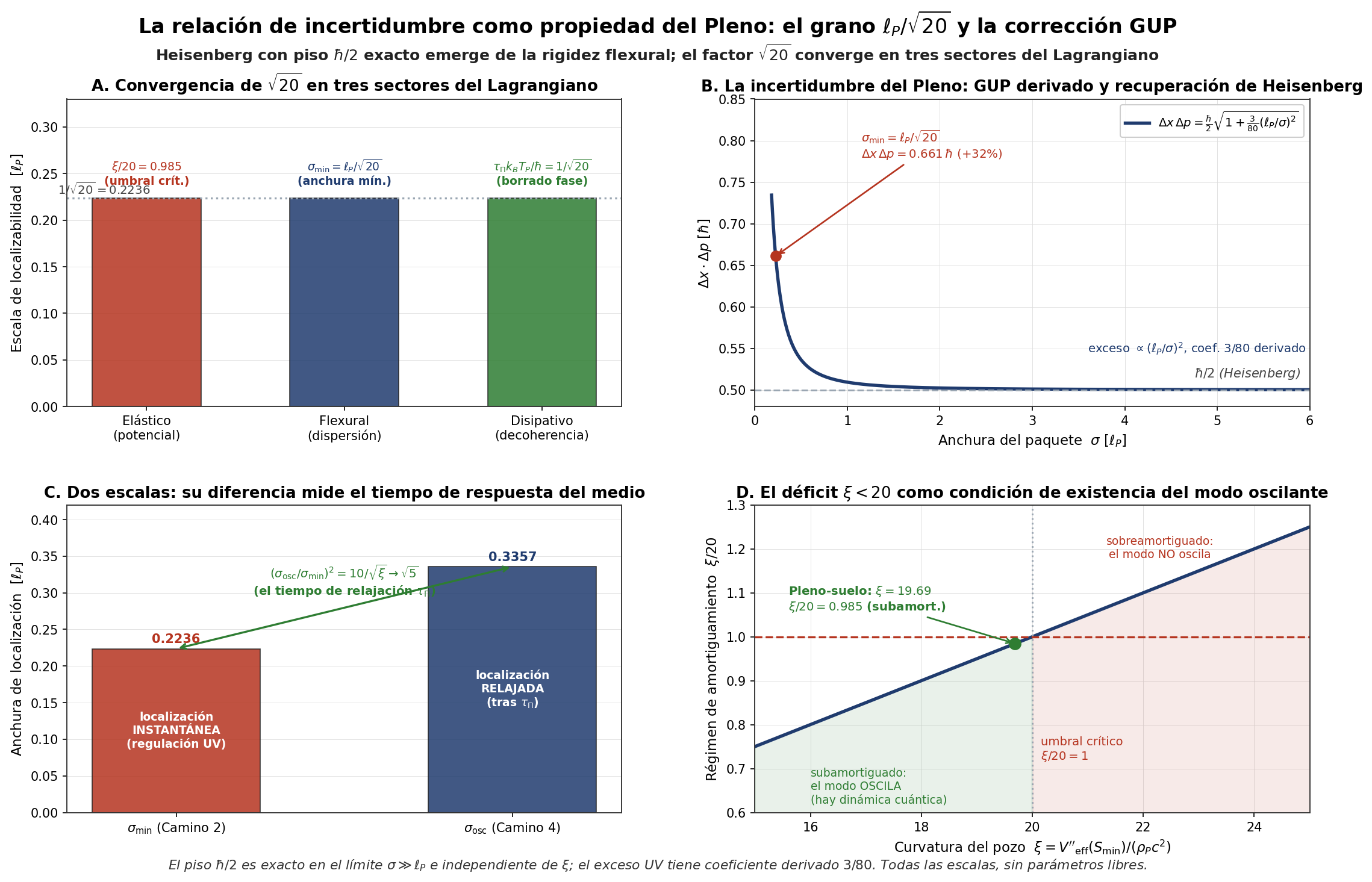
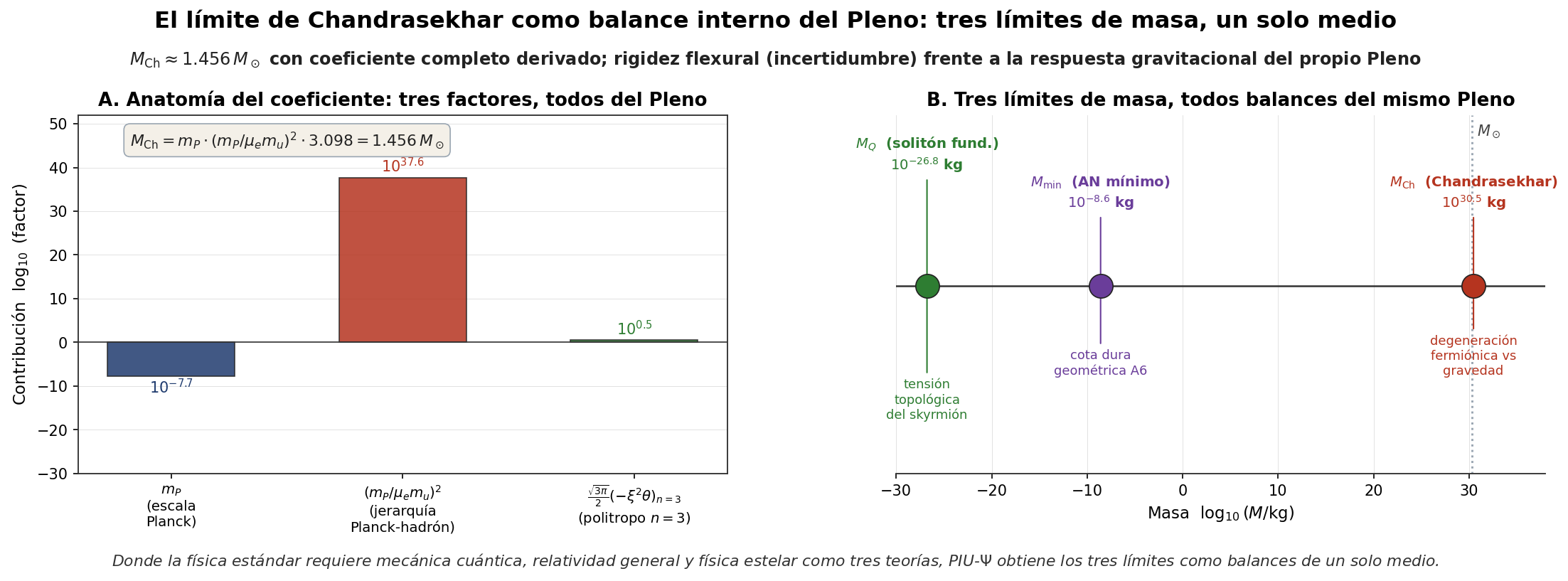
El fotón, Maxwell, Yang-Mills y el confinamiento, derivados
El electromagnetismo y las interacciones fuertes no son estructuras añadidas: brotan de la fase $\theta$ del Pleno sobre la red diamante. El fotón es un modo sin masa con dos polarizaciones contadas en el espacio de enlaces, Maxwell sale con su coeficiente, Yang-Mills no abeliano de la conexión del doblete de subredes, y el confinamiento como una obstrucción topológica de centro.
El fotón: canal sin gap y dos polarizaciones derivado
Ecuaciones de Maxwell, coeficiente $8/9$ derivado
Yang-Mills no abeliano y cancelación de anomalías derivado
Confinamiento como obstrucción $\mathbb{Z}_3$ derivado
Cuantización de la carga eléctrica derivado
Materia y hadrones como solitones del medio
Las partículas no son entidades fundamentales separadas: son configuraciones estables del Pleno. La materia es un solitón topológico con número bariónico entero, fermión para $B$ impar; el barión es un cluster de tres vórtices de winding fraccional, y su espectro de resonancias sale de la torre rotacional del mismo rotor.
Materia bariónica como solitón topológico derivado
Radio del protón $= 0.851$ fm 1 input
Torre rotacional bariónica DLF
Tres partículas reales desde la cristalización DLF hipótesis
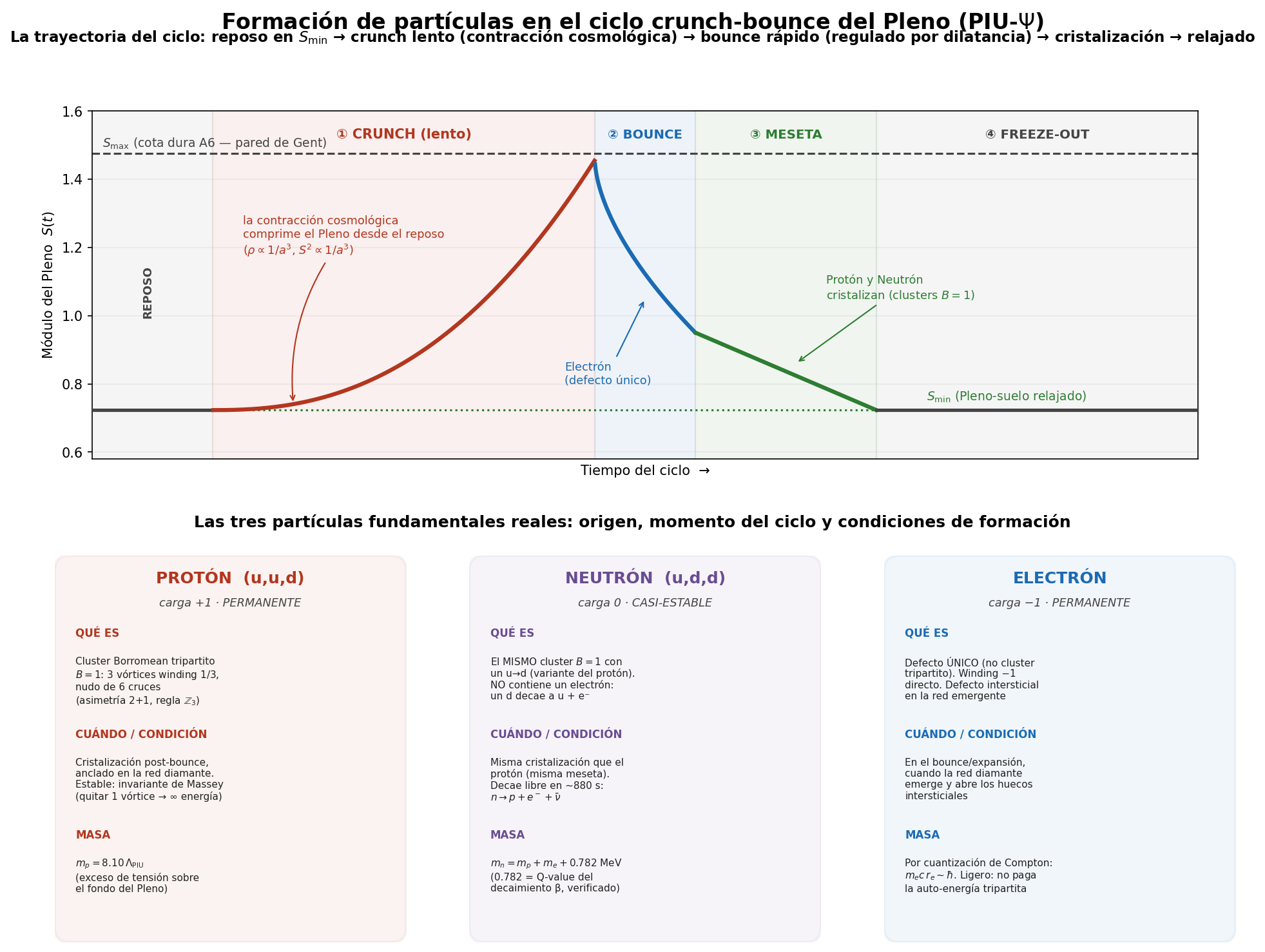
La red diamante, derivada —no postulada
La geometría microscópica del Pleno saturado no se elige a mano: se deriva. La unicidad del soporte diamante está cerrada en sus dos piezas —la coordinación tetraédrica $Z=4$ y el apilamiento cúbico $Fd\bar{3}m$—, y la red diamante es la configuración del Pleno saturado sin residuo de elección. De esta geometría brotan $S_{\min}$, el espectro de modos, los solitones y el sector gauge.
Coordinación $Z=4$ tetraédrica derivado
Apilamiento cúbico $Fd\bar{3}m$ y $S_{\min}$ en forma cerrada derivado
El sector oscuro sin ningún parámetro de ley
El 95 % del universo que la cosmología estándar postula sin derivar, PIU-Ψ lo obtiene del medio: la razón entre materia oscura y bariónica en forma cerrada, sin ningún dato, y el reparto energía oscura–materia con estructura derivada y un valor que lee la ocupación presente, los dos a menos de $1\sigma$ de Planck. La anatomía completa de las derivaciones está en §06 Sector Oscuro.
| Cantidad | PIU-Ψ | Planck 2018 | σ-distancia | Estatus |
|---|---|---|---|---|
| $\Omega_{MO}/\Omega_M$ | $\sqrt{3}\,\pi = 5.4414$ | $5.375 \pm 0.077$ | 0.86 σ | Derivado · cero parámetros |
| $\Omega_{EO} = f_c = 1-\Omega_m$ | $0.6869$ ($\Omega_m = 0.3131$) | $0.6847 \pm 0.0073$ | 0.30 σ | Estructura derivada · numerador posicional |
Razón materia oscura / bariónica $= \sqrt{3}\,\pi$ derivado
Energía oscura $= f_c \approx 0.6869$ derivado numerador posicional
El libro mayor de lo posicional: ningún parámetro de ley derivado
$H(z)$ ajusta DESI DR2 derivado
El factor de Lorentz como resistencia del medio
La Relatividad Especial se lee como la reología de un fluido dilatante de Herschel-Bulkley. El factor de Lorentz es la resistencia del medio a deformarse cerca de su velocidad límite, y la misma pared del potencial que acota el medio convierte el colapso cosmológico en rebote.
Factor de Lorentz como dilatancia DLF
Ciclo crunch-bounce sin singularidad derivado
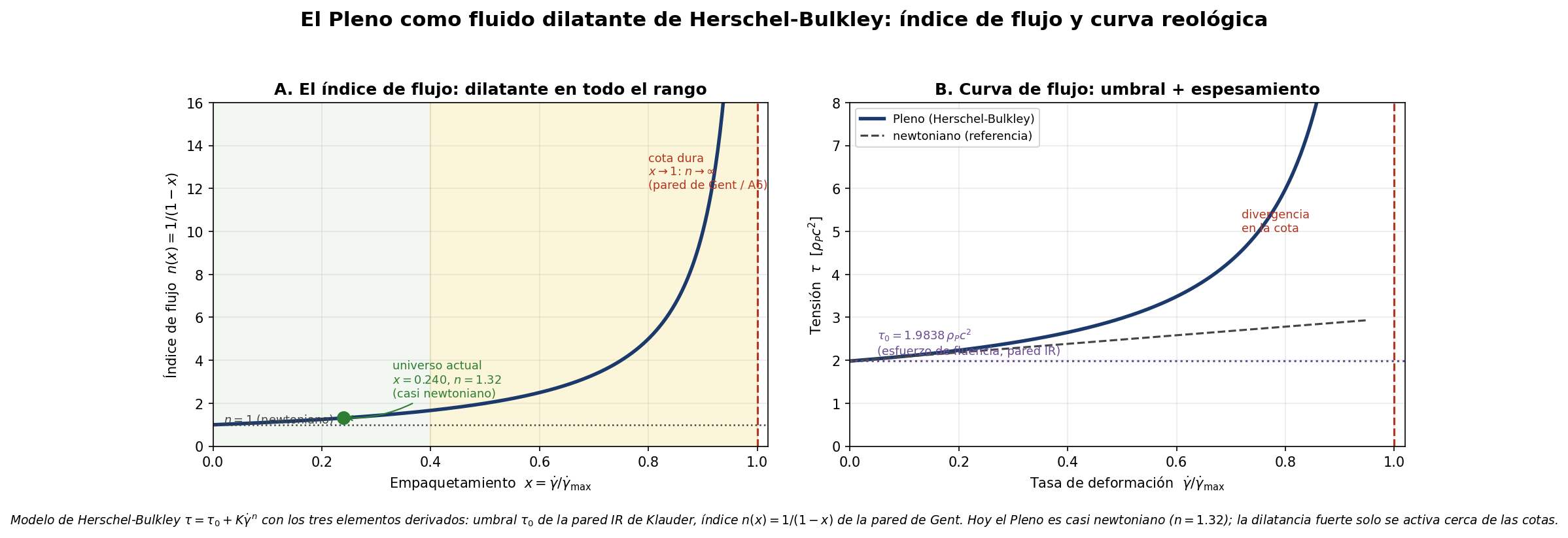
La termodinámica, desde el conteo de modos
La ocupación de Bose-Einstein y el coeficiente $2\pi^2/45$ de Stefan-Boltzmann salen de contar configuraciones de los modos propios de F1, sin suponer la estadística. Los modos térmicamente activos son los de la red diamante, cada rama sobre su banda, y con ellos el medio tiene temperatura máxima y viscosidad acotada.
Temperatura máxima $T_{\max} = 2.3545\,T_P$ derivado
$\eta/s$ del gas de modos: $R = 1.3232$ DLF
Veintiuna confrontaciones, cada una con su estatus
La tabla de §V.2.5 reúne las confrontaciones del programa con el dato, cada una con su clasificación. Para $G$ y $\hbar$ la columna de acuerdo no lleva porcentaje, y no por omisión: el coeficiente unidad es el diccionario y el valor numérico es la vara.
| Magnitud | Predicción PIU-Ψ | Observación | Acuerdo | Clasificación |
|---|---|---|---|---|
| Constante $G$ | $c^2/(\rho_P\ell_P^2)$ | $6.6743\times10^{-11}$ (CODATA 2022) | $\kappa_G = 1$ | DERIVADO |
| Constante $\hbar$ | $\rho_P c\,\ell_P^4$ | $1.0546\times10^{-34}$ J s | $\kappa_\hbar = 1$ | DERIVADO |
| $v_\text{OG}$ | $c$ exacta en el IR | GW170817, $<7\times10^{-16}$ | exacta | DERIVADO |
| $m_\gamma$ | $0$ exacta | $<10^{-54}$ kg | compatible | DERIVADO |
| Radio del protón $R_p$ | $0.851$ fm | $0.841$ fm | $1.19\,\%$ | [1 input] |
| Split $\Delta$-$N$ | $264.19$ MeV | $293.08$ MeV | razón $0.9014$ | DLF |
| $N(1680)$ | $1722$ MeV | $1680$ MeV | razón $1.025$ | DLF |
| $\Omega_{MO}/\Omega_M$ | $\sqrt{3}\pi = 5.4414$ | $5.375\pm0.077$ | $0.86\sigma$ | DERIVADO |
| $\Omega_{EO} = f_c = 1-\Omega_m$ | $0.6869$ | $0.6847\pm0.0073$ | $0.30\sigma$ (una sola comparación) | derivado, numerador posicional |
| $H(z)$ frente a BAO DESI DR2 | forma forzada por $V_\text{eff}$, $\delta_0 \to 0$ | indistinguible de ΛCDM | $\chi^2 = 6.54$ frente a $6.53$ | DERIVADO |
| $F_\text{AP} = D_M/D_H$ | cancela $r_d$; cero ajustes | seis puntos DESI DR2 | $\chi^2 = 6.669$ | DERIVADO |
| $H_0$ de fondo | $67.4$–$67.7$ (lado primordial) | $67.4\pm0.5$ Planck | coincide | CALIBRADO posicional |
| $w$ (sector tardío) | $-1$ exacto ($T_{\mu\nu}\propto g_{\mu\nu}$) | compatible | estructural | DERIVADO |
| Dilatación temporal SN Ia | $b = 1$ (factor compartido) | $1.003\pm0.011$ DES-SN5YR | $0.27\sigma$ | DERIVADO |
| Tensión de Hubble | artefacto de método | disolución en observables crudos | falsable | DLF |
| Razón Hubble/cizalla | $H_{\max}/\dot\gamma_{\max}$ | $3.7230 = \ell_P/\ell$ exacto | razón, no igualdad | DERIVADO |
| $n_s$ primordial | $1$ (orden cero); signo del tilt $=$ signo de $w_\text{eff}$ | $0.965\pm0.004$: tilt rojo | cronología del tilt: C-VII-05 | DERIVADO (signo) |
| $S_{\min}^\text{estr}$ | forma cerrada del factor de forma espectral; $E_0$ se despeja de ella | matemático | identidad por construcción | DERIVADO |
| $\eta/s$ del gas de modos | $R = 1.3232$ con el tiempo de relajación flexural | ventana $[1, 4\pi/5]$ | $32.32\,\%$ sobre KSS | DLF |
| Dispersión UV de la luz | $E_{\text{QG},2} = \sqrt{20}\,E_P$, subluminal | LHAASO $>7.3\times10^{11}$ GeV | margen $7.5\times10^{7}$ | DERIVADO |
| Confinamiento del color | regla de singlete $\mathbb{Z}_3$ | $qqq$, $q\bar q$ libres; $q$, $qq$ confinados | cualitativo exacto | DERIVADO |
Los seis problemas abiertos, abordados desde F1
La física contemporánea arrastra seis problemas abiertos. PIU-Ψ responde a los seis desde una sola afirmación —el universo es energía— y la ecuación que de ella se sigue, F1 sobre la red diamante, y cada respuesta lleva su resultado y su estatus (§VI.3).
| Problema | Lo que aporta PIU-Ψ | Estatus |
|---|---|---|
| 1. Constante cosmológica / energía del vacío | El suelo del medio es el cero de la escala y no gravita; la energía oscura es la fracción coherente del exceso, $\Omega_{EO} = f_c$ a $0.30\sigma$; la escala $\Theta_0 \sim 10^{-123}$ es la edad del universo en tics de Planck. | derivado numerador posicional |
| 2. Sectores oscuros | Materia oscura y energía oscura son configuraciones del mismo Pleno; $\Omega_{MO}/\Omega_M = \sqrt{3}\pi$ a $0.86\sigma$ con cero parámetros. | derivado |
| 3. Tensiones cosmológicas ($H_0$, $S_8$) | La tensión de $H_0$ y la señal de DESI son artefactos de analizar un medio con $w=-1$ exacto bajo la plantilla ΛCDM, con disolución predicha en observables crudos; la corrección no lineal de $H(z)$ es nula. | DLF |
| 4. Incompatibilidad RG–MQ | La frontera desaparece: ambas son lecturas del mismo Pleno; $G$, $\hbar$, la incertidumbre y Chandrasekhar salen del mismo medio, y la unitariedad está cerrada sobre la red. | derivado |
| 5. Constantes no explicadas | $G$ y $\hbar$ como identidades estructurales; dos cantidades sustantivas del medio, $\rho_P$ y $\ell_P$; $S_{\min}^\text{estr}$ y $S^2_{\max,\text{geom}}$ sin parámetros. | derivado |
| 6. Estatus ontológico de los campos / vacío | El campo es excitación de un sustrato físico identificado; el «vacío» es el Pleno en mínima excitación, estructurado y medible. | derivado |
Tres de cada cinco marcas son DERIVADO
El balance epistémico del programa no es una impresión: sale de contar las marcas del fuente del compendio, con un script que cualquiera puede ejecutar y que falla si la versión española y la inglesa difieren.
203 DERIVADO · 97 DLF · 37 CALIBRADO · 3 HIPÓTESIS · 2 CABO
Tres de cada cinco marcas son DERIVADO (203 de 342), y las otras 139 llevan nombrada la pieza que las separa de la prueba completa. Las 37 marcas CALIBRADO son el inventario íntegro de lo que el programa no deriva, y se reparten en sólo dos familias: la vara —$\rho_P$ y $\ell_P$— y la lectura posicional —$S^2_{\max,\text{eff}}(t_0)$, $\Lambda_\text{PIU}$, $H_0$—. Ninguna es un parámetro ajustado para forzar un acuerdo. De las 74 subsecciones con contenido derivacional, 40 son DERIVADO solo y 20 DERIVADO/DLF.
$\text{BF} \approx 3.4\times10^{4}$ contra la coincidencia
Quince resultados admitidos bajo cuatro criterios —que discriminen, que el programa no pueda ajustarlos, que su blanco estuviera establecido de antemano y que se lean con un canal de medida propio— y catorce excluidos con su motivo publicado. Ocho son predicciones y siete reconstrucciones, Maxwell entre ellas. Con $\prod p_i = 8.42\times10^{-10}$ y dependencia fuerte ($\lambda = 0.5$), el factor vale $3.4\times10^{4}$, con rango $[65,\ 1.2\times10^{9}]$ según el supuesto de dependencia; ninguna omisión individual lo baja más de $4.5$ veces. Una posición neutra pasa a $0.99997$; una escéptica de $10^{-2}$, a $0.9971$; una muy escéptica de $10^{-3}$, a $0.9718$.
El origen decide, no la proximidad
El peso de la rama óptica en la energía de punto cero vale $0.7253$ frente a $S_{\min}^\text{estr} = 0.7231$, un $0.30\,\%$, y se registra y no se usa: al deformar la red las dos cantidades se separan con pendientes de signo opuesto, $+0.2464$ y $-0.0484$, y $24$ expresiones distintas caen igual de cerca. Y una cuasi-coincidencia de cinco cifras —el periodo del modo radial, $1.4159833\,t_P$, frente al semiperiodo de la respuesta estática, $1.4160269\,\ell_P$— queda resuelta en forma cerrada: la igualdad es una raíz doble en $\xi = 20$, y la desviación entra al cuadrado (E-coinc-1). Descarte derivado
Veinticinco promesas: veintidós cumplidas, tres parcialmente
La presentación del corpus abre con una promesa concreta: que desde un único sustrato y dos propiedades del medio, el programa reproduce un conjunto definido de resultados de la física conocida y disuelve uno de sus grandes problemas abiertos. §VI.5 la salda punto por punto. De las veinticinco promesas, veintidós están cumplidas con resultado derivado y clasificado, y tres están cumplidas parcialmente, con su resultado central entregado y lo que resta nombrado: dos cabos, el valor de las masas fermiónicas y la confrontación de la tensión de $H_0$ en observables crudos, y la dinámica del bounce no lineal. Ninguna queda incumplida ni sobrevendida.
No hay una segunda fuente
La red diamante sale de A1 y de F1 —la coordinación $Z=4$ de la isotropía que A1 exige, el apilamiento del mínimo del funcional flexural—, y de su geometría salen las dos razones puras del medio, $S_{\min}^\text{estr} = 12(\pi^2-4)/\pi^4$ y $S^2_{\max,\text{geom}} = 8\sqrt6/9$; de su espectro, el techo de banda y la unitariedad; de sus plaquetas, el $8/9$ de Maxwell; de su doblete de subredes A/B, Yang-Mills; del grupo del sitio $T_d$, la estructura de Dirac; de su vía cristalina, el número tres del barión. La fase de F1 da $\hbar$, la carga cuantizada, la regla de Born y la cota de Tsirelson; su módulo da $G$, la pared que convierte el colapso en rebote y el núcleo finito de los agujeros negros.
El estado del programa, en una foto fija
identidades estructurales ($G$, $\hbar$)
de $G$ y $\hbar$ a $P37$
cada una con el instrumento que la refutaría
el Pleno
Lo que sostiene el catálogo
Lo abierto se lista con el mismo rigor que los éxitos, en §11 Cabos abiertos: veinte cabos, ninguno portante —cinco falsables y quince de enriquecimiento—, más siete subordinados, una vía de verificación y cinco fronteras declaradas, cada uno con su criterio de cierre escrito en el idioma de F1.
What PIU-Ψ achieves.
From a single statement —the universe is energy, finite at every point and conserved—, which fixes a single medium with two properties —its density $\rho_P$ and its grain $\ell_P$— and its causal structure $c$, and leads to the equation F1, PIU-Ψ obtains: the fundamental constants $G$ and $\hbar$ as identities of the medium, with derived unit coefficient; gravity, from Newton to Einstein's equations, with the black-hole interior closed and singularity-free and gravitational waves at speed $c$; quantum mechanics, with the exact $\hbar/2$ uncertainty floor, the Dirac structure, the Chandrasekhar limit and an exactly unitary evolution on the lattice; electromagnetism —the massless photon with its two polarizations and Maxwell's equations from phase circulation— and with it non-abelian Yang-Mills, confinement as a $\mathbb{Z}_3$ centre obstruction and the quantization of electric charge; matter, with the baryon as a cluster of three vortices, its radius and the rotational tower; the geometry of the medium, with the diamond lattice derived rather than postulated; the cosmological ratios of the dark sector with no law parameter at all; thermodynamics from mode counting; and relativity as rheology, with the Lorentz factor as resistance of the medium and a crunch-bounce cycle without a singularity.
Each result carries its epistemic classification in plain view: not as caution, but as precision. The numerical notebook recomputes each quantity from its first-principles formula in 648 checks over 617 rows —573 verdicts against the corpus and 75 against the compendium—, and all 648 pass; the algebra is redone separately in 312 checks, with 192 rows carrying a paired negative control that must give a different result for the row to pass; and a third notebook audits the 4905 figures printed across the four documents. The disagreements are shown just like the hits. A Bayes factor of $3.4\times10^{4}$ —fifteen results read with fifteen measurement channels that share nothing— weighs against the hypothesis that all of this is coincidence. This is what the program puts on the table.
$G$ and $\hbar$ as identities of the medium
The two constants that modern physics postulates without explaining, PIU-Ψ derives. They are not numbers to be measured and accepted: they are structural identities of the Pleno that follow from its density, its microscopic scale and its causal speed. The non-trivial content is not that the dimensions work out —they work out for infinitely many combinations— but that the dynamics of the medium selects a single one: the statics of the modulus produces exactly $c^2/(\rho_P\ell_P^2)$ and no other, and the quantization of the phase rotor produces exactly $\rho_P c\,\ell_P^4$. The unit coefficient of $\hbar$ is given by the rotor; the pair $\kappa_G = \kappa_\hbar = 1$ is the program's dictionary, declared once and equivalent to $\ell_P=\ell_\text{Planck}$. No parameter is fitted to the observed value.
The relation fixing $G$ lives entirely in the Pleno's language: it is a geometric identity between its properties, with no metres or seconds. The derivation ends there, complete, without a single unit having appeared. The numerical value $6.6743\times10^{-11}$ arises only when we translate that identity into our units: when we ask how many human yardsticks fit into $\rho_P$ and into $\ell_P$. Translating neither modifies what is derived nor turns it into a fit: it only places it on a scale where a torsion balance can test it. And there is no room to force it, because the yardstick is one and the same for the whole corpus and costs exactly two numbers: moving $\rho_P$ or $\ell_P$ to accommodate $G$ would break, in the same gesture, $\hbar$, the Schwarzschild radius and the Chandrasekhar limit. That is why what is calibrated here is the yardstick, the dimensional anchoring, and not a fitted parameter.
$G = c^2/(\rho_P\,\ell_P^2)$
Newton's constant emerges from the kinetic stiffness of the medium: the $\tfrac12\rho_P c^2\ell_P^2$ term of F1, which in relativistic language carries the scale $c^4/(2G)$. The coefficient of the coupling is fixed at tree level: the $8\pi$ is $2\times4\pi$, where the $4\pi$ is the measure of the sphere in the long-range response of the lattice —its Green function tends to $1/(4\pi r)$, and Gauss's theorem reads that measure— and the $2$ is the trace reversal. It is not a local coefficient of the lattice: no local coefficient carries $\pi$ to an odd power (parity criterion). Sakharov's induced gravity Sakharov 1967 contributes the sign, the scale $\rho_P c^2\ell_P^2$ and the non-contamination of the TT mode.
derived · structural identity; $\kappa_G = 1$, dictionary
$\hbar = \rho_P\,c\,\ell_P^4$
The Pleno's minimum unit of action is density × velocity × grain to the fourth: moment of inertia $I_\theta = \rho_P\ell_P^5$ times proper frequency $\omega_P = c/\ell_P$. Read in the language of quantum mechanics, that quantity is $\hbar$. It is not postulated: it follows from quantizing the $U(1)$ phase rotor of one cell of the medium, with no residual factor.
derived · structural identity, $\kappa_\hbar = 1$
From Newton to Einstein, as a property of the medium
Gravity is not a postulate in PIU-Ψ: it is the macroscopic response of the Pleno to concentrations of energy. In the weak field Newtonian mechanics is recovered; in the relativistic regime, the structure of Einstein's equations, with the geodesic closing the matter-geometry pair and the Schwarzschild metric as the geometric reading of the static configuration of the medium, with a full, bounded, singularity-free interior.
Newton as the weak-field limit derived
Einstein structure and the geodesic derived
Schwarzschild and the black-hole interior, closed derived
Gravitational waves at speed $c$ derived
Heisenberg with its exact $\hbar/2$ floor
The uncertainty relation is not imported: it is derived. PIU-Ψ obtains Heisenberg's principle with its exact $\hbar/2$ floor from the structure of the medium, and with it concrete physical consequences such as the Chandrasekhar limit. The historical incompatibility between General Relativity and Quantum Mechanics dissolves, because both are effective readings of the same substrate.
Heisenberg uncertainty, exact $\hbar/2$ floor derived
Chandrasekhar limit $\approx 1.456\,M_\odot$ derived
Structure of the Dirac equation derived
GR–QM integration: the boundary does not exist derived
The photon, Maxwell, Yang-Mills and confinement, derived
Electromagnetism and the strong interactions are not added structures: they spring from the phase $\theta$ of the Pleno on the diamond lattice. The photon is a massless mode with two polarizations counted in the space of bonds, Maxwell comes out with its coefficient, non-abelian Yang-Mills from the connection of the sublattice doublet, and confinement as a topological centre obstruction.
The photon: gapless channel and two polarizations derived
Maxwell's equations, coefficient $8/9$ derived
Non-abelian Yang-Mills and anomaly cancellation derived
Confinement as a $\mathbb{Z}_3$ obstruction derived
Electric charge quantization derived
Matter and hadrons as solitons of the medium
Particles are not separate fundamental entities: they are stable configurations of the Pleno. Matter is a topological soliton with integer baryon number, a fermion for odd $B$; the baryon is a cluster of three vortices of fractional winding, and its resonance spectrum follows from the rotational tower of the same rotor.
Baryonic matter as a topological soliton derived
Proton radius $= 0.851$ fm 1 input
Baryonic rotational tower SLD
Three real particles from crystallization SLD hypothesis
The diamond lattice, derived —not postulated
The microscopic geometry of the saturated Pleno is not chosen by hand: it is derived. The uniqueness of the diamond support is closed in its two pieces —tetrahedral coordination $Z=4$ and cubic stacking $Fd\bar{3}m$—, and the diamond lattice is the configuration of the saturated Pleno with no residue of choice. From this geometry spring $S_{\min}$, the mode spectrum, the solitons and the gauge sector.
Tetrahedral coordination $Z=4$ derived
Cubic stacking $Fd\bar{3}m$ and closed-form $S_{\min}$ derived
The dark sector with no law parameter
The 95 % of the universe that standard cosmology postulates without deriving, PIU-Ψ obtains from the medium: the ratio between dark and baryonic matter in closed form, with no datum, and the dark energy–matter split with a derived structure and a value that reads the present occupation, both within $1\sigma$ of Planck. The full anatomy of the derivations is in §06 Dark Sector.
| Quantity | PIU-Ψ | Planck 2018 | σ-distance | Status |
|---|---|---|---|---|
| $\Omega_{MO}/\Omega_M$ | $\sqrt{3}\,\pi = 5.4414$ | $5.375 \pm 0.077$ | 0.86 σ | Derived · zero parameters |
| $\Omega_{EO} = f_c = 1-\Omega_m$ | $0.6869$ ($\Omega_m = 0.3131$) | $0.6847 \pm 0.0073$ | 0.30 σ | Derived structure · positional numerator |
Dark-matter / baryonic ratio $= \sqrt{3}\,\pi$ derived
Dark energy $= f_c \approx 0.6869$ derived positional numerator
The ledger of the positional: no law parameter derived
$H(z)$ fits DESI DR2 derived
The Lorentz factor as the medium's resistance
Special Relativity reads as the rheology of a Herschel-Bulkley dilatant fluid. The Lorentz factor is the medium's resistance to deforming near its limiting speed, and the same wall of the potential that bounds the medium turns cosmological collapse into a bounce.
Lorentz factor as dilatancy SLD
Crunch-bounce cycle without singularity derived
Thermodynamics, from mode counting
Bose-Einstein occupation and the Stefan-Boltzmann coefficient $2\pi^2/45$ follow from counting configurations of the eigenmodes of F1, without assuming the statistics. The thermally active modes are those of the diamond lattice, each branch over its band, and with them the medium has a maximum temperature and a bounded viscosity.
Maximum temperature $T_{\max} = 2.3545\,T_P$ derived
$\eta/s$ of the mode gas: $R = 1.3232$ SLD
Twenty-one confrontations, each with its status
The table of §V.2.5 gathers the program's confrontations with the data, each with its classification. For $G$ and $\hbar$ the agreement column carries no percentage, and not by omission: the unit coefficient is the dictionary and the numerical value is the yardstick.
| Magnitude | PIU-Ψ prediction | Observation | Agreement | Classification |
|---|---|---|---|---|
| Constant $G$ | $c^2/(\rho_P\ell_P^2)$ | $6.6743\times10^{-11}$ (CODATA 2022) | $\kappa_G = 1$ | DERIVED |
| Constant $\hbar$ | $\rho_P c\,\ell_P^4$ | $1.0546\times10^{-34}$ J s | $\kappa_\hbar = 1$ | DERIVED |
| $v_\text{GW}$ | $c$ exact in the IR | GW170817, $<7\times10^{-16}$ | exact | DERIVED |
| $m_\gamma$ | $0$ exact | $<10^{-54}$ kg | compatible | DERIVED |
| Proton radius $R_p$ | $0.851$ fm | $0.841$ fm | $1.19\,\%$ | [1 input] |
| $\Delta$-$N$ split | $264.19$ MeV | $293.08$ MeV | ratio $0.9014$ | SLD |
| $N(1680)$ | $1722$ MeV | $1680$ MeV | ratio $1.025$ | SLD |
| $\Omega_{MO}/\Omega_M$ | $\sqrt{3}\pi = 5.4414$ | $5.375\pm0.077$ | $0.86\sigma$ | DERIVED |
| $\Omega_{EO} = f_c = 1-\Omega_m$ | $0.6869$ | $0.6847\pm0.0073$ | $0.30\sigma$ (a single comparison) | derived, positional numerator |
| $H(z)$ against DESI DR2 BAO | form forced by $V_\text{eff}$, $\delta_0 \to 0$ | indistinguishable from ΛCDM | $\chi^2 = 6.54$ against $6.53$ | DERIVED |
| $F_\text{AP} = D_M/D_H$ | cancels $r_d$; zero fits | six DESI DR2 points | $\chi^2 = 6.669$ | DERIVED |
| Background $H_0$ | $67.4$–$67.7$ (primordial side) | $67.4\pm0.5$ Planck | coincides | CALIBRATED positional |
| $w$ (late sector) | $-1$ exact ($T_{\mu\nu}\propto g_{\mu\nu}$) | compatible | structural | DERIVED |
| SN Ia time dilation | $b = 1$ (shared factor) | $1.003\pm0.011$ DES-SN5YR | $0.27\sigma$ | DERIVED |
| Hubble tension | method artifact | dissolution in raw observables | falsifiable | SLD |
| Hubble/shear ratio | $H_{\max}/\dot\gamma_{\max}$ | $3.7230 = \ell_P/\ell$ exact | ratio, not equality | DERIVED |
| Primordial $n_s$ | $1$ (zeroth order); sign of the tilt $=$ sign of $w_\text{eff}$ | $0.965\pm0.004$: red tilt | chronology of the tilt: C-VII-05 | DERIVED (sign) |
| $S_{\min}^\text{estr}$ | closed form of the spectral form factor; $E_0$ is solved from it | mathematical | identity by construction | DERIVED |
| $\eta/s$ of the mode gas | $R = 1.3232$ with the flexural relaxation time | window $[1, 4\pi/5]$ | $32.32\,\%$ above KSS | SLD |
| UV dispersion of light | $E_{\text{QG},2} = \sqrt{20}\,E_P$, subluminal | LHAASO $>7.3\times10^{11}$ GeV | margin $7.5\times10^{7}$ | DERIVED |
| Colour confinement | $\mathbb{Z}_3$ singlet rule | $qqq$, $q\bar q$ free; $q$, $qq$ confined | qualitative exact | DERIVED |
The six open problems, addressed from F1
Contemporary physics carries six open problems. PIU-Ψ answers all six from a single statement —the universe is energy— and the equation that follows from it, F1 over the diamond lattice, and each answer carries its result and its status (§VI.3).
| Problem | What PIU-Ψ contributes | Status |
|---|---|---|
| 1. Cosmological constant / vacuum energy | The floor of the medium is the zero of the scale and does not gravitate; dark energy is the coherent fraction of the excess, $\Omega_{EO} = f_c$ at $0.30\sigma$; the scale $\Theta_0 \sim 10^{-123}$ is the age of the universe in Planck ticks. | derived positional numerator |
| 2. Dark sectors | Dark matter and dark energy are configurations of the same Pleno; $\Omega_{MO}/\Omega_M = \sqrt{3}\pi$ at $0.86\sigma$ with zero parameters. | derived |
| 3. Cosmological tensions ($H_0$, $S_8$) | The $H_0$ tension and the DESI signal are artifacts of analysing a medium with $w=-1$ exact under the ΛCDM template, with predicted dissolution in raw observables; the nonlinear correction to $H(z)$ is zero. | SLD |
| 4. GR–QM incompatibility | The boundary disappears: both are readings of the same Pleno; $G$, $\hbar$, uncertainty and Chandrasekhar come from the same medium, and unitarity is closed on the lattice. | derived |
| 5. Unexplained constants | $G$ and $\hbar$ as structural identities; two substantive quantities of the medium, $\rho_P$ and $\ell_P$; $S_{\min}^\text{estr}$ and $S^2_{\max,\text{geom}}$ with no parameters. | derived |
| 6. Ontological status of fields / vacuum | The field is an excitation of an identified physical substrate; the "vacuum" is the Pleno at minimum excitation, structured and measurable. | derived |
Three in every five marks are DERIVED
The epistemic balance of the program is not an impression: it comes from counting the marks in the compendium source, with a script anyone can run and which fails if the Spanish and English versions differ.
203 DERIVED · 97 SLD · 37 CALIBRATED · 3 HYPOTHESIS · 2 OPEN END
Three in every five marks are DERIVED (203 of 342), and the other 139 carry named the piece that separates them from the complete proof. The 37 CALIBRATED marks are the full inventory of what the program does not derive, and they fall into only two families: the yardstick —$\rho_P$ and $\ell_P$— and the positional reading —$S^2_{\max,\text{eff}}(t_0)$, $\Lambda_\text{PIU}$, $H_0$—. Neither is a parameter fitted to force an agreement. Of the 74 subsections with derivational content, 40 are DERIVED alone and 20 DERIVED/SLD.
$\text{BF} \approx 3.4\times10^{4}$ against coincidence
Fifteen results admitted under four criteria —that they discriminate, that the program cannot adjust them, that their target was established beforehand and that they are read with a measurement channel of their own— and fourteen excluded with their reason published. Eight are predictions and seven reconstructions, Maxwell among them. With $\prod p_i = 8.42\times10^{-10}$ and strong dependence ($\lambda = 0.5$), the factor is $3.4\times10^{4}$, with range $[65,\ 1.2\times10^{9}]$ depending on the dependence assumption; no single omission lowers it by more than $4.5$ times. A neutral position moves to $0.99997$; a sceptical one at $10^{-2}$, to $0.9971$; a very sceptical one at $10^{-3}$, to $0.9718$.
Origin decides, not proximity
The weight of the optical branch in the zero-point energy is $0.7253$ against $S_{\min}^\text{estr} = 0.7231$, a $0.30\,\%$, and it is recorded and not used: deforming the lattice separates the two quantities with slopes of opposite sign, $+0.2464$ and $-0.0484$, and $24$ distinct expressions fall just as close. And a five-digit near-coincidence —the period of the radial mode, $1.4159833\,t_P$, against the half-period of the static response, $1.4160269\,\ell_P$— is resolved in closed form: the equality is a double root at $\xi = 20$, and the deviation enters squared (E-coinc-1). Rejection derived
Twenty-five promises: twenty-two fulfilled, three partially
The corpus overview opens with a concrete promise: that from a single substrate and two properties of the medium, the program reproduces a defined set of results of known physics and dissolves one of its great open problems. §VI.5 settles it point by point. Of the twenty-five promises, twenty-two are fulfilled with a derived and classified result, and three are partially fulfilled, with their central result delivered and what remains named: two threads, the value of the fermion masses and the confrontation of the $H_0$ tension in raw observables, and the nonlinear bounce dynamics. None is left unfulfilled or oversold.
There is no second source
The diamond lattice comes from A1 and F1 —the coordination $Z=4$ from the isotropy A1 demands, the stacking from the minimum of the flexural functional—, and from its geometry come the two pure ratios of the medium, $S_{\min}^\text{estr} = 12(\pi^2-4)/\pi^4$ and $S^2_{\max,\text{geom}} = 8\sqrt6/9$; from its spectrum, the band ceiling and unitarity; from its plaquettes, Maxwell's $8/9$; from its A/B sublattice doublet, Yang-Mills; from the site group $T_d$, the Dirac structure; from its crystalline route, the number three of the baryon. The phase of F1 gives $\hbar$, quantized charge, the Born rule and the Tsirelson bound; its modulus gives $G$, the wall that turns collapse into bounce, and the finite core of black holes.
The state of the program, in a still photograph
structural identities ($G$, $\hbar$)
from $G$ and $\hbar$ to $P37$
each with the instrument that would refute it
the Pleno
What sustains the catalogue
What is open is listed with the same rigour as the successes, in §11 Open threads: twenty threads, none load-bearing —five falsifiable and fifteen of enrichment—, plus seven subordinate threads, one verification route and five declared frontiers, each with its closure criterion written in the language of F1.
El catálogo completo de predicciones falsables.
Un programa de fundamentos se mide por lo que arriesga. El catálogo maestro del corpus (§V.1.9), de cuarenta y dos filas, combina tres familias de identificadores: las empíricas heredadas se agrupan en la fila inicial P1–P14; las estructurales nuevas se numeran de P15 a P37; y los bloques temáticos —fotón, hadrones y la escala hadrónica— usan prefijo nominal, para mantener juntas las predicciones de un mismo sector. Encabezan $G$, $\hbar$ y $v_\text{OG}$ por ser identidades estructurales del aparato.
Cada entrada cumple las tres capacidades que el programa exige a todo resultado: interpreta —nombra qué es el fenómeno como configuración del Pleno—, explica —se deriva del aparato A1–A6 más F1— y predice —se confronta con un dato medido o anuncia uno futuro falsable—. Ninguna invoca una sola de las tres como suficiente. Y cada una lleva su etiqueta de estatus, que es obligatoria y no opcional:
De las 342 marcas de estatus del compendio, 203 son DERIVADO —tres de cada cinco—, 97 DLF, 37 CALIBRADO, 3 HIPÓTESIS y 2 CABO, y las 135 que no son DERIVADO llevan nombrada la pieza que las separa de la prueba completa. Las 37 marcas calibrado son el inventario íntegro de lo que el programa no deriva: la vara de medir y la lectura posicional, y nada más. El programa no tiene ningún parámetro de ley, y la cuenta de parámetros libres de la tabla de confrontación es cero.
Constantes e identidades estructurales acuerdo con dato medido
Lo que las filas de $G$ y $\hbar$ confrontan es el coeficiente: las identidades salen de F1 —la estática del módulo en un caso, la cuantización del rotor en el otro— y su coeficiente sale uno sin nada que ajustar. Ese es el resultado que puede fallar, y no cambia aunque se conceda de antemano la forma del monomio.
Once predicciones, con el instrumento que las refutaría
El corpus publica, junto a lo consolidado (§VI.2), la lista de lo que puede romperlo, emparejada con lo que lo rompería. Cada fila nombra el observable, el instrumento y la dirección en que el resultado fallaría.
| Predicción falsable | Qué la refutaría | Dónde |
|---|---|---|
| Supresión ultravioleta del espectro tensorial primordial | un espectro tensorial sin corte a $k\sim\ell_P^{-1}$ | §III.3.6 |
| Déficit ultravioleta del momento del medio, coeficiente $3/80$ derivado y fijo | una desviación con el signo de la fenomenología GUP, que es el contrario | §III.2.6 |
| Firmas del polo de Lee-Wick; atenuación TT intrínseca, longitud de absorción $\sim10^{31}$ radios de Hubble | LISA, ET o CE midiendo absorción a escalas accesibles | §III.3.3 |
| Densidad gravitante de núcleo universal $1.6545\,\rho_P$ (supremo de ocupación $2.1773\,\rho_P$), independiente de la masa | una densidad de núcleo que dependa de la masa del agujero negro | §III.1.10, §IV.7 |
| Dispersión ultravioleta de la luz, subluminal, con $E_{\text{QG},2}=\sqrt{20}\,E_P$ en su parte isótropa (entre $3.93$ y $6\,E_P$ según el eje, E23-obs) | una dispersión cuadrática superluminal, una parte isótropa por debajo de $\sqrt{20}\,E_P$, o un patrón angular distinto del hexadecapolar, en los fotones de LHAASO y de Fermi-LAT | §II.5.4, §III.4.3 |
| Torre rotacional bariónica completa; separación de vórtices | espectroscopía hadrónica fuera de la torre predicha | §II.6.7 |
| Invariancia de la escala hadrónica $\Lambda_\text{PIU}$ con el corrimiento al rojo | una deriva de las constantes hadrónicas con $z$ | §III.5 |
| Exponente de dilatación $b=1$ exacto de las supernovas Ia | un exponente distinto de $1$ fuera de la barra de DES-SN5YR | §III.8.2-bis |
| Disolución de la tensión de Hubble y de la señal $w_0$–$w_a$ en observables crudos | que ambas persistan en $D_H/r_d$, $\theta_*$ y la forma de $E(z)$ | §III.8.7 |
| $n_s=1$ a orden cero del rebote de materia, sin inflación | un espectro primordial cuyo tilt no tenga el signo de $w_\text{eff}$ en el cruce de horizonte (E-cosmo-1-bis) | §III.8.4 |
| Potencial químico $\mu=0$ estructural del fondo cósmico | una distorsión $\mu$ del cuerpo negro por encima de la cota | §III.8.2 |
De P1 a P37, y los bloques temáticos
P17 y no un segundo acuerdo, porque por planitud las dos suman uno. DERIVADO estructura · CALIBRADO valor¿Coincidencia algebraica o estructura real? las dos pruebas, que no se combinan
Un programa que obtiene números cerrados de un Lagrangiano tiene que responder por qué no es el siguiente de una lista conocida. La ley de Titius-Bode ajustó los radios orbitales con una progresión geométrica y no significaba nada; los números grandes de Eddington relacionaron constantes con precisión notable y tampoco. La objeción admite dos lecturas que no deben confundirse ni combinarse.
Cuántas fórmulas. Se enumera computacionalmente el espacio de expresiones algebraicas simples —3778 distintas hasta complejidad $N=5$— y la probabilidad de que dos de ellas reproduzcan a la vez $\sqrt3\pi$ y $f_c$ dentro de $2\sigma$ resulta menor que $3\times10^{-4}$: un factor $K_c \approx 6.71\times10^5$ contra la lectura de esas dos razones concretas como fórmulas afortunadas.
Cuántos marcos. Es la pregunta que corresponde a un programa completo, y se computa aparte: quince resultados admitidos bajo cuatro criterios, leídos con quince instrumentos que no comparten nada, y otros catorce dejados fuera con su motivo publicado. Corregido por la dependencia del tronco común, el factor de referencia es $3.4\times10^{4}$, con el rango completo $[65,\;1.2\times10^{9}]$. Cada prueba acota una cosa distinta, y multiplicarlas sería contar dos veces.
Y hay una tercera pieza, que es la que responde de verdad: qué se hizo con las coincidencias que aparecieron y no se sostenían. El caso limpio está en el desarrollo completo, en §09 Papers: una proximidad del $0.30\,\%$ sobre la misma banda, registrada y no usada, con la comprobación que la descarta y las 24 expresiones que caen igual de cerca. Y una cuasi-coincidencia de cinco cifras entre el periodo del modo radial y el semiperiodo de la respuesta estática queda resuelta en forma cerrada: la igualdad es una raíz doble en $\xi = 20$, y la desviación entra al cuadrado (E-coinc-1).
Cómo refutar PIU como programa completo
Más allá de cada predicción individual, el corpus identifica las vías que refutarían el programa entero. La primera es la que el propio depósito anuncia como prueba de los coeficientes.
- Medir $\rho_P$ o $\ell_P$ por una vía que no pase por la gravitación ni por la cuantización. Con los dos primarios medidos independientemente, los coeficientes de $G$ y de $\hbar$ quedan expuestos: dos bits, uno por rama. Es la prueba que separa las dos ramas y la que el programa arriesga de forma más limpia. La vía de cierre está trazada: lo que la gravedad del núcleo de un objeto compacto mide es $G\rho_{\max,g} = 1.6545\,c^2/\ell_P^2$ (cabo C-meta-1.b).
- Detección directa indiscutible de una partícula de materia oscura: refutaría la materia oscura como Q-ball del Pleno.
- Desviación significativa de $\Omega_{MO}/\Omega_M$ del valor $\sqrt3\pi$: refutaría
P16, que es derivación estructural de la geometría de la red y no un ajuste. - Desviación significativa de $\Omega_{EO}$ del valor $f_c$: refutaría la identificación $\Omega_{EO}\equiv f_c$ de
P17. - Un residuo de DESI que persista sobre el dato desnudo y exija $\delta_0\neq0$: el programa deriva $\delta_0=0$, y ningún sector suyo puede portar otro valor.
El inventario completo de lo abierto —veinte cabos, ninguno portante: cinco falsables y quince de enriquecimiento, más siete subordinados y una vía de verificación, con su categoría, su severidad y su criterio de cierre, y cinco fronteras declaradas— está en §11 Abiertos.
The complete catalogue of falsifiable predictions.
A foundational program is measured by what it risks. The corpus's master catalogue (§V.1.9), with forty-two rows, combines three families of identifiers: the inherited empirical ones are grouped in the initial row P1–P14; the new structural ones are numbered from P15 to P37; and the thematic blocks —photon, hadrons and the hadronic scale— use a nominal prefix, to keep the predictions of one sector together. $G$, $\hbar$ and $v_\text{OG}$ head the list, being structural identities of the apparatus.
Every entry meets the three capacities the program demands of any result: it interprets —it names what the phenomenon is as a configuration of the Pleno—, it explains —it is derived from the A1–A6 apparatus plus F1— and it predicts —it is confronted with a measured datum or announces a future falsifiable one—. None invokes only one of the three as sufficient. And each carries its status label, which is mandatory and not optional:
Of the compendium's 342 status marks, 203 are DERIVED —three in every five—, 97 SLD, 37 CALIBRATED, 3 HYPOTHESIS and 2 OPEN END, and the 135 that are not DERIVED carry the named piece that separates them from the complete proof. The 37 calibrated marks are the complete inventory of what the program does not derive: the measuring yardstick and the positional reading, and nothing else. The program has no law parameter, and the confrontation table's count of free parameters is zero.
Constants and structural identities agreement with measured data
What the $G$ and $\hbar$ rows confront is the coefficient: the identities come out of F1 —the statics of the modulus in one case, the quantization of the rotor in the other— and their coefficient comes out one with nothing to fit. That is the result that can fail, and it does not change even if the form of the monomial is granted in advance.
Eleven predictions, with the instrument that would refute them
Alongside what is consolidated (§VI.2), the corpus publishes the list of what can break it, paired with what would break it. Each row names the observable, the instrument and the direction in which the result would fail.
| Falsifiable prediction | What would refute it | Where |
|---|---|---|
| Ultraviolet suppression of the primordial tensor spectrum | a tensor spectrum with no cutoff at $k\sim\ell_P^{-1}$ | §III.3.6 |
| Ultraviolet deficit of the medium momentum, coefficient $3/80$ derived and fixed | a deviation with the sign of GUP phenomenology, which is the opposite | §III.2.6 |
| Lee-Wick pole signatures; intrinsic TT attenuation, absorption length $\sim10^{31}$ Hubble radii | LISA, ET or CE measuring absorption at accessible scales | §III.3.3 |
| Universal gravitating core density $1.6545\,\rho_P$ (occupation supremum $2.1773\,\rho_P$), independent of the mass | a core density that depends on the mass of the black hole | §III.1.10, §IV.7 |
| Ultraviolet dispersion of light, subluminal, with $E_{\text{QG},2}=\sqrt{20}\,E_P$ in its isotropic part (between $3.93$ and $6\,E_P$ depending on the axis, E23-obs) | a superluminal quadratic dispersion, an isotropic part below $\sqrt{20}\,E_P$, or an angular pattern other than the hexadecapolar, in the photons of LHAASO and Fermi-LAT | §II.5.4, §III.4.3 |
| Complete baryonic rotational tower; vortex separation | hadron spectroscopy outside the predicted tower | §II.6.7 |
| Invariance of the hadronic scale $\Lambda_\text{PIU}$ with redshift | a drift of the hadronic constants with $z$ | §III.5 |
| Exact dilation exponent $b=1$ of type Ia supernovae | an exponent different from $1$ outside the DES-SN5YR bar | §III.8.2-bis |
| Dissolution of the Hubble tension and of the $w_0$–$w_a$ signal in raw observables | that both persist in $D_H/r_d$, $\theta_*$ and the shape of $E(z)$ | §III.8.7 |
| $n_s=1$ at zeroth order of the matter bounce, without inflation | a primordial spectrum whose tilt does not carry the sign of $w_\text{eff}$ at horizon crossing (E-cosmo-1-bis) | §III.8.4 |
| Structural chemical potential $\mu=0$ of the cosmic background | a $\mu$ distortion of the blackbody above the bound | §III.8.2 |
From P1 to P37, and the thematic blocks
P17 and not a second agreement, because by flatness the two add up to one. DERIVED structure · CALIBRATED valueAlgebraic coincidence or real structure? the two tests, which are not combined
A program that obtains closed numbers from a Lagrangian has to answer why it is not the next entry in a well-known list. The Titius-Bode law fitted the orbital radii with a geometric progression and meant nothing; Eddington's large numbers related constants with remarkable precision and meant nothing either. The objection admits two readings that must not be confused or combined.
How many formulas. The space of simple algebraic expressions is enumerated computationally —3778 distinct ones up to complexity $N=5$— and the probability that two of them reproduce both $\sqrt3\pi$ and $f_c$ within $2\sigma$ comes out below $3\times10^{-4}$: a factor $K_c \approx 6.71\times10^5$ against reading those two particular ratios as lucky formulas.
How many frameworks. This is the question that corresponds to a complete program, and it is computed separately: fifteen results admitted under four criteria, read with fifteen instruments that share nothing, and another fourteen left out with their reason published. Corrected for the dependence of the common trunk, the reference factor is $3.4\times10^{4}$, with the full range $[65,\;1.2\times10^{9}]$. Each test bounds a different thing, and multiplying them would be counting twice.
And there is a third piece, the one that really answers: what was done with the coincidences that showed up and did not hold. The clean case is in the full development, in §09 Papers: a $0.30\,\%$ proximity over one and the same band, recorded and not used, with the check that discards it and the 24 expressions that fall equally close. And a five-digit near-coincidence between the period of the radial mode and the half-period of the static response is resolved in closed form: the equality is a double root at $\xi = 20$, and the deviation enters squared (E-coinc-1).
How to refute PIU as a complete program
Beyond each individual prediction, the corpus identifies the routes that would refute the whole program. The first is the one the deposit itself announces as the test of the coefficients.
- Measuring $\rho_P$ or $\ell_P$ by a route that passes through neither gravitation nor quantization. With both primaries measured independently, the coefficients of $G$ and of $\hbar$ are exposed: two bits, one per branch. It is the test that separates the two branches and the one the program risks most cleanly. The route to closure is traced: what the gravity of the core of a compact object measures is $G\rho_{\max,g} = 1.6545\,c^2/\ell_P^2$ (thread C-meta-1.b).
- Indisputable direct detection of a dark-matter particle: it would refute dark matter as a Q-ball of the Pleno.
- Significant deviation of $\Omega_{MO}/\Omega_M$ from $\sqrt3\pi$: it would refute
P16, a structural derivation from the geometry of the lattice and not a fit. - Significant deviation of $\Omega_{EO}$ from $f_c$: it would refute the identification $\Omega_{EO}\equiv f_c$ of
P17. - A DESI residue that persists on the bare datum and requires $\delta_0\neq0$: the program derives $\delta_0=0$, and no sector of it can carry another value.
The complete inventory of what is open —twenty threads, none load-bearing: five falsifiable and fifteen of enrichment, plus seven subordinate threads and one verification route, with their category, their severity and their closure criterion, and five declared frontiers— is in §11 Open.
Corpus, papers, invitación a peer review.
El corpus V5.6 completo, en descarga directa, junto con el compendio matemático, la fuente LaTeX de cada idioma, los tres cuadernos de verificación ejecutables con sus impresiones, una introducción divulgativa de ochenta y cuatro páginas —en lenguaje cotidiano, en español e inglés, también en formato Kindle— y cinco papers temáticos publicados con DOI permanente. La comunidad científica está formalmente invitada a revisar, verificar y extender.
El corpus V5.6, en descarga directa
PIU-Ψ V5.6 — Corpus completo
El cuerpo principal de la teoría: 632 páginas en español y 634 en inglés, con los axiomas, todas las derivaciones, el inventario completo de lo abierto y los apéndices técnicos. 329 ecuaciones etiquetadas, catorce figuras y la clasificación epistémica visible resultado a resultado. Publicado bajo Creative Commons (CC BY 4.0), con el ORCID del autor.
El paquete V5.6 reúne, en español y en inglés: el corpus completo y el compendio matemático (150 pp en español, 151 en inglés) con el desarrollo íntegro de cada derivación; la fuente LaTeX en un archivo por idioma, con sus figuras, de modo que los cuatro documentos recompilan sin bibtex en tres pasadas; el divulgativo; y el archivo de verificación, con los cuadernos que los documentos nombran y sus salidas en .csv y PDF. Las dos versiones de cada documento son espejo: mismo conjunto de ecuaciones etiquetadas, mismas figuras, mismas tablas y mismas marcas de estatus. Las diferencias de paginación entre las dos lenguas son tipográficas. El depósito Zenodo de V5.6 lleva los dos idiomas bajo un mismo DOI: 10.5281/zenodo.23064146; el de la versión anterior, V5.5, es 10.5281/zenodo.22313421.
Una puerta de entrada sin requisitos previos
PIU-Ψ — ¿Qué es el cosmos? ¿Qué es el Pleno? ¿Cómo opera?
Una explicación pensada para cualquier lector curioso, escrita en lenguaje cotidiano y con una sola ecuación, explicada en palabras. Veinticinco secciones que recorren, con imágenes sencillas —el agua y sus formas, el cristal y su orden interno, la maicena que fluye, los cereales que se juntan en la leche—, qué es el Pleno y cómo de él emergen el tiempo, la gravedad, la luz, las partículas, el calor, las estrellas, el sector oscuro, el interior de los agujeros negros y el ciclo de crunch y rebote.
Reúne veintisiete leyes, constantes y hechos, la mayoría con nombre propio, en ocho sectores, y todos salen del mismo objeto. Al final, un anexo de consulta da una ficha por cada uno: de quién es la ley y de cuándo, qué dice, qué nos permite entender, predecir o construir, y contra qué se contrasta. El orden es el del árbol —raíz, tronco, ramas, follaje—: primero las dos constantes en que se apoya el resto, después cada sector, y al final el instante en que se formó la materia. Dentro de cada sector decide el peso probatorio, el mismo que el corpus asigna en su cómputo bayesiano.
Cada cuadro azul lleva su etiqueta epistémica en la cabecera y una entrada en lenguaje llano que dice en una frase el resultado; los que llevan un control lo presentan aparte, bajo el rótulo La comprobación, con el contraste que respalda el resultado. Cierra con el destino que el programa predice —un ritmo de expansión que tiende a cero, no una aceleración eterna— y con el ciclo de crunch y rebote: por qué solo cicla el 31 % y qué le falta a esa explicación. Y marca su propio límite: quita el misterio de que el tiempo tenga una dirección, y no deriva la segunda ley.
Disponible en español e inglés, en PDF y en EPUB. Las dos ediciones EPUB pasan EPUBCheck 5.3.0 sobre las reglas EPUB 3.3 con cero fatales, cero errores y cero avisos. Para el desarrollo formal completo —axiomas, derivaciones y clasificación epistémica— véase el corpus V5.6, arriba.
El compendio matemático completo
Compendio matemático PIU-Ψ V5.6
El reverso técnico de la introducción divulgativa. Recoge, reorganizadas por tema físico, todas las derivaciones del corpus con su desarrollo completo: desde la Lagrangiana F1 y los axiomas A1–A6 hasta la emergencia de la gravedad, la mecánica cuántica, el sector oscuro y las constantes operacionales. Es la misma física en el detalle argumental, sin saltos de «se sigue que», construida para analizarse por sí sola.
Su balance epistémico está declarado subsección por subsección. De las 74 subsecciones con contenido derivacional, 39 llevan prueba completa, 21 el núcleo probado con una pieza estructural sin cerrar, 8 argumento estructural sin demostración cerrada, 3 la cadena probada con un número tomado del mundo y 1 ambas cosas a la vez; las 2 restantes no enuncian resultado propio: son una prueba de falsación y una síntesis. De las 342 marcas de estatus, tres de cada cinco son derivado: 203, y las otras 139 llevan nombrada la pieza que las separa de la prueba completa. Las 37 marcas calibrado son el inventario íntegro de lo que el programa no deriva, repartidas en solo dos familias: la vara de medir ($\rho_P$ y $\ell_P$) y la lectura posicional ($S^2_{\max,\text{eff}}(t_0)$, $\Lambda_\text{PIU}$, $H_0$). Ninguna es un parámetro ajustado: la cuenta de parámetros libres de la tabla de confrontación es cero.
Se invita formalmente a físicos, matemáticos y demás científicos a descargar el compendio, examinar las derivaciones, reproducir los cálculos y someter el marco a su evaluación crítica. La solidez de un programa físico se mide por su exposición al escrutinio: toda objeción, corrección o extensión es bienvenida.
La versión inglesa del compendio da exactamente las mismas cifras: 74 subsecciones con el mismo reparto, 342 marcas con la misma distribución, 106 entradas de catálogo, 16 de ellas mixtas. La paridad la comprueba un script sobre los dos fuentes, y falla si difieren.
Los números, comprobables por cualquiera
PIU-Ψ V5.6 — El aparato de verificación
Un programa de física de fundamentos se sostiene o cae por sus números. El aparato son tres cuadernos con objetos distintos, y ninguno sustituye a otro: uno comprueba las cifras, otro el álgebra, y el tercero que lo impreso en los cuatro documentos sea lo que sus propias fórmulas dan. Nadie tiene que confiar en la palabra del autor: cualquiera con Python los ejecuta y comprueba que los números salen.
| Cuaderno | Qué hace | Resultado |
|---|---|---|
verificar_PIU.py | Recalcula en precisión arbitraria cada cantidad numérica del programa desde su fórmula de primeros principios y la confronta con lo impreso. Declara únicamente $(\rho_P, \ell_P, c)$: $G$, $\hbar$, $\tau_P$, $m_P$ y $E_P$ se derivan dentro, y una fila de control lee el código fuente y falla si alguna se reasigna. | 648 verificaciones · 573 contra el corpus y 75 contra el compendio, sobre 617 filas |
verificar_PIU_simbolico.py | Rehace el álgebra en forma exacta. Cada fila lleva la ubicación de la afirmación que ejecuta y una columna de riesgo que declara qué se arriesga en ella: teorema, coeficiente, transcripción o construcción. | 312 verificaciones · 192 filas con control negativo emparejado |
auditar_cifras.py | Recorre las fuentes LaTeX de los cuatro documentos, localiza cada decimal impreso y lo compara contra su forma cerrada recomputada. Comprueba además la concordancia entre documentos: si una misma cantidad se imprime con dos valores a la misma precisión, lo dice —es el modo de fallo que ninguna compilación puede ver. | 4905 cifras auditadas · 0 no cuadran |
La estratificación es por orden de aparición: cuándo entra por primera vez una magnitud medida. La capa 0 es lo que el medio produce sin vara alguna, y es la parte mayoritaria: el 60 % de las filas verificadas. Ahí ninguna cifra puede estar contaminada por una calibración, porque todas ocurren antes de que exista una vara. La capa 1 es el diccionario, que cuesta exactamente dos números. La capa 2 es la lectura en unidades humanas, la única donde un dato de laboratorio puede falsar algo, y ninguna de sus filas puede afirmar un acuerdo más fino que la incertidumbre de sus propias anclas.
Las comprobaciones están construidas para poder fallar, y eso no se afirma: se demuestra. Los tres cuadernos pueden correrse en un modo que los avería a propósito: ocho averías inyectadas en el numérico, tres en el auditor de cifras, y 192 controles negativos emparejados en el simbólico. Todas las averías se detectan, y todos los controles distinguen.
Varias comprobaciones se construyen del modo difícil a propósito: la cota de Tsirelson se maximiza numéricamente sobre los cuatro ángulos en vez de compararse con $2\sqrt2$; el coeficiente de Stefan-Boltzmann se contrasta contra las quince cifras de su integración por bisección, no contra su forma cerrada; y $\hbar$ sale del diccionario y se confronta contra el valor del SI, que no entró en el cómputo.
La tabla muestra los desacuerdos junto a los aciertos. El desacuerdo: el split $\Delta$-N, 264.19 MeV frente a 293.08 MeV, un 9.86 % que figura en la tabla en lugar de un cero. Los aciertos: el límite de Chandrasekhar con diferencia relativa de $2\times10^{-4}$, $\sqrt3\pi$ a $0.86\sigma$ y el exponente de dilatación de las supernovas a $0.27\sigma$, los tres sin parámetro ajustado.
Los tres son únicos para todo el paquete: verifican a la vez lo que el corpus reporta y lo que el compendio deriva paso a paso, de modo que no hay dos verificaciones que puedan divergir. Nada de lo que verifican se transcribe a mano: la tabla del Apéndice A del compendio la emite el cuaderno numérico, y el inventario de cabos lo emite el generador del registro de cabos, que falla si la tabla publicada difiere en un solo carácter de lo que el registro contiene.
Resolución Bayesiana de C-meta-1: selección de modelos
Enumeración computacional del espacio de fórmulas algebraicas simples: 3778 expresiones distintas sobre $\{1,2,3,4,\pi,e\}$ hasta complejidad $N=5$. La probabilidad de que dos de ellas reproduzcan a la vez $\sqrt{3}\pi$ y $f_c$ dentro de $2\sigma$ resulta menor que $3\times10^{-4}$: un factor $K_c \approx 6.71\times10^5$ contra la lectura de esas dos razones concretas como fórmulas afortunadas. Acota fórmulas, no marcos; la evaluación del conjunto del programa se computa aparte y las dos no se combinan.
¿Estructura, o coincidencia?
¿Estructura o coincidencia? La evaluación, en §V.2.6 del corpus
El programa deriva de un solo Lagrangiano cantidades que la física normalmente mide. Cabe entonces una objeción evidente, y hay que responderla con números: ¿qué tan improbable es que todos estos aciertos sean una coincidencia numerológica? El corpus la responde con un factor de Bayes construido para resistir el escrutinio: quince resultados que superan cuatro criterios de admisión, leídos por quince instrumentos que no comparten nada —balanzas de torsión y dinámica orbital, espectroscopía e interferometría, metrología cuántica, tests de Bell, alturas de los picos acústicos del fondo, escala del horizonte sónico, astrofísica estelar, neutralidad de la materia, radiometría, electrodinámica de precisión, precesión y deflexión y ondas gravitacionales, estructura fina, estadística de medidas cuánticas, física de colisionadores y materia degenerada—, más otros catorce dejados fuera del cómputo con su motivo publicado. Corregido por la dependencia del tronco común, el factor de referencia es $3.4\times10^{4}$, con el rango completo $[65,\;1.2\times10^{9}]$ según cuánta evidencia independiente se conceda al conjunto. Leído como probabilidad: quien llegue neutro sale con la coincidencia en tres posibilidades entre cien mil; quien llegue muy escéptico —una entre mil— sale con un 2.8 %.
Los quince admitidos no son homogéneos, y el cómputo lo dice. Ocho son predicciones, que ninguna teoría establecida produce: la neutralidad de la materia (0.05), la cota de Tsirelson (0.10), $\sqrt3\pi$ (0.10), el piso $\hbar/2$ (0.15), el coeficiente de Stefan-Boltzmann por conteo (0.15), $\hbar$ (0.20), el límite de Chandrasekhar (0.20) y $G$ (0.30). Siete son reconstrucciones, donde el blanco ya estaba clavado por la física establecida y la clase de formalismos que lo alcanza es amplia: Maxwell (0.60), la historia de expansión frente a BAO (0.60), Yang-Mills (0.55), la regla de Born (0.50), Fermi-Dirac (0.45), la estructura de Dirac (0.40) y las ecuaciones de Einstein (0.35). Las reconstrucciones cuentan, y por una razón precisa: un marco puede fallar en cada una de ellas, y no falló.
Su rasgo distintivo es lo que no hace. No multiplica probabilidades sobre todo lo que el programa deriva —eso mediría el tamaño del inventario, no la fuerza de la teoría, y contradiría la tesis del tronco común mientras se la defiende—. No elige un valor de dependencia: recorre el rango entero. Y publica los catorce ítems examinados y rechazados con el criterio que incumplen, para que el denominador de la selección quede visible. Excluirlos hace el cálculo más exigente, no más débil: cada exclusión reduce el factor resultante.
El resultado no descansa en ningún acierto concreto. Triplicando todas las probabilidades —suponiendo que cada una fue estimada tres veces demasiado favorable— y adoptando además el supuesto de dependencia muy fuerte, el factor se mantiene por encima de 10. Y retirando un ítem cada vez, ninguna omisión individual hace caer el factor más de 4.5 veces: no hay un resultado del que penda el argumento.
Las coincidencias que el programa encontró y no usó
Un recuento de aciertos, por disciplinado que sea, responde a medias. La respuesta fuerte a la objeción no es cuántas coincidencias se acertaron sino qué se hizo con las que aparecieron y no se sostenían, y esa parte también está registrada. El caso más limpio: sobre la misma banda y la misma medida, el peso de la rama óptica en la energía de punto cero vale $0.7253$ frente a $S_{\min}^\text{estr} = 0.7231$, un $0.30\,\%$. La tentación es real —son dos promedios de la misma banda—, y la pieza se registra y no se usa.
Las razones son dos, y ninguna es la proximidad. De origen: son construcciones distintas, porque el peso óptico es un cociente de frecuencias entre las dos ramas y no invoca ninguna referencia externa, mientras $S_{\min}^\text{estr}$ necesita la aproximación parabólica y sin ella no existe. Y la que decide: no es una identidad, y se comprueba deformando. Alargando progresivamente un enlace, las dos cantidades se separan con pendientes de signo opuesto —$+0.2464$ para el cociente espectral y $-0.0484$ para el peso óptico— y se cruzan en $\lambda^\ast = 1.0074$: la red simétrica no está sobre una identidad, está junto a un cruce.
Y hay una medida que cierra la cuestión de método. Enumerando el espacio de expresiones, 24 expresiones distintas caen a $0.30\,\%$ o menos del peso óptico, y $S_{\min}^\text{estr}$ no es la más próxima de ellas. Sobre una misma banda la densidad de coincidencias es alta, luego la proximidad no puede decidir: quien la use como criterio acertará por abundancia. Decide el origen.
La misma disciplina resuelve en forma cerrada una cuasi-coincidencia de cinco cifras. El periodo del modo radial, $T_\text{rad}=2\pi/\sqrt\xi=1.4159833\,t_P$, coincide en cinco cifras con el semiperiodo espacial de la respuesta estática del canal de amplitud, $\Delta_\text{signo}=1.4160269\,\ell_P$. Igualarlas exige $\xi=20$, y con raíz doble: $\xi=19.6899$ dista de $20$ un $1.551\,\%$, y la razón se desvía solo $3.08\times10^{-5}$, una supresión de factor $504$ porque la diferencia entra al cuadrado. La coincidencia no mide la proximidad de dos cantidades; mide que la fórmula es insensible a $\xi$ cerca de su raíz doble. El control positivo, $|m_\text{polo}|=(20\xi)^{1/4}$ frente a $m_S=\sqrt\xi$, se iguala con raíz simple y se desvía $3.91\times10^{-3}$, $127$ veces más. El criterio separa las dos. Descarte derivado (E-coinc-1).
El paquete autónomo trae el script que produce cada cifra, la tabla de evidencia y un README bilingüe. El análisis pide ser evaluado sustituyendo sus números, no aceptándolos: las quince asignaciones de probabilidad van con el razonamiento que las sostiene, y cambiar una y volver a ejecutar toma segundos. Las cifras vigentes son las de §V.2.6 del corpus V5.6.
Papers temáticos publicados, con DOI permanente
Cinco manuscritos derivados del corpus, cada uno enfocado en un resultado central del programa, están publicados en Zenodo bajo licencia CC BY 4.0 con DOI permanente y ORCID del autor enlazado. Cada uno lleva su propio script de verificación numérica reproducible. Las cifras válidas para todo el programa son las del corpus V5.6; donde un manuscrito reporte un valor distinto, prevalece el del corpus.
La constante de Newton y el cuanto de acción como identidades estructurales de un único medio elástico
¿Por qué la gravedad tiene la intensidad que tiene, y por qué el cuanto de acción tiene el tamaño que tiene? En el marco estándar no son preguntas, sino datos de entrada: $G$ y $\hbar$ se miden y se insertan a mano, y la relación de Planck que los liga a $c$ queda sin explicar. Este paper muestra que, si el vacío se modela como un único medio elástico relativista, $G$ y $\hbar$ no son entradas independientes sino identidades estructurales del medio: la respuesta lineal del campo fija $G=c^2/(\rho_P\ell_P^2)$ y la cuantización canónica del modo de fase da $\hbar=\rho_P c\,\ell_P^4$. Eliminar $\rho_P$ entre ambas devuelve la relación de Planck $\ell_P=\sqrt{\hbar G/c^3}$: un solo par $(\rho_P,\ell_P)$ reproduce las dos constantes a la vez, sin ajustar nada. Como corolario, las mismas dos identidades reproducen la masa de Chandrasekhar.
En el corpus V5.6 el coeficiente queda fijado a nivel de árbol, con el $8\pi$ del acoplo igual a $2\times4\pi$: el $4\pi$ es la medida de la esfera en la respuesta de largo alcance de la red —su función de Green tiende a $1/(4\pi r)$, y el teorema de Gauss lee esa medida—, y el $2$ lo pone la reversión de traza; un control negativo que la suprime entrega $4\pi$. El $8\pi$ no es un coeficiente local de la red. La vía inducida conserva íntegros el signo, la escala y la no-contaminación del modo TT.
↓ Ver el registro en Zenodo (DOI)Publicado únicamente en inglés.
Las constantes de la naturaleza como números puros vestidos de un único medio elástico
Un segundo enfoque, complementario, sobre las mismas constantes: qué son, en el fondo, $G$ y $\hbar$. La afirmación estructural es que un medio físico se describe internamente por números puros adimensionales, cada uno derivado de un solo Lagrangiano cuyos coeficientes fija la geometría del medio —ninguno libre, ninguno ajustado a datos—, y que una constante dimensional es uno de esos números puros vestido en unidades humanas por un único acto final de escala. Las unidades entran en la física en exactamente un lugar: el último paso. Así, la relación de Planck $\ell_P=\sqrt{\hbar G/c^3}$ deja de ser un postulado para volverse una consecuencia de la estructura del medio.
↓ Ver el registro en Zenodo (DOI)Publicado únicamente en inglés.
El 95 % del universo es geometría: ΛCDM como límite efectivo de un medio elástico
¿Y si el 95 % del universo —la materia oscura y la energía oscura— no fuera materia y energía de naturaleza desconocida, sino geometría? Este paper defiende una tesis concreta y comprobable: ΛCDM no es la teoría fundamental del cosmos, sino su límite efectivo, del mismo modo que la termodinámica resultó ser el límite macroscópico de la mecánica estadística. Las tensiones vivas de la cosmología —Hubble, DESI, crecimiento de estructura— dejan de ser anomalías sin causa y aparecen como la firma esperada de una descripción efectiva empujada más allá de su dominio; el marco predice el signo de cada desviación desde primeros principios. La afirmación más nítida: la razón entre materia oscura y bariónica es $\sqrt{3}\,\pi$, derivada de la geometría de la red, a $0.86\sigma$ de Planck. Un script recomputa cada número del cuerpo, sin ajustes ocultos.
↓ Ver el registro en Zenodo (DOI)$\sqrt{3}\,\pi$ en el sector oscuro: un fondo $w{=}{-}1$ sin libertad y la señal de energía oscura de DESI DR2
En 2024 DESI reportó hasta $3$–$4\sigma$ de evidencia de que la energía oscura evoluciona; de confirmarse, obligaría a reescribir el modelo estándar. Este paper sostiene —y pone a prueba— que esa señal no es dinámica de la energía oscura, sino la tensión en la densidad de materia $\Omega_m$ entre sondas, filtrándose por el procedimiento de inferencia. En PIU-Ψ la dinámica del medio fija $w=-1$ exacto sin libertad para apartarse, blindado contra la región fantasma por la positividad cinética, y el ajuste a los datos crudos de DESI DR2 es indistinguible del de $\Lambda$CDM.
Estado en el corpus V5.6: sobre $H(z)$ frente a las cinco distancias $D_H/r_d$ de DESI DR2, $\chi^2 = 6.54$ frente a $6.53$ de $\Lambda$CDM. Y sobre el cociente de Alcock-Paczyński $F_\text{AP}=D_M/D_H$, que cancela $r_d$ y toda escala absoluta, $\chi^2 = 6.669$ en seis puntos con cero parámetros ajustados. Medida ahí, la señal $w_0$–$w_a$ baja de $2.8$–$4.2\sigma$ a $1.3\sigma$: se atenúa sin anularse, de modo que la disolución se cumple en su forma débil —atenuación— y no en la fuerte. Lo que resta es la capa del análisis combinado —$r_d$ del fondo cósmico, muestra de supernovas, plantilla CPL—, y es el cabo falsable F-cosmo, con su criterio de cierre publicado.
↓ Ver el registro en Zenodo (DOI)El Idioma del Pleno: las constantes de la naturaleza como declinaciones geométricas de un solo medio elástico
Las constantes fundamentales entran en la física como datos: se miden y se insertan, sin que la teoría diga por qué valen lo que valen. Este paper presenta el sistema de lectura que hace legible su origen. La condensación del Pleno en red diamante rompe el grupo de rotaciones $SO(3)$ a su subgrupo tetraédrico binario $2T$, y de esas dos caras de una sola simetría se generan todos los invariantes internos; dos anclas dimensionales los visten como constantes físicas. La tesis no descansa en ningún resultado aislado sino en la cobertura: un mismo vocabulario de seis números —el $2$ de la bipartición, el $Z{=}4$ de la coordinación, los impares $3$, $5$, $7$ de las irreps y el $\pi$ del espectro— lee cuatro dominios que no comparten mecanismo de medición. En gravitación, $c^4/G=\rho_P c^2\ell_P^2=40\,\sigma_{\text{Pleno}}$; en mecánica cuántica, $\hbar=E_{\text{celda}}\tau_P$ reduce $\ell_P=\sqrt{\hbar G/c^3}$ a una tautología y la estadística de Bose-Einstein se deriva por conteo sobre los modos de F1, recuperando Stefan-Boltzmann a trece cifras; en termodinámica, el piso de disipación resulta un número puro con $k_B$ cancelándose; en cosmología, $\sqrt{3}\,\pi$ a $0.86\sigma$ de Planck. Incluye el registro de coincidencias numéricas rechazadas por el criterio de familias —una de ellas a $0.25\,\%$—.
↓ Ver el registro en Zenodo (DOI)Los PDF se sirven desde Zenodo (siempre disponibles bajo su DOI permanente) y con copia local en el sitio. Cada registro incluye las fuentes LaTeX y el script de verificación numérica reproducible.
Invitación formal a peer reviewers
El programa PIU está activo y abierto. Si usted es físico, matemático, cosmólogo, filósofo de la física, o tiene formación técnica suficiente para revisar críticamente el corpus, su lectura crítica es activamente solicitada. PIU se beneficia de toda crítica rigurosa.
Lo que es especialmente útil para el programa: identificación de errores derivacionales o de cálculo; verificación independiente de los dos resultados cosmológicos centrales ($\sqrt{3}\pi$ y $f_c$); revisión de las atribuciones intelectuales (queremos asegurarnos de que todos los teoremas, métodos y observaciones de terceros están atribuidos correctamente y con precisión); identificación de cabos estructuralmente relevantes que el inventario no liste; sugerencias sobre la prioridad de cierre de los cabos del inventario; propuestas de contribución directa a alguno de los papers publicados o en preparación.
Los canales de contacto formales están en la pestaña §11 Abiertos y al pie de página. La comunicación científica seria es bienvenida y será respondida.
Corpus, papers, invitation to peer review.
The complete V5.6 corpus, for direct download, together with the mathematical compendium, the LaTeX source of each language, the three executable verification notebooks with their printouts, an eighty-four-page general introduction —in plain language, in Spanish and English, also in Kindle format— and five thematic papers published with permanent DOI. The scientific community is formally invited to review, verify and extend.
The V5.6 corpus, direct download
PIU-Ψ V5.6 — Complete corpus
The main body of the theory: 632 pages in Spanish and 634 in English, with the axioms, every derivation, the complete inventory of what is open and the technical appendices. 329 labelled equations, fourteen figures, and the epistemic classification visible result by result. Published under Creative Commons (CC BY 4.0), with the author's ORCID.
The V5.6 package gathers, in Spanish and in English: the complete corpus and the mathematical compendium (150 pp in Spanish, 151 in English) with the full development of every derivation; the LaTeX source in one archive per language, with its figures, so that the four documents recompile without bibtex in three passes; the general introduction; and the verification archive, with the notebooks the documents name and their outputs in .csv and PDF. The two versions of each document are mirrors: same set of labelled equations, same figures, same tables and same status marks. Pagination differences between the two languages are typographic. The V5.6 Zenodo deposit carries both languages under one DOI: 10.5281/zenodo.23064146; that of the previous version, V5.5, is 10.5281/zenodo.22313421.
A way in with no prerequisites
PIU-Ψ — What is the cosmos? What is the Pleno? How does it operate?
An explanation written for any curious reader, in everyday language and with a single equation, explained in words. Twenty-five sections that travel, with simple images —water and its forms, the crystal and its inner order, cornstarch that flows, cereal flakes that gather in milk—, through what the Pleno is and how time, gravity, light, particles, heat, the stars, the dark sector, the interior of black holes and the crunch-and-bounce cycle emerge from it.
It gathers twenty-seven laws, constants and facts, most of them bearing a proper name, in eight sectors, and all of them come out of the same object. At the end, a reference appendix gives one entry for each: whose the law is and when, what it says, what it lets us understand, predict or build, and against what it is contrasted. The order is the tree's —root, trunk, branches, foliage—: first the two constants on which the rest stands, then each sector, and at the end the instant when matter was formed. Within each sector, evidential weight decides, the same weight the corpus assigns in its Bayesian computation.
Every blue box carries its epistemic label in the header and a plain-language opening that states the result in one sentence; those that carry a control set it apart, under the heading The check, with the contrast that backs the result. It closes with the destiny the program predicts —an expansion rate tending to zero, not an eternal acceleration— and with the crunch-and-bounce cycle: why only 31 % of the content cycles and what that explanation lacks. And it marks its own limit: it removes the mystery of time having a direction, and it does not derive the second law.
Available in English and Spanish, in PDF and in EPUB. Both EPUB editions pass EPUBCheck 5.3.0 against the EPUB 3.3 rules with zero fatals, zero errors and zero warnings. For the complete formal development —axioms, derivations and epistemic classification— see the V5.6 corpus, above.
The complete mathematical compendium
PIU-Ψ V5.6 mathematical compendium
The technical reverse of the general introduction. It gathers, reorganized by physical topic, every derivation of the corpus with its complete development: from the F1 Lagrangian and axioms A1–A6 to the emergence of gravity, quantum mechanics, the dark sector and the operational constants. It is the same physics in argumentative detail, with no "it follows that" jumps, built to be analysed on its own.
Its epistemic balance is set out subsection by subsection. Of the 74 subsections with derivational content, 39 carry a complete proof, 21 the core proved with one structural piece unclosed, 8 a structural argument without a closed proof, 3 the chain proved with one number taken from the world, and 1 both at once; the remaining 2 state no result of their own: they are a falsification test and a synthesis. Of the 342 status marks, three in five are derived: 203, and the other 139 name the piece that separates them from a complete proof. The 37 calibrated marks are the complete inventory of what the program does not derive, falling into only two families: the measuring yardstick ($\rho_P$ and $\ell_P$) and the positional reading ($S^2_{\max,\text{eff}}(t_0)$, $\Lambda_\text{PIU}$, $H_0$). None is a fitted parameter: the confrontation table's count of free parameters is zero.
Physicists, mathematicians and other scientists are formally invited to download the compendium, examine the derivations, reproduce the calculations and submit the framework to critical evaluation. The strength of a physical program is measured by its exposure to scrutiny: every objection, correction or extension is welcome.
The English version of the compendium gives exactly the same figures: 74 subsections with the same split, 342 marks with the same distribution, 106 catalogue entries, 16 of them mixed. Parity is checked by a script on both sources, and it fails if they differ.
The numbers, checkable by anyone
PIU-Ψ V5.6 — The verification apparatus
A program in foundational physics stands or falls by its numbers. The apparatus is three notebooks with distinct objects, and none replaces another: one checks the figures, another the algebra, and the third that what is printed in the four documents is what their own formulas give. Nobody has to take the author's word: anyone with Python runs them and checks that the numbers come out.
| Notebook | What it does | Result |
|---|---|---|
verificar_PIU.py | Recomputes in arbitrary precision every numerical quantity of the program from its first-principles formula and confronts it with what is printed. It declares only $(\rho_P, \ell_P, c)$: $G$, $\hbar$, $\tau_P$, $m_P$ and $E_P$ are derived inside, and a control row reads the source code and fails if any of them is reassigned. | 648 checks · 573 against the corpus and 75 against the compendium, over 617 rows |
verificar_PIU_simbolico.py | Redoes the algebra in exact form. Each row carries the location of the statement it executes and a risk column declaring what is at stake in it: theorem, coefficient, transcription or construction. | 312 checks · 192 rows with a paired negative control |
auditar_cifras.py | Walks the LaTeX sources of the four documents, locates every printed decimal and compares it against its recomputed closed form. It also checks agreement across documents: if one quantity is printed with two values at the same precision, it says so —the failure mode no compilation can see. | 4905 figures audited · 0 mismatches |
The stratification is by order of appearance: when a measured magnitude first enters. Layer 0 is what the medium produces with no yardstick at all, and it is the majority: 60 % of the verified rows. There no figure can be contaminated by a calibration, because all of them occur before a yardstick exists. Layer 1 is the dictionary, which costs exactly two numbers. Layer 2 is the reading in human units, the only place where a laboratory datum can falsify anything, and none of its rows may claim an agreement finer than the uncertainty of its own anchors.
The checks are built so that they can fail, and that is not asserted: it is demonstrated. The three notebooks can be run in a mode that breaks them on purpose: eight faults injected into the numerical one, three into the figure auditor, and 192 paired negative controls in the symbolic one. Every fault is caught, and every control discriminates.
Several checks are built the hard way on purpose: the Tsirelson bound is maximized numerically over the four angles instead of being compared with $2\sqrt2$; the Stefan-Boltzmann coefficient is contrasted against the fifteen digits of its bisection integration, not against its closed form; and $\hbar$ comes out of the dictionary and is confronted with the SI value, which did not enter the computation.
The table shows the disagreements alongside the hits. The disagreement: the $\Delta$-N split, 264.19 MeV against 293.08 MeV, a 9.86 % that appears in the table instead of a zero. The hits: the Chandrasekhar limit with a relative difference of $2\times10^{-4}$, $\sqrt3\pi$ at $0.86\sigma$ and the supernova dilation exponent at $0.27\sigma$, all three with no fitted parameter.
All three are unique to the whole package: they verify at once what the corpus reports and what the compendium derives step by step, so no two verifications can diverge. Nothing they verify is transcribed by hand: the compendium's Appendix A table is emitted by the numerical notebook, and the inventory of open threads is emitted by the thread-register generator, which fails if the published table differs by a single character from what the register holds.
Bayesian Resolution of C-meta-1: model selection
Computational enumeration of the space of simple algebraic formulas: 3778 distinct expressions over $\{1,2,3,4,\pi,e\}$ up to complexity $N=5$. The probability that two of them reproduce both $\sqrt{3}\pi$ and $f_c$ within $2\sigma$ comes out below $3\times10^{-4}$: a factor $K_c \approx 6.71\times10^5$ against reading those two particular ratios as lucky formulas. It bounds formulas, not frameworks; the evaluation of the program as a whole is computed separately and the two are not combined.
Structure, or coincidence?
Structure or coincidence? The evaluation, in §V.2.6 of the corpus
The program derives from a single Lagrangian quantities that physics normally measures. An obvious objection follows, and it has to be answered with numbers: how improbable is it that all these successes are a numerological coincidence? The corpus answers with a Bayes factor built to withstand scrutiny: fifteen results that clear four admission criteria, read by fifteen instruments that share nothing —torsion balances and orbital dynamics, spectroscopy and interferometry, quantum metrology, Bell tests, acoustic peak heights of the background, the sound-horizon standard ruler, stellar astrophysics, matter neutrality, radiometry, precision electrodynamics, precession and deflection and gravitational waves, fine structure, quantum measurement statistics, collider physics and degenerate matter—, plus another fourteen left out of the count with their reason published. Corrected for the dependence of the common trunk, the reference factor is $3.4\times10^{4}$, with the full range $[65,\;1.2\times10^{9}]$ depending on how much independent evidence is granted to the set. Read as probability: whoever arrives neutral leaves with coincidence at three chances in a hundred thousand; whoever arrives very sceptical —one in a thousand— leaves at 2.8 %.
The fifteen admitted are not homogeneous, and the computation says so. Eight are predictions, which no established theory produces: matter neutrality (0.05), the Tsirelson bound (0.10), $\sqrt3\pi$ (0.10), the $\hbar/2$ floor (0.15), the Stefan-Boltzmann coefficient by counting (0.15), $\hbar$ (0.20), the Chandrasekhar limit (0.20) and $G$ (0.30). Seven are reconstructions, where the target was already fixed by established physics and the class of formalisms reaching it is broad: Maxwell (0.60), the expansion history against BAO (0.60), Yang-Mills (0.55), the Born rule (0.50), Fermi-Dirac (0.45), the Dirac structure (0.40) and the Einstein equations (0.35). Reconstructions count, and for a precise reason: a framework can fail at each of them, and it did not.
Its distinctive feature is what it does not do. It does not multiply probabilities over everything the program derives —that would measure the size of the inventory, not the strength of the theory, and would contradict the common-trunk thesis while defending it—. It does not choose a dependence value: it walks the entire range. And it publishes the fourteen items examined and rejected with the criterion each fails, so the denominator of the selection stays visible. Excluding them makes the calculation more demanding, not weaker: every exclusion lowers the resulting factor.
The result does not rest on any single success. Tripling all the probabilities —supposing each was estimated three times too favourably— and adopting in addition the very strong dependence assumption, the factor stays above 10. And removing one item at a time, no individual omission drops the factor by more than 4.5: there is no single result the argument hangs on.
The coincidences the program found and did not use
A count of successes, however disciplined, answers only half. The strong answer to the objection is not how many coincidences were hit but what was done with the ones that showed up and did not hold, and that part is on the record too. The cleanest case: over the same band and the same measure, the weight of the optical branch in the zero-point energy is $0.7253$ against $S_{\min}^\text{estr} = 0.7231$, a $0.30\,\%$. The temptation is real —they are two averages of the same band—, and the piece is recorded and not used.
There are two reasons, and neither is proximity. Of origin: they are distinct constructions, because the optical weight is a frequency ratio between the two branches and invokes no external reference, whereas $S_{\min}^\text{estr}$ needs the parabolic approximation and without it does not exist. And the deciding one: it is not an identity, and that is checked by deforming. Progressively lengthening one bond, the two quantities separate with slopes of opposite sign —$+0.2464$ for the spectral ratio and $-0.0484$ for the optical weight— and they cross at $\lambda^\ast = 1.0074$: the symmetric lattice is not on an identity, it sits next to a crossing.
And there is a measurement that settles the question of method. Enumerating the space of expressions, 24 distinct expressions fall within $0.30\,\%$ or less of the optical weight, and $S_{\min}^\text{estr}$ is not the closest of them. Over one and the same band the density of coincidences is high, so proximity cannot decide: whoever uses it as a criterion will be right by abundance. Origin decides.
The same discipline resolves in closed form a five-digit near-coincidence. The period of the radial mode, $T_\text{rad}=2\pi/\sqrt\xi=1.4159833\,t_P$, agrees to five digits with the spatial half-period of the static response of the amplitude channel, $\Delta_\text{signo}=1.4160269\,\ell_P$. Equating them requires $\xi=20$, and as a double root: $\xi=19.6899$ lies $1.551\,\%$ from $20$, and the ratio deviates by only $3.08\times10^{-5}$, a suppression by a factor of $504$ because the difference enters squared. The coincidence does not measure how close two quantities are; it measures that the formula is insensitive to $\xi$ near its double root. The positive control, $|m_\text{polo}|=(20\xi)^{1/4}$ against $m_S=\sqrt\xi$, is equated with a simple root and deviates by $3.91\times10^{-3}$, $127$ times more. The criterion separates the two. Derived discard (E-coinc-1).
The standalone package carries the script that produces every figure, the evidence table and a bilingual README. The analysis asks to be evaluated by substituting its numbers, not by accepting them: the fifteen probability assignments come with the reasoning that supports them, and changing one and re-running takes seconds. The figures in force are those of §V.2.6 of the V5.6 corpus.
Thematic papers published, with permanent DOI
Five manuscripts derived from the corpus, each focused on a central result of the program, are published on Zenodo under CC BY 4.0 with permanent DOI and the author's ORCID linked. Each carries its own reproducible numerical verification script. The figures valid for the whole program are those of the V5.6 corpus; where a manuscript reports a different value, the corpus prevails.
Newton's constant and the quantum of action as structural identities of a single elastic medium
Why does gravity have the strength it has, and why does the quantum of action have the size it has? In the standard framework these are not questions but inputs: $G$ and $\hbar$ are measured and inserted by hand, and the Planck relation that ties them to $c$ goes unexplained. This paper shows that, if the vacuum is modelled as a single relativistic elastic medium, $G$ and $\hbar$ are not independent inputs but structural identities of the medium: the linear response of the field fixes $G=c^2/(\rho_P\ell_P^2)$ and canonical quantization of the phase mode gives $\hbar=\rho_P c\,\ell_P^4$. Eliminating $\rho_P$ between the two returns the Planck relation $\ell_P=\sqrt{\hbar G/c^3}$: a single pair $(\rho_P,\ell_P)$ reproduces both constants at once, with nothing fitted. As a corollary, the same two identities reproduce the Chandrasekhar mass.
In the V5.6 corpus the coefficient is fixed at tree level, with the $8\pi$ of the coupling equal to $2\times4\pi$: the $4\pi$ is the measure of the sphere in the long-range response of the lattice —its Green function tends to $1/(4\pi r)$, and Gauss's theorem reads that measure—, and the $2$ comes from trace reversal; a negative control that suppresses it returns $4\pi$. The $8\pi$ is not a local coefficient of the lattice. The induced route preserves intact the sign, the scale and the non-contamination of the TT mode.
↓ View the Zenodo record (DOI)Published in English only.
The constants of nature as pure numbers dressed by a single elastic medium
A second, complementary approach to the same constants: what $G$ and $\hbar$ fundamentally are. The structural claim is that a physical medium is described internally by dimensionless pure numbers, each derived from a single Lagrangian whose coefficients are fixed by the geometry of the medium —none free, none fitted to data—, and that a dimensional constant is one of those pure numbers dressed in human units by a single final act of scaling. Units enter physics in exactly one place: the last step. The Planck relation $\ell_P=\sqrt{\hbar G/c^3}$ thus stops being a postulate and becomes a consequence of the structure of the medium.
↓ View the Zenodo record (DOI)Published in English only.
95 % of the universe is geometry: ΛCDM as the effective limit of an elastic medium
What if 95 % of the universe —dark matter and dark energy— were not matter and energy of unknown nature, but geometry? This paper defends a concrete, checkable thesis: ΛCDM is not the fundamental theory of the cosmos but its effective limit, in the same way thermodynamics turned out to be the macroscopic limit of statistical mechanics. The live tensions of cosmology —Hubble, DESI, structure growth— stop being causeless anomalies and appear as the expected signature of an effective description pushed beyond its domain; the framework predicts the sign of each deviation from first principles. The sharpest claim: the ratio of dark to baryonic matter is $\sqrt{3}\,\pi$, derived from the geometry of the lattice, at $0.86\sigma$ from Planck. A script recomputes every number in the body, with no hidden fits.
↓ View the Zenodo record (DOI)$\sqrt{3}\,\pi$ in the dark sector: a $w{=}{-}1$ background with no freedom and the DESI DR2 dark-energy signal
In 2024 DESI reported up to $3$–$4\sigma$ of evidence that dark energy evolves; if confirmed, it would force a rewrite of the standard model. This paper argues —and tests— that the signal is not dark-energy dynamics but the tension in the matter density $\Omega_m$ between probes, leaking through the inference procedure. In PIU-Ψ the dynamics of the medium fixes $w=-1$ exactly with no freedom to depart, shielded from the phantom region by kinetic positivity, and the fit to the raw DESI DR2 data is indistinguishable from $\Lambda$CDM's.
Status in the V5.6 corpus: on $H(z)$ against the five $D_H/r_d$ distances of DESI DR2, $\chi^2 = 6.54$ against $6.53$ for $\Lambda$CDM. And on the Alcock-Paczyński ratio $F_\text{AP}=D_M/D_H$, which cancels $r_d$ and any absolute scale, $\chi^2 = 6.669$ over six points with zero fitted parameters. Measured there, the $w_0$–$w_a$ signal drops from $2.8$–$4.2\sigma$ to $1.3\sigma$: it attenuates without vanishing, so the dissolution holds in its weak form —attenuation— and not in the strong one. What remains is the combined-analysis layer —$r_d$ from the cosmic background, supernova sample, CPL template—, and it is the falsifiable thread F-cosmo, with its closure criterion published.
↓ View the Zenodo record (DOI)The Language of the Pleno: the constants of nature as geometric declensions of a single elastic medium
Fundamental constants enter physics as data: they are measured and inserted, with the theory saying nothing about why they take the values they do. This paper presents the reading system that makes their origin legible. The condensation of the Pleno into a diamond lattice breaks the rotation group $SO(3)$ to its binary tetrahedral subgroup $2T$, and from those two faces of a single symmetry all internal invariants are generated; two dimensional anchors dress them as physical constants. The thesis rests on no isolated result but on coverage: one and the same vocabulary of six numbers —the $2$ of the bipartition, the $Z{=}4$ of the coordination, the odd $3$, $5$, $7$ of the irreps and the $\pi$ of the spectrum— reads four domains that share no measurement mechanism. In gravitation, $c^4/G=\rho_P c^2\ell_P^2=40\,\sigma_{\text{Pleno}}$; in quantum mechanics, $\hbar=E_{\text{cell}}\tau_P$ reduces $\ell_P=\sqrt{\hbar G/c^3}$ to a tautology and Bose-Einstein statistics is derived by counting over the modes of F1, recovering Stefan-Boltzmann to thirteen digits; in thermodynamics, the dissipation floor turns out to be a pure number with $k_B$ cancelling; in cosmology, $\sqrt{3}\,\pi$ at $0.86\sigma$ from Planck. It includes the register of numerical coincidences rejected by the family criterion —one of them at $0.25\,\%$—.
↓ View the Zenodo record (DOI)The PDFs are served from Zenodo (always available under their permanent DOI) and with a local copy on the site. Each record includes the LaTeX sources and the reproducible numerical verification script.
Formal invitation to peer reviewers
The PIU program is active and open. If you are a physicist, mathematician, cosmologist, philosopher of physics, or have sufficient technical background to critically review the corpus, your critical reading is actively requested. PIU benefits from all rigorous criticism.
What is especially useful for the program: identification of derivational or calculation errors; independent verification of the two central cosmological results ($\sqrt{3}\pi$ and $f_c$); review of intellectual attributions (we want to ensure all third-party theorems, methods, and observations are correctly and precisely attributed); identification of structurally relevant threads the inventory does not list; suggestions on closure priority for the threads in the inventory; proposals for direct contribution to any of the published papers or those in preparation.
Formal contact channels are in tab §11 Open and at the footer. Serious scientific communication is welcome and will be answered.
La disciplina que sostiene el programa.
PIU-Ψ se construye bajo una metodología explícita y exigente. Cada resultado pasa por una cadena de protocolos que decide qué se acepta, cómo se clasifica y dónde encaja en la arquitectura. La trazabilidad no es un añadido: es la estructura misma del programa, y es lo que permite afirmar con seguridad lo que está derivado y declarar con precisión lo que permanece abierto.
Las reglas no negociables
Toda decisión derivacional pasa por cinco filtros estructurales. Ninguna ecuación entra al corpus sin atravesarlos.
El Pleno como único agente
Antes de aceptar cualquier ecuación: ¿es derivable de los axiomas A1–A6? ¿Es el Pleno el agente, o hay algo externo actuando como mecanismo? ¿La física estándar aparece como límite efectivo (correcto) o como origen (incorrecto)? La gravedad, el tiempo, la geometría y el espacio deben emerger del Pleno, nunca postularse. Señal de alarma: un término como $R/(16\pi G)$ independiente, o una métrica $g_{\mu\nu}$ puesta a mano sin derivación.
Clasificación epistémica obligatoria
Cada resultado declara su etiqueta: derivado, DLF, calibrado, hipótesis o cabo. La física estándar entra solo como límite efectivo, nunca como mecanismo. Todo número se verifica contra las cotas observacionales conocidas antes de documentarse. Y si una fórmula nueva produce un resultado fuera de las cotas, se corrige la fórmula — no se documenta la anomalía.
Coherencia entre secciones
Antes de cerrar cualquier sección se verifica que no contradice ontológicamente a las anteriores. ¿Postula algo que otra sección debe derivar? ¿Usa conceptos —tiempo, espacio, métrica— ya definidos en PIU, o son préstamos no declarados de la física estándar? Un préstamo no declarado es un error del mismo tipo que postular $R/(16\pi G)$.
Cada teorema, a su autor
Toda pieza heredada de la física establecida se atribuye explícitamente a quien la produjo, con nombre, año y resultado específico. PIU integra el conocimiento humano; no se lo apropia. La originalidad del programa está en la integración coherente, y reconocer la herencia es parte del rigor, no una cortesía.
Declarar dónde entra la primera magnitud medida
Cada resultado declara en qué punto entra por primera vez una magnitud medida. Ese orden de aparición separa lo que el medio produce solo de lo que se lee contra una vara, y es lo que permite que ninguna cifra de capa 0 pueda estar contaminada por una calibración posterior.
Teoría antes que confrontación
Lo abierto se ordena con un principio y dos ejes. El principio de perímetro: PIU-Ψ debe exactamente dos cosas —que cada eslabón de la cadena que va de A1–A6 a una cantidad confrontada esté cerrado o tenga declarada con precisión la condición de la que depende, y que sus predicciones falsables estén enunciadas con criterio de falsación previo—; nada más es deuda. El primer eje es la clase de cada cabo, que dice qué se cae hoy si sigue abierto: portante cuando alguna afirmación viva del corpus lo presupone, falsable cuando cerrarlo crea una confrontación que hoy no existe, enriquecimiento cuando ni lo uno ni lo otro. La cifra que mide deuda es la de los portantes, y vale cero. El segundo eje, más fundamental, separa los cabos de teoría de los de confrontación, y la prioridad entre ellos es inequívoca.
Cabos de teoría
Huecos en la cadena que va de los axiomas a un resultado: un coeficiente no cerrado, un paso que descansa en un argumento estructural en lugar de una prueba algebraica completa. Se cierran primero, porque dependen solo del rigor interno del programa.
Cabos de confrontación
El resultado ya está derivado con rigor; lo que resta es contrastarlo con datos de terceros, catálogos que evolucionan, parametrizaciones ajenas. Reproducir por vía propia un número ya validado no cuestiona el hecho: ofrece otra forma de verlo. Por eso la confrontación es una aplicación de la teoría, no una precondición de su cierre.
La regla, en una frase: primero se cierra la teoría con rigor; después esa teoría se usa para analizar las observaciones. Un cabo de teoría pesa más que uno de confrontación de igual severidad nominal.
Las reglas finas de la derivación
Cada una de estas reglas cierra el paso a un modo de error concreto, identificado y corregido en el corpus.
Contrastar con el corpus antes de corregir
El razonamiento independiente, por sólido que parezca, introduce errores cuando se aparta del corpus ya establecido. Antes de corregir cualquier sección se verifica contra el texto existente: muchas "inconsistencias" resultan ser lecturas incompletas, no problemas reales.
Sin coincidencias forzadas
Está prohibido conectar dos cifras por una fórmula algebraica sin un mecanismo físico que la justifique. Dos cantidades calibradas del mismo campo —el numerador cosmológico y la escala hadrónica— comparten estatus pero no se ligan por álgebra: pertenecen a regímenes distintos. Una conexión sin mecanismo es numerología, no derivación.
Distinguir lo permanente de lo actual
Un resultado estructural es independiente de la época cosmológica, anclado en el sustrato. Un resultado de régimen depende de la evolución temporal del universo. La constante geométrica $S_{\max,\text{geom}}$ es estructural; la cota efectiva $S_{\max,\text{eff}}$ es una variable de estado del momento presente, análoga a $H_0$. Confundirlas contamina la ontología. El libro mayor de lo posicional (§V.5) hace la cuenta completa: dos cantidades de estado —el arco y la ocupación—, una escala infrarroja y la vara. Ningún parámetro de ley.
La obligación se restringe a lo estable
El programa debe derivar lo que entra en el ensamblaje estable de la materia: protón, neutrón, electrón. Las propiedades de los fragmentos transitorios son de interés estructural, no de obligación. Un programa que deriva el sustrato debe que el ensamblaje sea posible y compatible, no catalogarlo: esto delimita con precisión qué cuenta como cabo y qué como horizonte de programa.
Nunca mezclar fundamentales con derivadas
El programa tiene exactamente tres cantidades primarias: $\rho_P$, $c$ y $\ell_P$. Todo lo demás es derivado y tiene su equivalente en esas tres. Ningún enunciado canónico puede mezclar los dos niveles: la forma correcta es $G = c^2/(\rho_P\ell_P^2)$ y no $G = c^3\ell_P^2/\hbar$, aunque sean algebraicamente equivalentes, porque la segunda mide $G$ contra $\hbar$, que es derivada. La regla decide además qué pertenece a la capa 0: una magnitud vive ahí si se escribe solo con las tres primarias, y el cuaderno lo comprueba mecánicamente sobre la columna de unidades.
Qué $\pi$ puede producir cada objeto
Un criterio de descarte antes de calcular. Una cantidad local de la red —un coeficiente de la expansión en torno al centro de la zona— se compone de momentos de la capa, promedios angulares de polinomios y las cotas del campo: los dos primeros son racionales, $S^2_{\max,\text{geom}}$ no lleva $\pi$ y $S_{\min}^\text{estr}=12(\pi^2-4)/\pi^4$ lo lleva en potencias pares. Ningún coeficiente local, ni cociente o producto de ellos, lleva $\pi$ en potencia impar; si un blanco la lleva, el $\pi$ pertenece a otro paso de la cadena. Así el $1/(8\pi)$ del acoplo gravitatorio no es un coeficiente local de la red: el $4\pi$ lo fija la respuesta de largo alcance de la misma red —su función de Green tiende a $1/(4\pi r)$, y el teorema de Gauss lee esa medida— y el $2$, la reversión de traza.
Errores formalmente identificados
Dos patrones de error están catalogados, cada uno con su mecanismo de corrección.
Sobreclasificación epistémica
Presentar una deducción como derivación, o una hipótesis como deducción. Corrección: etiqueta epistémica obligatoria en cada afirmación; revisión sistemática al cerrar cada sección; por defecto una afirmación es deducción, y solo se promueve a derivado con demostración formal completa.
Sobre-diagnóstico de inconsistencias
Tomar por problema interno algo que es, en realidad, una lectura incompleta del corpus. Corrección: antes de declarar una inconsistencia, verificar contra el glosario de símbolos, el mapa de dependencias y las secciones relacionadas; documentarla solo si persiste tras la revisión completa.
Sobre la construcción del programa
El corpus PIU-Ψ se desarrolla en sesiones extensas que combinan disciplina humana —lectura crítica, decisiones epistémicas, control metodológico, revisión de atribuciones— con instrumentos computacionales modernos para el apoyo simbólico, la verificación de cálculo y la exploración derivacional.
Esta combinación corresponde a la práctica científica contemporánea, donde se aprovechan herramientas computacionales para ejecutar cálculos extensos, mantener consistencia notacional, explorar derivaciones alternativas y revisar la coherencia global de un cuerpo teórico amplio. Tanto la disciplina como las herramientas son herederas del conocimiento humano acumulado: la disciplina viene de la formación científica y filosófica del autor; las herramientas contienen, codificados, los resultados publicados por generaciones de investigadores.
El control de calidad reside en los protocolos descritos arriba, ejercidos sistemáticamente sobre cada paso. Toda afirmación del corpus es responsabilidad del autor: las herramientas son medio, no agente epistémico.
Tres cuadernos, tres capas, y el veredicto desdoblado
Un cuaderno de verificación puede engañar de dos maneras opuestas, y ambas son fáciles de cometer sin advertirlo. La primera es comparar la teoría consigo misma: recalcular una cantidad desde su fórmula y contrastarla con el número impreso en el manuscrito da acuerdo perfecto siempre, porque los dos lados salen del mismo sitio; eso comprueba la transcripción, no la naturaleza. La segunda es cobrar dos veces el mismo acierto: gastar un dato medido para fijar una escala y exhibir después esa escala como predicción. La organización en capas impide las dos, y el criterio que las separa es el orden de aparición: cuándo entra por primera vez una magnitud medida.
| Cuaderno | Qué comprueba | Resultado |
|---|---|---|
verificar_PIU.py | Recalcula en precisión arbitraria cada cantidad numérica desde su fórmula de primeros principios. Inyección única de unidades: se declaran $(\rho_P, \ell_P, c)$ y nada más, y una fila de control lee el código fuente y falla si $G$, $\hbar$, $\tau_P$, $m_P$ o $E_P$ se reasignan en cualquier punto. | 648 verificaciones · 573 contra el corpus y 75 contra el compendio, sobre 617 filas |
verificar_PIU_simbolico.py | Rehace el álgebra en forma exacta, con la ubicación de cada afirmación y una columna de riesgo que declara qué se arriesga: teorema, coeficiente, transcripción o construcción. | 312 verificaciones · 192 filas con control negativo emparejado |
auditar_cifras.py | Recorre las fuentes LaTeX de los cuatro documentos y compara cada decimal impreso contra su forma cerrada. Comprueba además la concordancia entre documentos: si una cantidad se imprime con dos valores a la misma precisión, lo dice. | 4905 cifras auditadas · 0 no cuadran |
El veredicto se desdobla en dos, y confundirlos es el error que las capas evitan. La fidelidad documento-código pregunta si el cómputo reproduce cada cantidad que el manuscrito imprime: cubre las tres capas y debe pasar íntegra. El acuerdo con la medida pregunta si la lectura en unidades humanas coincide con el dato de laboratorio y a qué distancia: solo aplica a la capa 2, y solo a las filas cuyo tipo lo admite —predicción, validación, calibrado, identidad, cota, matemático o pendiente—.
La capa 0 es lo que el medio produce sin vara alguna, y es la parte mayoritaria: el 60 % de las filas verificadas. La capa 1 es el diccionario, que cuesta exactamente dos números. La capa 2 es la lectura en unidades humanas, la única donde un dato de laboratorio puede falsar algo, y ninguna de sus filas puede exhibir un acuerdo más fino que la incertidumbre de sus propias anclas: las que lo hacen se marcan, y su acuerdo se lee como consistencia de la calibración y no como confirmación independiente.
El criterio de acuerdo no tiene tolerancia que ajustar. Una fila pasa cuando el valor recalculado a precisión plena, redondeado a la precisión con que el documento lo escribe, coincide dígito a dígito. Una tolerancia se elige, y una batería con la tolerancia bastante ancha pasa entera aunque el documento esté mal; aquí la tolerancia la fija el propio documento al decidir cuántas cifras publica.
Retirar una afirmación es media tarea: la otra media es verificar el reemplazo desde cero
Cuando el corpus retira una afirmación que no se sostenía, el reemplazo no se da por bueno porque suene mejor: se comprueba desde cero, recalculando la geometría en lugar de releer el texto, y el criterio de admisión es el mismo para los dos: la matemática. El Apéndice C.6 somete a esa prueba ocho retiradas, una por una, y publica el resultado de cada comprobación junto al texto que reemplaza.
Las razones de las familias de lazos, en una sola convención de área
Recalcular en lugar de releer es lo que permite fijar la convención: el par de enlaces, el triángulo y el hexágono se miden todos con el área orientada. Como el área entra al cuadrado, la convención decide el valor, y las razones quedan fijadas en 24 y 48 por sitio, y 6 y 24 por lazo. Lo que la geometría del medio afirma se mantiene: las razones son enteros exactos.
Qué queda establecido sobre $E_0$
$E_0$ se despeja de la igualdad entre las dos vías, de modo que su coincidencia no es una comprobación independiente. Lo que sí queda establecido son tres condiciones con contenido, y las tres pueden fallar: que $E_0$ salga positivo y de orden unidad, que la raíz sea simple, y que el cruce sea único en $(0, S_{\max})$. Las tres se comprueban en el cuaderno numérico.
Reproducir, derivar, explicar
Tres operaciones distintas se confunden con facilidad bajo la misma palabra. Reproducir es obtener un resultado conocido dentro del formalismo, con su blanco ya clavado por la física establecida. Derivar es obtenerlo de F1 y los axiomas, con el álgebra a la vista y sin premisa importada que lo cargue. Explicar es decir además por qué la naturaleza tiene esa estructura y no otra. La etiqueta derivado afirma lo segundo, y el programa declara dónde está ese techo: el grano $\ell_P$ y la densidad $\rho_P$ del medio son su punto de partida, no una consecuencia suya.
The discipline that holds the program together.
PIU-Ψ is built under an explicit and demanding methodology. Every result passes through a chain of protocols that decides what is accepted, how it is classified, and where it fits in the architecture. Traceability is not an add-on: it is the very structure of the program, and it is what makes it possible to affirm with confidence what is derived and to declare with precision what remains open.
The non-negotiable rules
Every derivational decision passes through five structural filters. No equation enters the corpus without crossing them.
The Pleno as the only agent
Before accepting any equation: is it derivable from the axioms A1–A6? Is the Pleno the agent, or is something external acting as the mechanism? Does standard physics appear as an effective limit (correct) or as the origin (incorrect)? Gravity, time, geometry and space must emerge from the Pleno, never be postulated. Alarm signal: a term like $R/(16\pi G)$ standing on its own, or a metric $g_{\mu\nu}$ put in by hand without derivation.
Mandatory epistemic classification
Every result declares its label: derived, SLD, calibrated, hypothesis or open end. Standard physics enters only as an effective limit, never as a mechanism. Every number is verified against the known observational bounds before being documented. And if a new formula produces a result outside the bounds, the formula is corrected — the anomaly is not documented.
Coherence between sections
Before closing any section, it is verified that it does not ontologically contradict the previous ones. Does it postulate something another section must derive? Does it use concepts —time, space, metric— already defined in PIU, or undeclared borrowings from standard physics? An undeclared borrowing is the same kind of error as postulating $R/(16\pi G)$.
Every theorem, to its author
Every piece inherited from established physics is explicitly attributed to whoever produced it, with name, year and specific result. PIU integrates human knowledge; it does not appropriate it. The program's originality lies in the coherent integration, and acknowledging the heritage is part of the rigor, not a courtesy.
Declare where the first measured magnitude enters
Every result declares at what point a measured magnitude first enters. That order of appearance separates what the medium produces on its own from what is read against a yardstick, and it is what guarantees that no layer-0 figure can be contaminated by a later calibration.
Theory before confrontation
What is open is ordered by one principle and two axes. The perimeter principle: PIU-Ψ owes exactly two things —that every link of the chain that goes from A1–A6 to a confronted quantity be closed or have the condition on which it depends declared with precision, and that its falsifiable predictions be stated with a prior falsification criterion—; nothing else is debt. The first axis is the class of each thread, which says what falls today if it stays open: load-bearing when some live assertion of the corpus presupposes it, falsifiable when closing it creates a confrontation that does not exist today, enrichment when neither. The figure that measures debt is the load-bearing count, and it is zero. The second axis, more fundamental, separates theory threads from confrontation threads, and the priority between them is unambiguous.
Theory threads
Gaps in the chain from the axioms to a result: an unclosed coefficient, a step that rests on a structural argument instead of a complete algebraic proof. They are closed first, because they depend only on the program's internal rigor.
Confrontation threads
The result is already rigorously derived; what remains is to contrast it with third-party data, catalogs that evolve, external parametrizations. Reproducing by one's own route a number that is already validated does not question the fact: it offers another way to see it. That is why confrontation is an application of the theory, not a precondition of its closure.
The rule, in one sentence: first the theory is closed with rigor; then that theory is used to analyze the observations. A theory thread weighs more than a confrontation thread of equal nominal severity.
The fine rules of derivation
Each of these rules closes the way to a concrete error mode, identified and corrected in the corpus.
Check against the corpus before correcting
Independent reasoning, however solid it seems, introduces errors when it departs from the established corpus. Before correcting any section, it is verified against the existing text: many "inconsistencies" turn out to be incomplete readings, not real problems.
No forced coincidences
It is forbidden to connect two figures by an algebraic formula without a physical mechanism that justifies it. Two calibrated quantities of the same field —the cosmological numerator and the hadronic scale— share status but are not linked by algebra: they belong to different regimes. A connection without a mechanism is numerology, not derivation.
Distinguish the permanent from the present
A structural result is independent of the cosmological epoch, anchored in the substrate. A regime result depends on the temporal evolution of the universe. The geometric constant $S_{\max,\text{geom}}$ is structural; the effective bound $S_{\max,\text{eff}}$ is a state variable of the present moment, analogous to $H_0$. Confusing them contaminates the ontology. The ledger of the positional (§V.5) makes the complete count: two state quantities —the arc and the occupation—, one infrared scale and the yardstick. No law parameter.
The obligation is restricted to the stable
The program must derive what enters the stable assembly of matter: proton, neutron, electron. The properties of transient fragments are of structural interest, not of obligation. A program that derives the substrate owes that the assembly be possible and compatible, not that it be catalogued: this delimits precisely what counts as a thread and what as a program horizon.
Never mix fundamentals with derived quantities
The program has exactly three primary quantities: $\rho_P$, $c$ and $\ell_P$. Everything else is derived and has its equivalent in those three. No canonical statement may mix the two levels: the correct form is $G = c^2/(\rho_P\ell_P^2)$ and not $G = c^3\ell_P^2/\hbar$, even though they are algebraically equivalent, because the second measures $G$ against $\hbar$, which is derived. The rule also decides what belongs to layer 0: a magnitude lives there if it is written with the three primaries alone, and the notebook checks this mechanically on the units column.
Which $\pi$ each object can produce
A discard criterion before computing. A local quantity of the lattice —a coefficient of the expansion around the centre of the zone— is made of shell moments, angular averages of polynomials and the bounds of the field: the first two are rational, $S^2_{\max,\text{geom}}$ carries no $\pi$ and $S_{\min}^\text{estr}=12(\pi^2-4)/\pi^4$ carries it in even powers. No local coefficient, nor any quotient or product of them, carries $\pi$ in an odd power; if a target does, the $\pi$ belongs to another step of the chain. So the $1/(8\pi)$ of the gravitational coupling is not a local coefficient of the lattice: the $4\pi$ is fixed by the long-range response of the same lattice —its Green function tends to $1/(4\pi r)$, and Gauss's theorem reads that measure— and the $2$ by trace reversal.
Formally identified errors
Two error patterns are catalogued, each with its correction mechanism.
Epistemic overclassification
Presenting a deduction as a derivation, or a hypothesis as a deduction. Correction: mandatory epistemic label on every claim; systematic review when closing each section; by default a claim is a deduction, and is promoted to derived only with a complete formal demonstration.
Over-diagnosis of inconsistencies
Taking for an internal problem something that is, in fact, an incomplete reading of the corpus. Correction: before declaring an inconsistency, verify against the symbol glossary, the dependency map, and the related sections; document it only if it persists after the complete review.
On the construction of the program
The PIU-Ψ corpus is developed in extensive sessions combining human discipline —critical reading, epistemic decisions, methodological control, review of attributions— with modern computational instruments for symbolic support, calculation verification, and derivational exploration.
This combination corresponds to contemporary scientific practice, where computational tools are leveraged to execute extensive calculations, maintain notational consistency, explore alternative derivations, and review the global coherence of a broad theoretical body. Both the discipline and the tools are inheritors of accumulated human knowledge: the discipline comes from the scientific and philosophical formation of the author; the tools contain, encoded, the results published by generations of researchers.
Quality control resides in the protocols described above, systematically exercised on every step. Every corpus claim is the author's responsibility: the tools are means, not an epistemic agent.
Three notebooks, three layers, and the split verdict
A verification notebook can deceive in two opposite ways, and both are easy to commit without noticing. The first is comparing the theory with itself: recomputing a quantity from its formula and contrasting it with the number printed in the manuscript always gives perfect agreement, because both sides come from the same place; that checks transcription, not nature. The second is charging twice for the same success: spending a measured datum to fix a scale and then exhibiting that scale as a prediction. The layered organization prevents both, and the criterion that separates them is the order of appearance: when a measured magnitude first enters.
| Notebook | What it checks | Result |
|---|---|---|
verificar_PIU.py | Recomputes in arbitrary precision every numerical quantity from its first-principles formula. Single injection of units: only $(\rho_P, \ell_P, c)$ are declared, and a control row reads the source code and fails if $G$, $\hbar$, $\tau_P$, $m_P$ or $E_P$ is reassigned at any point. | 648 checks · 573 against the corpus and 75 against the compendium, over 617 rows |
verificar_PIU_simbolico.py | Redoes the algebra in exact form, with the location of each statement and a risk column declaring what is at stake: theorem, coefficient, transcription or construction. | 312 checks · 192 rows with a paired negative control |
auditar_cifras.py | Walks the LaTeX sources of the four documents and compares every printed decimal against its closed form. It also checks agreement across documents: if one quantity is printed with two values at the same precision, it says so. | 4905 figures audited · 0 mismatches |
The verdict splits in two, and confusing them is the error the layers prevent. Document-code fidelity asks whether the computation reproduces every quantity the manuscript prints: it covers all three layers and must pass in full. Agreement with measurement asks whether the reading in human units matches the laboratory datum and at what distance: it applies only to layer 2, and only to rows whose type admits it —prediction, validation, calibrated, identity, bound, mathematical or pending—.
Layer 0 is what the medium produces with no yardstick at all, and it is the majority: 60 % of the verified rows. Layer 1 is the dictionary, which costs exactly two numbers. Layer 2 is the reading in human units, the only place where a laboratory datum can falsify anything, and none of its rows may exhibit an agreement finer than the uncertainty of its own anchors: those that do are marked, and their agreement is read as consistency of the calibration and not as independent confirmation.
The agreement criterion has no tolerance to tune. A row passes when the value recomputed at full precision, rounded to the precision at which the document writes it, matches digit by digit. A tolerance is chosen, and a battery with a wide enough tolerance passes entirely even if the document is wrong; here the tolerance is fixed by the document itself when it decides how many digits to publish.
Withdrawing a claim is half the task: the other half is verifying the replacement from scratch
When the corpus withdraws a claim that did not hold, the replacement is not accepted because it reads better: it is checked from scratch, recomputing the geometry rather than rereading the text, and the admission criterion is the same for both: the mathematics. Appendix C.6 puts eight withdrawals through that test, one by one, and publishes the outcome of each check alongside the text it replaces.
The loop-family ratios, in a single area convention
Recomputing instead of rereading is what settles the convention: the bond pair, the triangle and the hexagon are all measured with the oriented area. Since the area enters squared, the convention decides the value, and the ratios are fixed at 24 and 48 per site, and 6 and 24 per loop. What the geometry of the medium asserts stands: the ratios are exact integers.
What is established about $E_0$
$E_0$ is solved from the equality between the two routes, so its agreement is not an independent check. What is established are three conditions with content, and all three can fail: that $E_0$ come out positive and of order unity, that the root be simple, and that the crossing be unique in $(0, S_{\max})$. All three are checked in the numerical notebook.
Reproduce, derive, explain
Three distinct operations are easily confused under the same word. Reproducing is obtaining a known result within the formalism, with its target already fixed by established physics. Deriving is obtaining it from F1 and the axioms, with the algebra in plain view and with no imported premise carrying it. Explaining is saying in addition why nature has that structure and not another. The label derived asserts the second, and the program states where that ceiling lies: the grain $\ell_P$ and the density $\rho_P$ of the medium are its starting point, not a consequence of it.
El perímetro de trabajo de un programa sin deuda portante.
El inventario del corpus tiene veinte cabos, y ninguno es portante: ninguna afirmación viva del corpus presupone un cabo abierto. Cinco son confrontaciones falsables —cinco vías declaradas por las que el dato puede refutar el programa, cada una con su criterio— y quince son de enriquecimiento, que añaden al cerrar y no quitan nada mientras siguen abiertos. Siete subordinados viven dentro de su principal; una vía de verificación y cinco fronteras van aparte, se declaran y no se cuentan. Ningún cabo tiene severidad alta.
Un cabo no es lo mismo que una frontera
Un cabo es una pregunta que el programa reconoce como legítima y que no ha cerrado: su criterio de cierre se escribe entero en el idioma de F1, y cerrarlo depende solo de trabajo propio. Una frontera es un hueco cuyo cierre no es escribible así —porque presupone objetos que el Pleno no tiene, o porque su blanco es la salida de un ajuste hecho con otra teoría—. La frontera se declara y no se cuenta. La distinción decide qué mide el inventario: un registro cargado de deudas de otro programa deja de medir si este converge.
El perímetro está escrito. PIU-Ψ debe exactamente dos cosas: que cada eslabón de la cadena que va de A1–A6 a una cantidad confrontada esté cerrado o tenga declarada con precisión la condición de la que depende, y que sus predicciones falsables estén enunciadas con criterio de falsación previo. Nada más es deuda. Por eso el registro clasifica cada cabo por lo que se cae si sigue abierto. Un cabo portante es el que alguna afirmación viva del corpus presupone: eso es deuda, y la cuenta es cero. Un cabo falsable es aquel cuyo cierre crea una confrontación que hoy no existe: no es deuda, es la vía por la que el programa puede ser refutado, y tenerlas abiertas y declaradas es condición de que el programa sea ciencia. Un cabo de enriquecimiento añade cuando cierra y no quita mientras no cierra: es agenda de investigación, y ningún marco de fundamentos carece de ella. La cifra que encabeza el inventario es la de clase portante, porque es la única que mide deuda.
Dentro de los cabos, cuatro categorías: conceptual cuando falta un argumento, computacional cuando falta una cuenta, confrontación cuando el resultado está derivado y lo que resta es contrastarlo con datos de terceros, y nativo para el único anclaje externo del aparato. La prioridad no coincide con la severidad: un cabo puede ser grave y a la vez estar subordinado a otro que hay que cerrar antes. Un cabo subordinado es el mismo desconocido leído en otro sector: vive dentro de su principal y no se cuenta aparte, porque listarlo por separado multiplicaría un solo hueco. Y un eje independiente, la obligación: si el programa debe cerrarlo alguna vez por el principio del constituyente persistente. La masa del electrón no es portante y sí es obligación; la calibración de $\rho_P$ es falsable y su cierre no depende del programa sino de una medida. De los veinte cabos, cinco llevan obligación y quince no.
La tabla del corpus no se escribe: se genera. Es una vista del registro de cabos del programa, y una comprobación falla si la tabla publicada difiere en un solo carácter de lo que el registro emite. Así el inventario vive en un solo sitio y no puede decir dos cosas a la vez. La tabla que sigue reproduce esa vista, con los identificadores del registro.
Cinco vías por las que el dato puede refutar el programa
Cerrar cualquiera de ellas crea una confrontación que hoy no existe, y cada una lleva escrito su criterio. Un programa que declara de antemano dónde puede caer se expone a la medida, y ésa es su fuerza.
Embedding de hipercarga $Y(\Phi)=1/2$: qué fija la normalización relativa de la dirección abeliana frente a $T_3$ en el espectro de $2T$ [en trabajo]
media · altaC-VIII-05 — la ley de Kirchhoff está ausente del corpus, y es la única de las cuatro leyes del cuerpo negro cuya desviación no queda protegida por $(T/T_P)^2$: el único blanco falsable a energía accesible del sector térmico (§B)
media · media-altaC-meta-1.b — calibración de $\rho_P$ o $\ell_P$ desde física no gravitacional/cuántica; vía de cierre trazada (densidad de saturación $\rho_{\max}\approx 2.1773\,\rho_P$ de un objeto compacto, §B)
baja · mediaC-IV-02 — desviación custodial del sector débil. El sector débil observado exige $\rho=1.00031(19)$, es decir violación custodial $\lesssim10^{-3}$. PIU no la ha calculado: el potencial de F1 no es $U(2)$-invariante sitio a sitio, pero la violación custodial del sector emergente no se lee en el contenido microscópico (§III.4.2, principio del código toral), y el coeficiente del operador custodial en la teoría efectiva a la escala electrodébil no está computado. Criterio de cierre en el idioma de F1: calcular ese coeficiente y compararlo con $10^{-3}$. Cláusula: si la estructura que resulte es simetría exacta de $\hat H_{F1}$ y actúa sitio a sitio, su ausencia de anomalía se sigue como en §III.4.6; si es emergente, mostrar que describe la dinámica de F1 incluye mostrar que su corriente se conserva y que es consistente con las cargas de los constituyentes persistentes (§III.5.1)
media · mediaF-cosmo — lo que resta de la confrontación cosmológica, acotado a su capa. Sobre el dato desnudo la confrontación está hecha: $F_\text{AP}=D_M/D_H$ cancela $r_d$ y da $\chi^2=6.669$ en seis puntos de DESI DR2 con cero parámetros ajustados (E-AP-2, §III.8.6). Lo que permanece es la capa del análisis combinado —$r_d$ del FCM, muestra de supernovas, plantilla CPL—, donde la señal $w_0$–$w_a$ baja a $1.3\sigma$ sin anularse: la disolución predicha se cumple en su forma débil y no en la fuerte. Criterio de cierre: rehacer el análisis con las covarianzas completas y sin la plantilla CPL, y decidir cuál de las dos capas sostiene el residuo; depende además de un dato móvil (DR2$\to$DR3). Sigue abierta la amplitud $S_8$ desde el arrastre de fase, cuyo signo está derivado y cuya magnitud exige la dinámica acoplada
baja · subordinadaLos cuatro que el programa cierra primero
Ninguno sostiene una afirmación publicada; cada uno, al cerrarse, añade una pieza derivada donde hoy hay una comprobación o una condición.
El factor que separa la escala de relajación flexural de $\ell_P/c$: $\tau_\Pi = \ell_P/(\sqrt{20}\,c)$ y el $1/\sqrt{20}$ aparece idéntico desde el sector disipativo y desde el flexural (§III.9.8), pero la coincidencia se comprueba y no se deriva. Criterio de cierre: obtener el $\sqrt{20}$ de la relajación como consecuencia del coeficiente $\gamma_\kappa$ de F1, sin pasar por el espectro
media-alta · altaMasas fermiónicas: qué fija el tamaño del defecto extenso —el electrón es un defecto de winding $-1$ anclado en la subred intersticial con perfil de $\sim10^{22}$ pasos (§III.4.5-quater), y la masa se sigue del tamaño—. Condición: la fracción de su energía a escala de grano ha de ser $\varepsilon\lesssim10^{-20}$ (§III.4.5-quater) [en trabajo]
media · media-altaEl punto del congelamiento gauge sobre la trayectoria del módulo: §III.4.7-bis lo pone en $S=1.2508$, por encima del $S^*=1.0329$ en que arranca el transitorio de §IV.5-ter, de modo que solo puede corresponder al descenso desde la saturación y no a la fase posterior a la cristalización. Falta la datación sobre esa rama
media · media-altaModo cero fermiónico ligado a un defecto (tipo índice): la pieza ausente que uniría la vía de banda y la solitónica en vez de separarlas (§III.4.5-quater)
media · media-altaVeinte cabos, siete subordinados y una vía de verificación
En el orden del registro: por clase y, dentro de ella, por prioridad; cada subordinado va debajo de su principal, y la vía de verificación cierra la tabla. El número es el identificador del registro.
| # | Clase | Cabo | Categoría | Severidad | Prioridad |
|---|---|---|---|---|---|
| 1 | falsable | Embedding de hipercarga $Y(\Phi)=1/2$: qué fija la normalización relativa de la dirección abeliana frente a $T_3$ en el espectro de $2T$ [en trabajo] | computacional | media | alta |
| 30 | ↳ subordinado | Valor numérico de $\alpha$ (subordinado a masas y a hipercarga) | conceptual | media | subordinada |
| 9 | falsable | C-VIII-05 — la ley de Kirchhoff está ausente del corpus, y es la única de las cuatro leyes del cuerpo negro cuya desviación no queda protegida por $(T/T_P)^2$: el único blanco falsable a energía accesible del sector térmico (§B) | confrontación | media | media-alta |
| 11 | falsable | C-meta-1.b — calibración de $\rho_P$ o $\ell_P$ desde física no gravitacional/cuántica; vía de cierre trazada (densidad de saturación $\rho_{\max}\approx 2.1773\,\rho_P$ de un objeto compacto, §B) | nativo | baja | media |
| 34 | falsable | C-IV-02 — desviación custodial del sector débil. El sector débil observado exige $\rho=1.00031(19)$, es decir violación custodial $\lesssim10^{-3}$. PIU no la ha calculado: el potencial de F1 no es $U(2)$-invariante sitio a sitio, pero la violación custodial del sector emergente no se lee en el contenido microscópico (§III.4.2, principio del código toral), y el coeficiente del operador custodial en la teoría efectiva a la escala electrodébil no está computado. Criterio de cierre en el idioma de F1: calcular ese coeficiente y compararlo con $10^{-3}$. Cláusula: si la estructura que resulte es simetría exacta de $\hat H_{F1}$ y actúa sitio a sitio, su ausencia de anomalía se sigue como en §III.4.6; si es emergente, mostrar que describe la dinámica de F1 incluye mostrar que su corriente se conserva y que es consistente con las cargas de los constituyentes persistentes (§III.5.1) | confrontación | media | media |
| 31 | falsable | F-cosmo — lo que resta de la confrontación cosmológica, acotado a su capa. Sobre el dato desnudo la confrontación está hecha: $F_\text{AP}=D_M/D_H$ cancela $r_d$ y da $\chi^2=6.669$ en seis puntos de DESI DR2 con cero parámetros ajustados (E-AP-2, §III.8.6). Lo que permanece es la capa del análisis combinado —$r_d$ del FCM, muestra de supernovas, plantilla CPL—, donde la señal $w_0$–$w_a$ baja a $1.3\sigma$ sin anularse: la disolución predicha se cumple en su forma débil y no en la fuerte. Criterio de cierre: rehacer el análisis con las covarianzas completas y sin la plantilla CPL, y decidir cuál de las dos capas sostiene el residuo; depende además de un dato móvil (DR2$\to$DR3). Sigue abierta la amplitud $S_8$ desde el arrastre de fase, cuyo signo está derivado y cuya magnitud exige la dinámica acoplada | confrontación | baja | subordinada |
| 4 | enriquecimiento | El factor que separa la escala de relajación flexural de $\ell_P/c$: $\tau_\Pi = \ell_P/(\sqrt{20}\,c)$ y el $1/\sqrt{20}$ aparece idéntico desde el sector disipativo y desde el flexural (§III.9.8), pero la coincidencia se comprueba y no se deriva. Criterio de cierre: obtener el $\sqrt{20}$ de la relajación como consecuencia del coeficiente $\gamma_\kappa$ de F1, sin pasar por el espectro | conceptual | media-alta | alta |
| 2 | enriquecimiento | Masas fermiónicas: qué fija el tamaño del defecto extenso —el electrón es un defecto de winding $-1$ anclado en la subred intersticial con perfil de $\sim10^{22}$ pasos (§III.4.5-quater), y la masa se sigue del tamaño—. Condición: la fracción de su energía a escala de grano ha de ser $\varepsilon\lesssim10^{-20}$ (§III.4.5-quater) [en trabajo] | computacional | media | media-alta |
| 15 | ↳ subordinado | Generaciones: los elementos de matriz del operador que porta $\omega$. El número tres y la no mezcla están derivados (tres irreps espinoriales de $2T$ más Schur, §III.4.7-ter); lo que falta es si producen la jerarquía | computacional | baja-media | media |
| 33 | ↳ subordinado | C-IV-01.d — corrección del potencial al acoplo Yukawa $\alpha_\text{rad}$: evaluar $\int V'(S)\,d^3x$ sobre el perfil solitónico y afinar $\alpha_\text{rad}=2/S_{\min}=2.7659$, el acoplo de la materia al modo radial masivo del módulo ($m_\text{radial}c^2=4.4373\,E_P$, alcance $0.2589\,\ell_P$). Es un número del sector de contacto y no toca ninguna constante | computacional | baja | baja |
| 3 | enriquecimiento | El punto del congelamiento gauge sobre la trayectoria del módulo: §III.4.7-bis lo pone en $S=1.2508$, por encima del $S^*=1.0329$ en que arranca el transitorio de §IV.5-ter, de modo que solo puede corresponder al descenso desde la saturación y no a la fase posterior a la cristalización. Falta la datación sobre esa rama | conceptual | media | media-alta |
| 7 | enriquecimiento | Modo cero fermiónico ligado a un defecto (tipo índice): la pieza ausente que uniría la vía de banda y la solitónica en vez de separarlas (§III.4.5-quater) | conceptual | media | media-alta |
| 10 | enriquecimiento | $\tau_0$ frente a los canales de deslizamiento $\{111\}$: los dos umbrales están derivados —el del módulo como campo, $\tau_0=1.9838\,\rho_Pc^2$, y el del cristal como cristal—, y el corpus decide cuál opera: $\tau_\text{eff}=0.1501\,\rho_Pc^2$, el único que es umbral de flujo (§III.9.4-bis). Criterio de cierre: obtener $\tau(\mathbf b,d)$ como barrera del funcional F1 sobre la falla de apilamiento y compararla con (E48) al mismo orden | conceptual | baja | media |
| 13 | enriquecimiento | $g_3^2 = 9/32$: sumar las áreas orientadas sobre la familia de lazos del cluster tripartito y ver si vuelve a dar $8/9$. La ceguera al índice interno no es el obstáculo (§III.4.5) | computacional | baja | media |
| 17 | enriquecimiento | $v_\text{EW}$ por transmutación dimensional del sector confinante, y con ella $M_W$: la escala electrodébil no tiene todavía origen en el medio. Criterio de cierre: obtener $v_\text{EW}$ del mismo mecanismo infrarrojo que fija $\Lambda_\text{PIU}$, con su cociente a la escala hadrónica | conceptual | media | media |
| 8 | ↳ subordinado | Escala hadrónica desde el bounce (C-Cosmo-$\Lambda$); es el mismo desconocido infrarrojo que el tamaño congelado | computacional | media | media-alta |
| 18 | enriquecimiento | C-VII-01 — acople $F_\text{ext}$ del ciclo a Friedmann. Cláusula (cota volumétrica): contrastar la compresión máxima del ciclo contra $S^*=1.1121$, donde $De=1$; la tasa volumétrica no tiene techo fijo: crece sin cota fija al acercar $S^*$ a $S_{\max,\text{geom}}$, sin alcanzarla. De esta entrada depende el alcance del regulador dilatante | conceptual | baja | media |
| 36 | ↳ subordinado | C-VII-05 — tramo F: cronología de la impresión del espectro primordial, es decir cuántos e-folds abarca cada rama del cruce $Z=12\to Z=4$. Junto con C-VII-01 decide si el tilt recorre su rango entero dentro de la ventana observable y, con él, el running $dn_s/d\ln k$ (§III.8) | computacional | media | media |
| 19 | enriquecimiento | Valor del calor latente de la transición $Z=12\to Z=4$, duración absoluta de la meseta de cristalización y arrastre PBH-galaxia: el tamaño de equilibrio está derivado y falta la escala temporal. Criterio de cierre: computar el calor latente con el potencial de Gent del medio y de él la duración de la meseta, que fija también la escala de truncamiento del electrón | conceptual | baja | media |
| 20 | enriquecimiento | C-VIII-03 — $\xi_\text{loc}$ es función de dos variables: rehacer §V.3 y la Parte IV con $\xi_\text{loc}(S,T)$ y con el desplazamiento del mínimo. Acotado: $1.0988\times10^{-4}$ bajo $0.5\,T_P$, $1.6902\,\%$ en $T_P$, $25.76\,\%$ resumado en el techo. La ecuación de gap está resuelta (§III.9.5-quater) | computacional | media | media |
| 21 | ↳ subordinado | C-VIII-04 — $\eta_\text{coh}=dS/dC$ explícita y el cociente $\int_\text{crunch}dC/\int_\text{rebote}dC$ de (E-eta-3), que debe reproducir $N_\text{tic}=8.4918\times10^{60}$. La asimetría está enunciada sin reloj de fondo (§IV.5); falta la integral. Depende de C-VIII-03 | computacional | baja | media |
| 35 | enriquecimiento | C-VI-05 — cómputo numérico del factor de forma $f(H)$ del perfil hopfiónico $H=1$, y con él la torre rotacional y el radio. La parte estructural está cerrada (§II.6.2): $c_2$ sale del cinético vía Fubini-Study y $c_4$ es el término de Maxwell del medio (E-hopf-5), cuyo $8/9$ deriva §III.4.4; resta el cómputo numérico de $f(H)$ | computacional | baja | media |
| 26 | ↳ subordinado | Estados altos de la torre rotacional bariónica: el split $\Delta$-$N$ está derivado del momento de inercia del cluster, y el espectro por encima de él exige el factor de forma del perfil hopfiónico. Criterio de cierre: computar $f(H)$ (C-VI-05) y con él $m(J)$ para $J>3/2$ | computacional | baja-media | baja |
| 23 | enriquecimiento | Energía de punto cero del modo radial en el pozo anarmónico: el gap está derivado ($m_\text{radial}c^2=\sqrt\xi\,E_P$) sobre la aproximación armónica, y falta la corrección del cuarto orden, $V^{(4)}_\text{eff}=855.6278$. Criterio de cierre: evaluar el nivel fundamental del pozo (E11-bis) por perturbación o numéricamente y acotar el desplazamiento del gap | conceptual | baja | baja |
| 25 | enriquecimiento | Reglas de selección dinámicas de la ruptura $SO(3)\to 2T$: el grupo puntual del sitio está fijado por la coordinación tetraédrica derivada, y falta qué transiciones entre irreps permite la dinámica de F1. Criterio de cierre: calcular los elementos de matriz del acoplo entre irreps de $2T$ sobre el estado de la red y publicar las prohibidas | conceptual | baja | baja |
| 27 | enriquecimiento | C-VIII-02 — $\eta/s$ del Pleno térmico: valor exacto dentro de la ventana $[1,\,4\pi/5]\times\hbar/4\pi k_B$, cuyo extremo superior $4\pi/5=2.5133$ es exacto y no depende de $T_{\max}$. Requiere el tiempo de relajación colisional preciso del gas de modos. El tiempo de relajación flexural $\tau_\Pi$ evaluado en $T_{\max}=2.3545\,T_P$ da $R=1.3232$: cumple la cota por sí solo y cae dentro de la ventana, un $32.32\,\%$ sobre el piso. El vacío frío $s=0$ está derivado | computacional | baja | baja |
| 29 | enriquecimiento | C-born-2 — prefactor de Nelson (no independiente: es el hueco de masas visto desde la difusión de Born) | computacional | baja | subordinada |
| 24 | vía de verificación | Verificación no perturbativa por Monte Carlo de red del espectro y de las configuraciones solitónicas, con la acción de F1 discretizada sobre la red diamante. Criterio de cierre: reproducir el gap radial, el modo de fase sin masa y la carga topológica del solitón fundamental sin recurrir a la linealización | confrontación | baja | baja |
Siete entradas del registro cerradas, con su resultado
| # | Entrada | Resultado | Dónde |
|---|---|---|---|
| 5 | C-VIII-01 — grados de libertad térmicamente activos y $T_{\max}$ | El conjunto es el de la red diamante: las dos ramas de fase (fotón y TT, un solo canal, $g=2$) y las dos ramas del módulo sobre su banda. Con él, $T_{\max}=2.3545\,T_P$ y $R(\tau_\Pi,T_{\max})=1.3232$, un $32.32\,\%$ sobre la cota KSS y dentro de la ventana $[1,\,4\pi/5]$ | §III.9.6 |
| 6 | Normalización de las amplitudes en el funcional flexural periódico con que se comparan politipos | El discriminante $J$ es homogéneo de grado cero en los pesos y su condición de igualdad depende solo del soporte: $J_{3C}=1$ exacto para toda elección de amplitudes relativas. El orden de los politipos no depende de la normalización | §II.3.7-bis |
| 12 | Completitud UV: unitariedad | El hamiltoniano de red es autoadjunto y acotado inferiormente, y las raíces de regulación de la forma continua quedan fuera del espectro (fase y TT: $\omega\ge\sqrt{20}\,c/\ell_P$ frente al techo de banda $\sqrt{12}\,c/\ell_P$). Evolución unitaria exacta y no perturbativa. derivado | §III.3.4, §V.4.2 |
| 14 | Interior del agujero negro | Objeto lleno y acotado —núcleo a la densidad gravitante máxima $\rho_{\max,g}=1.6545\,\rho_P$, en tensión, y halo de campo radial $\rho\propto r^{-4}$—, fijado por $\ell=0.2686\,\ell_P$; curvatura acotada por $120/\ell^4$; $M_{\min}=0.1343\,m_P$ | §III.1.10 |
| 16 | Cancelación de anomalías gauge | La corriente de A5 no tiene anomalía: la simetría actúa sitio a sitio y se localiza exactamente sobre la red. Carga entera de todo objeto libre, $Q_p=-Q_e$, neutralidad y singlete de color, derivados por topología sobre los constituyentes persistentes | §III.4.6, §III.5.3, §IV.6 |
| 32 | Libro mayor de lo posicional | Dos cantidades de estado —el arco y la ocupación—, una escala infrarroja y la vara. Ningún parámetro de ley. derivado el conteo | §V.5 |
| 37 | Portador en F1 del sector vectorial transverso | La parte orientada de la resolución por enlaces de segundos vecinos es $T_1\oplus T_2$ bajo $T_d$: un vector polar ($a_\mu$) y uno axial ($\mathbf B$), cada uno una vez, poblada por la circulación orientada de la fase. Las dos polarizaciones del fotón son los dos ciclos transversos del espacio de enlaces. Maxwell del campo libre, con $(8/9)F^2$, derivado | §III.4.4 |
Fuera del inventario por otra vía: C-heal-1 (tamaño físico del núcleo del defecto) está retirado, y la lectura ontológica de tiempo, masa y materia condensada es frontera (§11.06).
El $8\pi$ es $2\times4\pi$, y no lo fija ningún lazo
El coeficiente queda fijado a nivel de árbol: el $8\pi$ del acoplo es $2\times4\pi$ —la reversión de traza por la medida de $S^2$ en $d=3$—, con control negativo que entrega $4\pi$ al suprimir la reversión. Ni lazo, ni corte, ni esquema. De ahí la rigidez del canal de espín 2, $K_\text{TT} = \rho_P c^2\ell_P^2/(8\pi)$, y el coeficiente $1/4$ de la entropía de Bekenstein-Hawking, que depende del mismo $c^4/(16\pi G)$, es consecuencia de una normalización derivada.
La vía de Sakharov no puede fijarlo: el cálculo independiente del $a_1$ inducido da $\gamma_G=N/12\pi$ —$0.1326$ con los cinco grados del modo TT— y es dependiente de esquema. Lo que esa vía establece, y se conserva íntegro, es el signo, la escala $\rho_Pc^2\ell_P^2$ y la no-contaminación del modo TT: conteo $2\ell+1=5$ por dos vías, residuo del polo físico $+1$, y el fakeon localizado en $a_0$ y no en el $a_1$ que fija $G$.
Y el $8\pi$ no es un coeficiente local de la red. Toda rigidez de gradiente de alcance finito sobre la red es función racional de $S_{\min}^\text{estr}=12(\pi^2-4)/\pi^4$ con coeficientes algebraicos, y lleva $\pi$ solo en potencias pares; como $\pi$ es trascendente, $1/(8\pi)$ no puede ser esa rigidez. El $4\pi$ lo fija la respuesta de largo alcance de la misma red —su función de Green tiende a $1/(4\pi r)$, y el teorema de Gauss lee esa medida— y el $2$, la reversión de traza. La red fija la escala $\rho_Pc^2\ell_P^2$, el índice —bajo el grupo del sitio $T_d$ el espín 2 es $E\oplus T_2$, que en las seis clases de enlace no orientado de la subred de segundos vecinos aparece exactamente una vez—, la dispersión y el polo del modo TT; su función de Green fija el $4\pi$. No hay, por tanto, predicción de $\gamma_G$ desde una suma local de la red: el criterio de paridad la excluye.
$\dot{\bar S}=-\tfrac12\bar S\,x(\bar S)$, y la tasa de deformación es el ritmo de expansión
La ley de relajación está en forma cerrada, y la ley de continuidad da una identidad, no una proporcionalidad aproximada: $|H| = x/3$. La identidad convierte la tasa de deformación en ritmo de expansión sin intermediarios; no convierte en cota de expansión ninguna cota de tasa, porque el fondo no tiene cizalla y A6 acota el valor del módulo, no su ritmo: la tasa del fondo la fija la energía, sin techo propio. La ausencia de singularidades tampoco depende de la viscosidad: con la energía total finita, $\bar S(t)\le V_\text{eff}^{-1}(E_\text{tot})<S_{\max,\text{geom}}$ para todo $t$, y el rebote lo dan el componente hiperelástico $W_\text{bare}$ y el término de Gent $V_\text{topo}$, la pared de $V_\text{eff}$. Con la ley cerrada, $\delta_0$ —el único parámetro de la familia de fondo— tiene valor derivado $\delta_0=0$, y ningún sector puede portar $\delta_0\neq0$.
Lo que no figura en la tabla, y por qué
La quiralidad no es cabo: es la ruptura espontánea de la paridad $P=K$, derivada en su mecanismo, y cuál mano se realizó es la libertad residual de una simetría rota, no hueco de ninguna clase. El valor de $\lambda_\text{SO}$ tampoco: es el único invariante de segundo vecino compatible con la simetría del sitio —dos de cuarenta y ocho, y uno solo capaz de abrir el nodo— y su razón a la constante de red la fija la isotropía del cono, $\lambda_\text{SO}a^2 = 4t$. El coeficiente $3/8$ de Klauder sale del álgebra afín sobre la semirrecta, sin libertad de ordenamiento. Del tilt espectral no figura el valor: su signo es el de $w_\text{eff}$ en el cruce (derivado), su cronología es C-VII-05, subordinado de C-VII-01, y lo que resta es dónde sobre la trayectoria del rebote se imprimieron los modos, que es cantidad de estado —dónde está el medio sobre su trayectoria, §V.5— y no cabo. Y la neutralidad cósmica tampoco figura: el conteo de sitios no la sostiene, y lo que sí la sostiene está entero en F1 —el winding total es un entero conservado por la topología de A5, no por su corriente de Noether, no alterable sin desenrollar la fase globalmente, lo que A2 y la pared de Klauder, que mantiene $S>0$, prohíben; luego toda carga se crea en pares opuestos y la suma es cero por construcción.
Cuatro asuntos que el corpus deja fuera
Primero, los lazos del sector de módulo: el punto cero por celda da $w=-1$ con cualquier funcional —cerrado a un lazo—, y la burbuja mixta módulo–fase y los dos lazos no están calculados; no se abre cabo por ellos. Segundo, el grano: es espacial —el de la red diamante—, y el tiempo se hace real solo en el módulo; cualquier revisión reescribiría §II.5.4, §III.4.2–§III.4.4 y §III.4.5-ter y exigiría antes el cálculo de lazos. Tercero, la cota de Kovtun-Son-Starinets como principio: el programa la cumple con su tiempo de relajación flexural, pero no la confronta con F1 como teorema. Cuarto, la compresión alcanzable del ciclo (C-VII-01), de la que depende el alcance del regulador dilatante.
Huecos que el programa no cuenta como deuda propia
No son deudas del programa, y por eso no entran al inventario. Se declaran igual.
Naturalidad del escalar electrodébil
«Por qué la masa de un escalar fundamental no es empujada al corte» presupone un escalar fundamental, y F1 no lo tiene: $\Phi$ es la amplitud del sector de fase y su mínimo lo fija el potencial del medio. Lo que sí queda —qué fija la escala congelada— está contado una sola vez, arriba.
Los acoplamientos renormalizados en $M_Z$ y su esquema
No son objetos del Pleno sino la salida de un ajuste hecho con otra teoría, y el puente hasta la escala de red son diecisiete décadas cuyo contenido el programa no deriva. El recorrido se publica como traducción documentada, con su orden y su piso.
El coeficiente de fuentes del empalme red→continuo
Demostrado degenerado con la escala de empalme: ningún observable lo separa, de modo que no hay refinamiento que lo haga contrastable. Es descarte cuantificado, no trabajo pendiente.
La lectura ontológica de tiempo, masa y materia condensada
Su cierre no se escribe entero en el idioma de F1: produce lecturas consistentes con lo observado, pero ninguna cantidad que F1 deba entregar a un orden dado. Es interpretación, no deuda.
El sector que porta el campo radial del halo del agujero negro
Su perfil y su amplitud están derivados; su portador se une a la reconstrucción de la carga (§III.4.6), y no puede ser la carga eléctrica ordinaria, que no tiene portadores ligeros en el interior.
Invitación abierta a contribuir
Esta lista es un mapa de trabajo conjunto: cada cabo es una pieza abierta a colaboración. Si usted es matemático, físico, cosmólogo o filósofo de la física, su contribución a cualquiera de estos cabos será bienvenida y, según corresponda, reconocida formalmente en versiones futuras del corpus y en los papers derivados.
Vías de contribución útiles: revisión crítica del corpus completo; verificación independiente de derivaciones clave; propuestas de cierre para cabos específicos; identificación de cabos que el inventario no liste; sugerencias sobre prioridades; refinamiento de atribuciones intelectuales, para asegurar que cada teorema usado del trabajo de terceros esté atribuido con precisión.
Canales de contacto
The working perimeter of a program with no load-bearing debt.
The corpus inventory has twenty threads, and none is load-bearing: no live assertion of the corpus presupposes an open thread. Five are falsifiable confrontations —five declared routes by which data can refute the program, each with its criterion— and fifteen are enrichment, which add when closed and take nothing away while they stay open. Seven subordinates live inside their principal; one verification route and five frontiers go separately, declared and not counted. No thread has high severity.
A thread is not the same as a frontier
A thread is a question the program recognizes as legitimate and has not closed: its closure criterion is written entirely in the language of F1, and closing it depends only on its own work. A frontier is a gap whose closure is not writable that way —either because it presupposes objects the Pleno does not have, or because its target is the output of a fit made with another theory—. A frontier is declared and not counted. The distinction decides what the inventory measures: a register loaded with another program's debts stops measuring whether this one converges.
The perimeter is written. PIU-Ψ owes exactly two things: that every link of the chain that goes from A1–A6 to a confronted quantity be closed or have the condition on which it depends declared with precision, and that its falsifiable predictions be stated with a prior falsification criterion. Nothing else is debt. That is why the register classifies every thread by what falls if it stays open. A load-bearing thread is one that some live assertion of the corpus presupposes: that is debt, and the count is zero. A falsifiable thread is one whose closure creates a confrontation that does not exist today: it is not debt, it is the route by which the program can be refuted, and having such routes open and declared is a condition of the program being science. An enrichment thread adds when it closes and takes nothing away while it does not: it is a research agenda, and no foundational framework lacks one. The figure heading the inventory is the load-bearing one, because it is the only one that measures debt.
Within threads, four categories: conceptual when an argument is missing, computational when a computation is missing, confrontation when the result is derived and what remains is to contrast it with third-party data, and native for the apparatus's single external anchor. Priority does not coincide with severity: a thread can be serious and at the same time subordinate to another that must be closed first. A subordinate thread is the same unknown read in another sector: it lives inside its principal and is not counted separately, because listing it apart would multiply a single gap. And an independent axis, obligation: whether the program must close it at some point by the principle of the persistent constituent. The mass of the electron is not load-bearing and is an obligation; the calibration of $\rho_P$ is falsifiable and its closure depends not on the program but on a measurement. Of the twenty threads, five carry obligation and fifteen do not.
The corpus table is not written: it is generated. It is a view of the program's thread register, and a check fails if the published table differs by a single character from what the register emits. So the inventory lives in a single place and cannot say two things at once. The table that follows reproduces that view, with the register identifiers.
Five routes by which data can refute the program
Closing any of them creates a confrontation that does not exist today, and each carries its criterion in writing. A program that declares in advance where it can fall exposes itself to measurement, and that is its strength.
Hypercharge embedding $Y(\Phi)=1/2$: what fixes the relative normalization of the abelian direction against $T_3$ in the spectrum of $2T$ [in progress]
medium · highC-VIII-05 — Kirchhoff's law is absent from the corpus, and it is the only one of the four blackbody laws whose deviation is not protected by $(T/T_P)^2$: the only falsifiable target at accessible energy of the thermal sector (§B)
medium · medium-highC-meta-1.b — calibration of $\rho_P$ or $\ell_P$ from non-gravitational/non-quantum physics; route of closure traced (saturation density $\rho_{\max}\approx 2.1773\,\rho_P$ of a compact object, §B)
low · mediumC-IV-02 — custodial deviation of the weak sector. The observed weak sector demands $\rho=1.00031(19)$, that is, custodial violation $\lesssim10^{-3}$. PIU has not computed it: the potential of F1 is not $U(2)$-invariant site by site, but the custodial violation of the emergent sector is not read in the microscopic content (§III.4.2, principle of the toric code), and the coefficient of the custodial operator in the effective theory at the electroweak scale is not computed. Closure criterion in the language of F1: compute that coefficient and compare it with $10^{-3}$. Clause: if the resulting structure is an exact symmetry of $\hat H_{F1}$ and acts site by site, its absence of anomaly follows as in §III.4.6; if it is emergent, showing that it describes the dynamics of F1 includes showing that its current is conserved and that it is consistent with the charges of the persistent constituents (§III.5.1)
medium · mediumF-cosmo — what remains of the cosmological confrontation, bounded to its layer. On the bare datum the confrontation is done: $F_\text{AP}=D_M/D_H$ cancels $r_d$ and gives $\chi^2=6.669$ over six DESI DR2 points with zero fitted parameters (E-AP-2, §III.8.6). What remains is the combined-analysis layer —$r_d$ from the CMB, a supernova sample, the CPL template—, where the $w_0$–$w_a$ signal drops to $1.3\sigma$ without vanishing: the predicted dissolution holds in its weak form and not in the strong one. Closure criterion: redo the analysis with the full covariances and without the CPL template, and decide which of the two layers sustains the residue; it depends besides on a moving datum (DR2$\to$DR3). The amplitude $S_8$ from the phase drag remains open, its sign derived and its magnitude requiring the coupled dynamics
low · subordinateThe four the program closes first
None sustains a published claim; each, when closed, adds a derived piece where today there is a check or a condition.
The factor separating the flexural relaxation scale from $\ell_P/c$: $\tau_\Pi = \ell_P/(\sqrt{20}\,c)$, and the $1/\sqrt{20}$ appears identical from the dissipative sector and from the flexural one (§III.9.8), but the coincidence is checked and not derived. Closure criterion: obtain the $\sqrt{20}$ of the relaxation as a consequence of the coefficient $\gamma_\kappa$ of F1, without passing through the spectrum
medium-high · highFermionic masses: what fixes the size of the extended defect —the electron is a defect of winding $-1$ anchored in the interstitial sublattice with a profile of $\sim10^{22}$ steps (§III.4.5-quater), and the mass follows from the size—. Condition: the fraction of its energy at grain scale must be $\varepsilon\lesssim10^{-20}$ (§III.4.5-quater) [in progress]
medium · medium-highThe point of the gauge freeze-out on the trajectory of the modulus: §III.4.7-bis places it at $S=1.2508$, above the $S^*=1.0329$ at which the transient of §IV.5-ter starts, so that it can only correspond to the descent from saturation and not to the phase after crystallization. The dating on that branch is missing
medium · medium-highFermionic zero mode bound to a defect (index type): the absent piece that would unite the band route and the solitonic one instead of separating them (§III.4.5-quater)
medium · medium-highTwenty threads, seven subordinates and one verification route
In register order: by class and, within it, by priority; each subordinate goes under its principal, and the verification route closes the table. The number is the register identifier.
| # | Class | Thread | Category | Severity | Priority |
|---|---|---|---|---|---|
| 1 | falsifiable | Hypercharge embedding $Y(\Phi)=1/2$: what fixes the relative normalization of the abelian direction against $T_3$ in the spectrum of $2T$ [in progress] | computational | medium | high |
| 30 | ↳ subordinate | Numerical value of $\alpha$ (subordinate to masses and to hypercharge) | conceptual | medium | subordinate |
| 9 | falsifiable | C-VIII-05 — Kirchhoff's law is absent from the corpus, and it is the only one of the four blackbody laws whose deviation is not protected by $(T/T_P)^2$: the only falsifiable target at accessible energy of the thermal sector (§B) | confrontation | medium | medium-high |
| 11 | falsifiable | C-meta-1.b — calibration of $\rho_P$ or $\ell_P$ from non-gravitational/non-quantum physics; route of closure traced (saturation density $\rho_{\max}\approx 2.1773\,\rho_P$ of a compact object, §B) | native | low | medium |
| 34 | falsifiable | C-IV-02 — custodial deviation of the weak sector. The observed weak sector demands $\rho=1.00031(19)$, that is, custodial violation $\lesssim10^{-3}$. PIU has not computed it: the potential of F1 is not $U(2)$-invariant site by site, but the custodial violation of the emergent sector is not read in the microscopic content (§III.4.2, principle of the toric code), and the coefficient of the custodial operator in the effective theory at the electroweak scale is not computed. Closure criterion in the language of F1: compute that coefficient and compare it with $10^{-3}$. Clause: if the resulting structure is an exact symmetry of $\hat H_{F1}$ and acts site by site, its absence of anomaly follows as in §III.4.6; if it is emergent, showing that it describes the dynamics of F1 includes showing that its current is conserved and that it is consistent with the charges of the persistent constituents (§III.5.1) | confrontation | medium | medium |
| 31 | falsifiable | F-cosmo — what remains of the cosmological confrontation, bounded to its layer. On the bare datum the confrontation is done: $F_\text{AP}=D_M/D_H$ cancels $r_d$ and gives $\chi^2=6.669$ over six DESI DR2 points with zero fitted parameters (E-AP-2, §III.8.6). What remains is the combined-analysis layer —$r_d$ from the CMB, a supernova sample, the CPL template—, where the $w_0$–$w_a$ signal drops to $1.3\sigma$ without vanishing: the predicted dissolution holds in its weak form and not in the strong one. Closure criterion: redo the analysis with the full covariances and without the CPL template, and decide which of the two layers sustains the residue; it depends besides on a moving datum (DR2$\to$DR3). The amplitude $S_8$ from the phase drag remains open, its sign derived and its magnitude requiring the coupled dynamics | confrontation | low | subordinate |
| 4 | enrichment | The factor separating the flexural relaxation scale from $\ell_P/c$: $\tau_\Pi = \ell_P/(\sqrt{20}\,c)$, and the $1/\sqrt{20}$ appears identical from the dissipative sector and from the flexural one (§III.9.8), but the coincidence is checked and not derived. Closure criterion: obtain the $\sqrt{20}$ of the relaxation as a consequence of the coefficient $\gamma_\kappa$ of F1, without passing through the spectrum | conceptual | medium-high | high |
| 2 | enrichment | Fermionic masses: what fixes the size of the extended defect —the electron is a defect of winding $-1$ anchored in the interstitial sublattice with a profile of $\sim10^{22}$ steps (§III.4.5-quater), and the mass follows from the size—. Condition: the fraction of its energy at grain scale must be $\varepsilon\lesssim10^{-20}$ (§III.4.5-quater) [in progress] | computational | medium | medium-high |
| 15 | ↳ subordinate | Generations: the matrix elements of the operator that carries $\omega$. The number three and the non-mixing are derived (three spinorial irreps of $2T$ plus Schur, §III.4.7-ter); what is missing is whether they produce the hierarchy | computational | low-medium | medium |
| 33 | ↳ subordinate | C-IV-01.d — correction of the potential to the Yukawa coupling $\alpha_\text{rad}$: evaluate $\int V'(S)\,d^3x$ over the solitonic profile and refine $\alpha_\text{rad}=2/S_{\min}=2.7659$, the coupling of matter to the massive radial mode of the modulus ($m_\text{radial}c^2=4.4373\,E_P$, range $0.2589\,\ell_P$). It is a number of the contact sector and touches no constant | computational | low | low |
| 3 | enrichment | The point of the gauge freeze-out on the trajectory of the modulus: §III.4.7-bis places it at $S=1.2508$, above the $S^*=1.0329$ at which the transient of §IV.5-ter starts, so that it can only correspond to the descent from saturation and not to the phase after crystallization. The dating on that branch is missing | conceptual | medium | medium-high |
| 7 | enrichment | Fermionic zero mode bound to a defect (index type): the absent piece that would unite the band route and the solitonic one instead of separating them (§III.4.5-quater) | conceptual | medium | medium-high |
| 10 | enrichment | $\tau_0$ against the $\{111\}$ slip channels: both thresholds are derived —that of the modulus as a field, $\tau_0=1.9838\,\rho_Pc^2$, and that of the crystal as a crystal—, and the corpus decides which one is operative: $\tau_\text{eff}=0.1501\,\rho_Pc^2$, the only one that is a flow threshold (§III.9.4-bis). Closure criterion: obtain $\tau(\mathbf b,d)$ as the barrier of the F1 functional over the stacking fault and compare it with (E48) at the same order | conceptual | low | medium |
| 13 | enrichment | $g_3^2 = 9/32$: sum the oriented areas over the family of loops of the tripartite cluster and see whether it gives $8/9$ again. The blindness to the internal index is not the obstacle (§III.4.5) | computational | low | medium |
| 17 | enrichment | $v_\text{EW}$ by dimensional transmutation of the confining sector, and with it $M_W$: the electroweak scale does not yet have an origin in the medium. Closure criterion: obtain $v_\text{EW}$ from the same infrared mechanism that fixes $\Lambda_\text{PIU}$, with its ratio to the hadronic scale | conceptual | medium | medium |
| 8 | ↳ subordinate | Hadronic scale from the bounce (C-Cosmo-$\Lambda$); it is the same infrared unknown as the frozen size | computational | medium | medium-high |
| 18 | enrichment | C-VII-01 — coupling $F_\text{ext}$ of the cycle to Friedmann. Clause (volumetric bound): contrast the maximal compression of the cycle against $S^*=1.1121$, where $De=1$; the volumetric rate has no fixed ceiling: it grows without a fixed bound as $S^*$ approaches $S_{\max,\text{geom}}$, without reaching it. The reach of the dilatant regulator depends on this entry | conceptual | low | medium |
| 36 | ↳ subordinate | C-VII-05 — stretch F: chronology of the imprinting of the primordial spectrum, that is how many e-folds each branch of the crossing $Z=12\to Z=4$ spans. Together with C-VII-01 it decides whether the tilt traverses its entire range inside the observable window and, with it, the running $dn_s/d\ln k$ (§III.8) | computational | medium | medium |
| 19 | enrichment | Value of the latent heat of the $Z=12\to Z=4$ transition, absolute duration of the crystallization plateau and PBH-galaxy drag: the equilibrium size is derived and the time scale is missing. Closure criterion: compute the latent heat with the Gent potential of the medium and from it the duration of the plateau, which also fixes the truncation scale of the electron | conceptual | low | medium |
| 20 | enrichment | C-VIII-03 — $\xi_\text{loc}$ is a function of two variables: redo §V.3 and Part IV with $\xi_\text{loc}(S,T)$ and with the displacement of the minimum. Bounded: $1.0988\times10^{-4}$ below $0.5\,T_P$, $1.6902\,\%$ at $T_P$, $25.76\,\%$ resummed at the ceiling. The gap equation is solved (§III.9.5-quater) | computational | medium | medium |
| 21 | ↳ subordinate | C-VIII-04 — $\eta_\text{coh}=dS/dC$ explicit and the quotient $\int_\text{crunch}dC/\int_\text{rebound}dC$ of (E-eta-3), which must reproduce $N_\text{tic}=8.4918\times10^{60}$. The asymmetry is stated without a background clock (§IV.5); the integral is missing. It depends on C-VIII-03 | computational | low | medium |
| 35 | enrichment | C-VI-05 — numerical computation of the form factor $f(H)$ of the $H=1$ hopfion profile, and with it the rotational tower and the radius. The structural part is closed (§II.6.2): $c_2$ comes from the kinetic term via Fubini-Study and $c_4$ is the Maxwell term of the medium (E-hopf-5), whose $8/9$ §III.4.4 derives; what remains is the numerical computation of $f(H)$ | computational | low | medium |
| 26 | ↳ subordinate | High states of the baryonic rotational tower: the $\Delta$-$N$ split is derived from the moment of inertia of the cluster, and the spectrum above it requires the form factor of the hopfionic profile. Closure criterion: compute $f(H)$ (C-VI-05) and with it $m(J)$ for $J>3/2$ | computational | low-medium | low |
| 23 | enrichment | Zero-point energy of the radial mode in the anharmonic well: the gap is derived ($m_\text{radial}c^2=\sqrt\xi\,E_P$) over the harmonic approximation, and the fourth-order correction, $V^{(4)}_\text{eff}=855.6278$, is missing. Closure criterion: evaluate the ground level of the well (E11-bis) by perturbation or numerically and bound the shift of the gap | conceptual | low | low |
| 25 | enrichment | Dynamical selection rules of the $SO(3)\to 2T$ breaking: the point group of the site is fixed by the derived tetrahedral coordination, and what transitions between irreps the dynamics of F1 allows is missing. Closure criterion: compute the matrix elements of the coupling between irreps of $2T$ over the lattice state and publish the forbidden ones | conceptual | low | low |
| 27 | enrichment | C-VIII-02 — $\eta/s$ of the thermal Pleno: exact value inside the window $[1,\,4\pi/5]\times\hbar/4\pi k_B$, whose upper end $4\pi/5=2.5133$ is exact and does not depend on $T_{\max}$. It requires the precise collisional relaxation time of the gas of modes. The flexural relaxation time $\tau_\Pi$ evaluated at $T_{\max}=2.3545\,T_P$ gives $R=1.3232$: it satisfies the bound by itself and falls inside the window, $32.32\,\%$ above the floor. The cold vacuum $s=0$ is derived | computational | low | low |
| 29 | enrichment | C-born-2 — Nelson prefactor (not independent: it is the mass gap seen from the Born diffusion) | computational | low | subordinate |
| 24 | verification route | Non-perturbative verification by lattice Monte Carlo of the spectrum and of the solitonic configurations, with the action of F1 discretized over the diamond lattice. Closure criterion: reproduce the radial gap, the massless phase mode and the topological charge of the fundamental soliton without resorting to linearization | confrontation | low | low |
Seven register entries closed, with their result
| # | Entry | Result | Where |
|---|---|---|---|
| 5 | C-VIII-01 — thermally active degrees of freedom and $T_{\max}$ | The set is that of the diamond lattice: the two phase branches (photon and TT, a single channel, $g=2$) and the two branches of the modulus over its band. With it, $T_{\max}=2.3545\,T_P$ and $R(\tau_\Pi,T_{\max})=1.3232$, $32.32\,\%$ above the KSS bound and inside the window $[1,\,4\pi/5]$ | §III.9.6 |
| 6 | Normalization of the amplitudes in the periodic flexural functional with which polytypes are compared | The discriminant $J$ is homogeneous of degree zero in the weights and its equality condition depends only on the support: $J_{3C}=1$ exactly for every choice of relative amplitudes. The ordering of the polytypes does not depend on the normalization | §II.3.7-bis |
| 12 | UV completeness: unitarity | The lattice Hamiltonian is self-adjoint and bounded below, and the regulator roots of the continuum form lie outside the spectrum (phase and TT: $\omega\ge\sqrt{20}\,c/\ell_P$ against the band ceiling $\sqrt{12}\,c/\ell_P$). Exact, non-perturbative unitary evolution. derived | §III.3.4, §V.4.2 |
| 14 | Black-hole interior | A filled, bounded object —a core at the maximal gravitating density $\rho_{\max,g}=1.6545\,\rho_P$, in tension, and a radial-field halo $\rho\propto r^{-4}$—, fixed by $\ell=0.2686\,\ell_P$; curvature bounded by $120/\ell^4$; $M_{\min}=0.1343\,m_P$ | §III.1.10 |
| 16 | Gauge anomaly cancellation | The A5 current has no anomaly: the symmetry acts site by site and is localized exactly on the lattice. Integer charge of every free object, $Q_p=-Q_e$, neutrality and colour singlet, derived by topology over the persistent constituents | §III.4.6, §III.5.3, §IV.6 |
| 32 | Ledger of the positional | Two state quantities —the arc and the occupation—, one infrared scale and the yardstick. No law parameter. The count is derived | §V.5 |
| 37 | Carrier in F1 of the transverse vector sector | The oriented part of the bond resolution over second neighbours is $T_1\oplus T_2$ under $T_d$: one polar vector ($a_\mu$) and one axial ($\mathbf B$), each once, populated by the oriented circulation of the phase. The two photon polarizations are the two transverse cycles of the bond space. Free-field Maxwell, with $(8/9)F^2$, derived | §III.4.4 |
Out of the inventory by another route: C-heal-1 (physical size of the defect core) is withdrawn, and the ontological reading of time, mass and condensed matter is a frontier (§11.06).
The $8\pi$ is $2\times4\pi$, and no loop fixes it
The coefficient is fixed at tree level: the $8\pi$ of the coupling is $2\times4\pi$ —trace reversal times the measure of $S^2$ in $d=3$—, with a negative control that returns $4\pi$ when the reversal is suppressed. Neither loop, nor cutoff, nor scheme. Hence the stiffness of the spin-2 channel, $K_\text{TT} = \rho_P c^2\ell_P^2/(8\pi)$, and the $1/4$ coefficient of the Bekenstein-Hawking entropy, which depends on the same $c^4/(16\pi G)$, is a consequence of a derived normalization.
The Sakharov route cannot fix it: the independent computation of the induced $a_1$ gives $\gamma_G=N/12\pi$ —$0.1326$ with the five degrees of the TT mode— and is scheme-dependent. What that route establishes, and is preserved intact, is the sign, the scale $\rho_Pc^2\ell_P^2$ and the non-contamination of the TT mode: mode count $2\ell+1=5$ by two routes, physical-pole residue $+1$, and the fakeon localized in $a_0$ and not in the $a_1$ that fixes $G$.
And the $8\pi$ is not a local coefficient of the lattice. Every finite-range gradient rigidity on the lattice is a rational function of $S_{\min}^\text{estr}=12(\pi^2-4)/\pi^4$ with algebraic coefficients, and carries $\pi$ only in even powers; since $\pi$ is transcendental, $1/(8\pi)$ cannot be that rigidity. The $4\pi$ is fixed by the long-range response of the same lattice —its Green function tends to $1/(4\pi r)$, and Gauss's theorem reads that measure— and the $2$ by trace reversal. The lattice fixes the scale $\rho_Pc^2\ell_P^2$, the index —under the site group $T_d$ spin 2 is $E\oplus T_2$, which appears exactly once in the six non-oriented bond classes of the second-neighbour sublattice—, the dispersion and the pole of the TT mode; its Green function fixes the $4\pi$. There is therefore no prediction of $\gamma_G$ from a local lattice sum: the parity criterion excludes it.
$\dot{\bar S}=-\tfrac12\bar S\,x(\bar S)$, and the deformation rate is the expansion rate
The relaxation law is in closed form, and the continuity law gives an identity, not an approximate proportionality: $|H| = x/3$. The identity turns the deformation rate into the expansion rate with no intermediaries; it turns no rate bound into an expansion bound, because the background has no shear and A6 bounds the value of the modulus, not its rate: the rate of the background is fixed by the energy, with no ceiling of its own. The absence of singularities does not depend on viscosity either: with finite total energy, $\bar S(t)\le V_\text{eff}^{-1}(E_\text{tot})<S_{\max,\text{geom}}$ for all $t$, and the bounce is given by the hyperelastic component $W_\text{bare}$ and the Gent term $V_\text{topo}$, the wall of $V_\text{eff}$. With the law closed, $\delta_0$ —the only parameter of the background family— has the derived value $\delta_0=0$, and no sector can carry $\delta_0\neq0$.
What does not figure in the table, and why
Chirality is not a thread: it is the spontaneous breaking of parity $P=K$, derived in its mechanism, and which handedness was realized is the residual freedom of a broken symmetry, not a gap of any kind. Nor is the value of $\lambda_\text{SO}$: it is the only second-neighbour invariant compatible with the site symmetry —two out of forty-eight, and only one able to open the node— and its ratio to the lattice constant is fixed by the isotropy of the cone, $\lambda_\text{SO}a^2 = 4t$. The $3/8$ coefficient of Klauder follows from the affine algebra on the half-line, with no ordering freedom. Of the spectral tilt the value does not figure: its sign is that of $w_\text{eff}$ at the crossing (derived), its chronology is C-VII-05, a subordinate of C-VII-01, and what remains is where over the bounce trajectory the modes were imprinted, which is a state quantity —where the medium is along its trajectory, §V.5— and not a thread. And cosmic neutrality does not figure either: the count of sites does not sustain it, and what does sustain it is entire in F1 —the total winding is an integer conserved by the topology of A5, not by its Noether current, unalterable without unwinding the phase globally, which A2 and the Klauder wall, which keeps $S>0$, forbid; hence all charge is created in opposite pairs and the sum is zero by construction.
Four matters the corpus leaves out
First, the loops of the modulus sector: the zero point per cell gives $w=-1$ with any functional —closed at one loop—, and the mixed modulus–phase bubble and the two loops are not computed; no thread is opened for them. Second, the grain: it is spatial —that of the diamond lattice—, and time becomes real only in the modulus; any revision would rewrite §II.5.4, §III.4.2–§III.4.4 and §III.4.5-ter and would first require the computation of loops. Third, the Kovtun-Son-Starinets bound as a principle: the program meets it with its flexural relaxation time, but does not confront it with F1 as a theorem. Fourth, the reachable compression of the cycle (C-VII-01), on which the reach of the dilatant regulator depends.
Gaps the program does not count as its own debt
They are not debts of the program, and that is why they do not enter the inventory. They are declared all the same.
Naturalness of the electroweak scalar
"Why the mass of a fundamental scalar is not pushed to the cutoff" presupposes a fundamental scalar, and F1 does not have one: $\Phi$ is the amplitude of the phase sector and its minimum is fixed by the medium's potential. What does remain —what fixes the frozen scale— is counted exactly once, above.
The renormalized couplings at $M_Z$ and their scheme
They are not objects of the Pleno but the output of a fit made with another theory, and the bridge to the lattice scale is seventeen decades whose content the program does not derive. The run is published as documented translation, with its order and its floor.
The source coefficient of the lattice→continuum matching
Proved degenerate with the matching scale: no observable separates it, so no refinement can make it testable. It is quantified discard, not pending work.
The ontological reading of time, mass and condensed matter
Its closure is not written entirely in the language of F1: it produces readings consistent with what is observed, but no quantity that F1 must deliver at a given order. It is interpretation, not debt.
The sector that carries the radial field of the black-hole halo
Its profile and its amplitude are derived; its carrier joins the reconstruction of the charge (§III.4.6), and it cannot be the ordinary electric charge, which has no light carriers in the interior.
Open invitation to contribute
This list is a map of joint work: every thread is a piece open to collaboration. If you are a mathematician, physicist, cosmologist or philosopher of physics, your contribution to any of these threads will be welcome and, as appropriate, formally acknowledged in future versions of the corpus and in the derived papers.
Useful avenues of contribution: critical review of the complete corpus; independent verification of key derivations; closure proposals for specific threads; identification of threads the inventory does not list; suggestions on priorities; refinement of intellectual attributions, to ensure that every theorem used from third-party work is attributed with precision.
Contact channels
La herencia sobre la que se construye el corpus.
PIU-Ψ es un programa original sobre los fundamentos físicos del universo, construido estrictamente sobre teoremas y resultados validados por la comunidad científica. Cada uso de un resultado de tercero está identificado con autor, año, contribución específica y lugar de uso en el corpus. Esta bibliografía reconoce explícitamente esa deuda intelectual.
Sobre los hombros de gigantes
El conocimiento físico es construcción colectiva acumulada a lo largo de generaciones. PIU no inventa los teoremas matemáticos sobre los que se apoya; los integra en un edificio derivacional novedoso. Cada idea que el corpus usa, está atribuida explícitamente a su autor o autores originales, con cita bibliográfica y descripción del uso específico en PIU.
Esta bibliografía es parte estructural del corpus: la trazabilidad intelectual completa de cada premisa, cada afirmación y cada derivación. Sin Finkelstein-Rubinstein, en la forma de Wilczek-Zee, no hay fermiones forzados; sin Peter-Weyl no hay cociente exacto $1/2$; sin Sakharov no hay gravedad inducida; sin Madelung y Bohm no hay mecánica cuántica desde $\Psi$; sin Gent no hay potencial topológico saturable; sin Bogoliubov y Yukalov no hay $f_c$; sin Klauder no hay pared IR con el $3/8$ que sale del álgebra afín; sin Kepler-Hales no hay cota dura $S_{\max,\text{geom}}$; y sin la cota de Kovtun-Son-Starinets no hay con qué medir el piso de disipación del medio. PIU integra; no se apropia.
Teoremas matemáticos fundamentales
Solitones topológicos y skyrmiones
Medios continuos, redes cristalinas y mecánica de sólidos
Mecánica cuántica y formulación hidrodinámica
Gravedad inducida, simetrías y cosmología
Condensados de Bose y depleción cuántica
Observaciones astronómicas y cosmológicas
Otras referencias usadas en el corpus
Esta es la bibliografía consolidada del programa. La trazabilidad bibliográfica completa de cada afirmación derivacional —con la atribución exacta de cada teorema en su lugar de uso— está documentada en el corpus PIU-Ψ V5.6, cuya bibliografía reúne 129 entradas.
The inheritance on which the corpus is built.
PIU-Ψ is an original program on the physical foundations of the universe, built strictly on theorems and results validated by the scientific community. Every use of a third-party result is identified with author, year, specific contribution and place of use in the corpus. This bibliography acknowledges that intellectual debt explicitly.
On the shoulders of giants
Physical knowledge is a collective construction accumulated over generations. PIU does not invent the mathematical theorems it rests on; it integrates them into a new derivational structure. Every idea the corpus uses is explicitly attributed to its original author or authors, with the bibliographic citation and a description of its specific use in PIU.
This bibliography is structural, not ornamental: it is the complete intellectual traceability of every premise, claim and derivation. Without Finkelstein-Rubinstein, in the Wilczek-Zee form, there are no forced fermions; without Peter-Weyl no exact $1/2$ ratio; without Sakharov no induced gravity; without Madelung and Bohm no quantum mechanics from $\Psi$; without Gent no saturable topological potential; without Bogoliubov and Yukalov no $f_c$; without Klauder no IR wall with the $3/8$ that comes from the affine algebra; without Kepler-Hales no hard bound $S_{\max,\text{geom}}$; and without the Kovtun-Son-Starinets bound nothing against which to measure the dissipation floor of the medium. PIU integrates; it does not appropriate.
Fundamental mathematical theorems
Topological solitons and skyrmions
Continuous media, crystal lattices and solid mechanics
Quantum mechanics and the hydrodynamic formulation
Induced gravity, symmetries and cosmology
Bose condensates and quantum depletion
Astronomical and cosmological observations
Other references used in the corpus
This is the consolidated bibliography of the program. The complete bibliographic traceability of every derivational claim —with the exact attribution of each theorem at its place of use— is documented in the PIU-Ψ V5.6 corpus, whose bibliography gathers 129 entries.